

Viral “Army Woman” Account Revealed to Be AI-Generated, Raising Questions About Online Authenticity
A Rapid Rise on Social Media
Thousands of users followed her posts, drawn in by a carefully curated image of a confident and patriotic figure. She shared photos featuring fighter jets, appeared in military-style clothing, and posted messages that resonated strongly with audiences online.
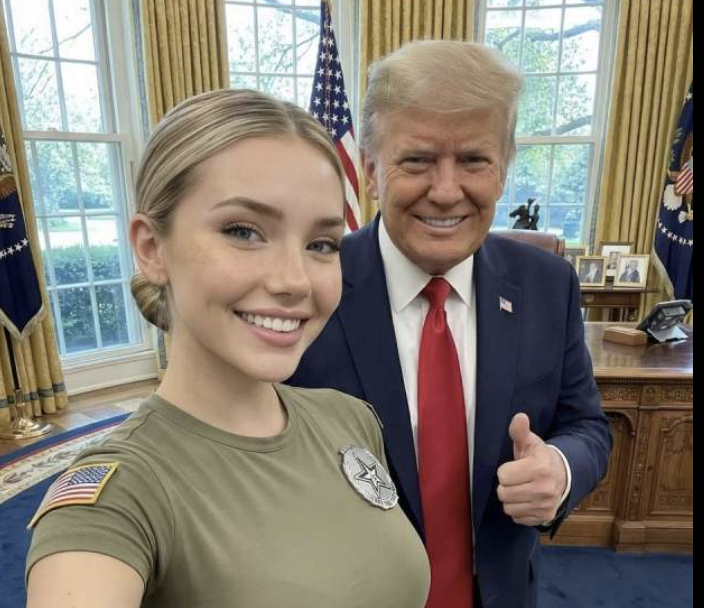
One image, showing her alongside Donald Trump, quickly gained widespread attention and contributed to her growing popularity. In a short period of time, her account attracted a large following, with many people expressing admiration and support.
To her audience, she appeared to represent a blend of dedication, strength, and national pride, making her content highly engaging and widely shared.
A Carefully Crafted Online Persona
The individual presented online as Jessica Foster was portrayed as a member of the U.S. Army, frequently shown in settings that suggested direct involvement with military operations. Images depicted her near advanced aircraft and on what appeared to be active military bases.
Her content was designed to reflect a lifestyle that combined service with visibility, creating a compelling narrative that attracted attention across multiple platforms.
Many followers believed the account to be genuine, often leaving comments expressing appreciation and respect for her supposed service.
Early Signs of Doubt
Despite the account’s popularity, some viewers began to question its authenticity. Observers pointed out inconsistencies in the details presented within the images.
Among the concerns raised were unusual elements in the uniforms, including badges that did not align with standard military designs. Others noticed irregular lighting and background details that appeared inconsistent with real-world conditions.
These observations led to growing skepticism, as more people began to examine the content more closely.
Lack of Verifiable Records
Further doubt emerged when attempts to verify the identity of Jessica Foster produced no official records. There was no confirmation of a service member by that name matching the profile presented online.
This absence of documentation added to the uncertainty surrounding the account and prompted deeper investigation into its origins.
As questions continued to surface, attention shifted toward the possibility that the entire persona had been fabricated.
Analysis Points to Artificial Creation
Experts who reviewed the images identified characteristics consistent with content generated using artificial intelligence. These included subtle visual distortions and patterns commonly associated with AI-produced media.
It was later confirmed that the images did not depict a real individual. Instead, the figure known as Jessica Foster was created using digital tools designed to produce lifelike visuals.
This revelation highlighted how advanced technology can be used to construct highly convincing online identities.
The Strategy Behind Digital Personas
Researchers note that accounts built around fictional individuals are becoming increasingly common across social platforms. By presenting a visually appealing character with a compelling story, creators can quickly attract attention and build large audiences.
Once established, such accounts may be used for various purposes, including directing traffic to external platforms or generating revenue through engagement.
In this case, the account linked followers to paid websites, a tactic that aligns with patterns observed in similar digital campaigns.
Why These Accounts Gain Traction
Content that combines strong visuals with clear themes often spreads quickly online. In this situation, the portrayal of a confident and patriotic figure contributed to the account’s appeal.
Audiences are often drawn to stories that appear authentic and relatable, especially when they reflect widely recognized values.
The combination of imagery, messaging, and perceived credibility allowed the account to gain momentum before questions about its authenticity became widely known.
The Challenge of Identifying What Is Real
The case highlights the growing difficulty of distinguishing between genuine content and digitally created material. Advances in technology have made it possible to produce images that closely resemble real photographs.
As a result, even careful observers may find it challenging to identify subtle inconsistencies without closer analysis.
This evolving landscape requires increased awareness and a more critical approach when engaging with online content.
The Role of Technology in Content Creation
Modern tools allow creators to generate highly detailed images and realistic scenarios that were once difficult to produce. These capabilities can be used for creative and beneficial purposes, but they also introduce new challenges.
When applied to social media, such tools can create entirely fictional narratives that appear credible to large audiences.
This development underscores the importance of understanding how technology shapes the information people encounter online.
Lessons From the Jessica Foster Case
The story of Jessica Foster illustrates how quickly a digital persona can gain widespread attention. It also shows how easily audiences can connect with content that appears authentic and emotionally engaging.
At the same time, it serves as a reminder that not all online identities represent real individuals. Careful evaluation and attention to detail are increasingly important when interpreting what is seen on social platforms.
The situation reflects broader changes in how content is created, shared, and perceived in a digital environment.
Looking Ahead in a Changing Online Landscape
As technology continues to evolve, the ability to create realistic digital identities is likely to become more accessible. This will shape how people interact with content and how trust is established online.
Understanding these developments can help individuals navigate digital spaces more effectively, encouraging thoughtful engagement with the information they encounter.
The case serves as an example of how innovation can influence perception and highlights the need for continued awareness in an increasingly complex online world.