
Two Forgotten Souls Found Each Other on a Small Veranda and Brought Life Back to a Silent Home
An overcrowded animal shelter can be a difficult place for any animal, but it can be especially hard for those who are older, frightened, or withdrawn. These are often the animals people pass by first, even though they may be the ones most in need of patience, safety, and care.
For one shelter volunteer, those overlooked cases became impossible to ignore. In some situations, the volunteer was permitted to bring certain animals home for a temporary stay, offering them relief from the stress of the shelter and a chance to recover in a calmer environment.
That was how Bruno entered the picture.
A Dog Who Had Stopped Expecting Anything
Bruno is a small terrier mix believed to be around ten or eleven years old. He arrived at the shelter after being surrendered by his family, though no clear explanation was given for why he had been left behind.
His behavior in the kennel reflected a dog carrying far more than simple nervousness. He pressed himself into the corner and stayed there, making himself as small as possible.
He trembled constantly. His eyes remained fixed on the floor, and he showed little response to the activity around him.
He did not bark for attention. He did not wag his tail when people passed. He did not try to win anyone over in the way many dogs do when they still believe there is something to hope for.
To the volunteer watching him, Bruno seemed like a dog who had stopped expecting comfort. He appeared to have retreated so deeply into himself that even basic trust felt out of reach.
That quiet despair is often what makes older shelter animals so easy to overlook. They do not always put themselves forward, and they may not have the energy or confidence to compete for attention.
But sometimes those same animals are the ones whose lives can change most dramatically when someone gives them one more chance.
A Temporary Home With a Different Kind of Silence
The volunteer decided to take Bruno home. The arrangement was only meant to be temporary, a way to give him a break from the pressure of shelter life and see whether he could begin to relax in a quieter setting.
Not far away lived a neighbor named Karl. He was eighty four years old and had become a widower the previous winter.
Since losing his wife, Karl had settled into a routine that reflected the emptiness around him. He often sat on his porch and looked down the street, as though he were waiting for something that would never arrive.
After decades of marriage, his home had changed completely. Where there had once been companionship, conversation, and familiar daily rhythms, there was now only stillness.
The silence in a house after loss is not always obvious from the outside. A porch, a front door, and a quiet street can look ordinary to anyone passing by.
But for the person living inside, every room can feel transformed. The absence of one voice can make an entire home seem unfamiliar.
The volunteer had seen Karl sitting there often. It was the kind of image that stays with a person: an older man alone on a porch, gazing outward as though hoping for a return to something already gone.
A Visit That Changed Everything
One afternoon, the volunteer walked over to say hello and brought Bruno along. The dog was in the volunteer’s arms as they approached Karl.
Karl looked at the small terrier mix and immediately recognized something in him. “Another old guy, huh?” he said.
The reply was simple and direct. “Yes,” the volunteer answered. “He really needs someone to show him that he still matters.”
That sentence captured the condition of more than just the dog. It also echoed the emotional reality of an elderly man learning how to live after losing the person who had shared his life.
The volunteer carefully placed Bruno on the porch. What happened next was immediate and unexpected.
The same dog who had barely moved in the shelter did not hesitate at all. Bruno walked straight toward Karl.
He sniffed the older man’s leg, then gently licked his hand. It was a small gesture, but it carried a striking sense of certainty.
For a dog who had seemed shut down and unreachable, that decision felt almost like a declaration. Without words, Bruno appeared to be saying that he had found the place where he wanted to stay.
A Real Laugh After Deep Loss
Karl’s reaction came just as quickly. He laughed, and it was not the kind of polite laugh people offer out of habit.
It was warm and genuine, the sort of laughter that rises naturally and surprises even the person making it. For someone who had been living in the shadow of grief, that moment carried unusual weight.
Real laughter after loss can feel like a reopening. It does not erase pain, but it briefly breaks through it.
Karl bent down, scratched Bruno behind the ears, and spoke to him softly. “Come on… we both know what that feels like, don’t we?”
In that instant, the bond between them became clear. Both had been left in very different ways.
Bruno had been surrendered and shut out of the life he once knew. Karl had been left to face the emptiness that follows the death of a spouse.
Neither of them had chosen that loneliness. Yet on a small porch, each seemed to recognize something familiar in the other.
From Temporary Arrangement to Permanent Companionship
At first, Bruno was only supposed to be in the volunteer’s care for a short time. The plan had been simple: offer him temporary shelter, see whether he improved, and help him through a difficult transition.
But some changes happen so naturally that they make formal plans irrelevant. What began as a brief visit soon became something more meaningful.
Weeks passed, and Bruno did not return to the shelter. Instead, he found a home with Karl.
The new arrangement grew out of that first porch meeting and the ease with which they connected. It was not forced, and it did not need explanation.
Bruno had found someone who understood quiet suffering. Karl had found a presence that filled his home with companionship again.
The volunteer continued to visit and regularly brought them food. In that ongoing routine, the story remained active, not as a dramatic rescue scene frozen in one moment, but as a steady, daily restoration of life.
Sometimes the most meaningful change is not loud or public. It is found in the ordinary act of returning to a house and sensing that the atmosphere inside has shifted.
A Home That No Longer Felt Empty
On one visit, the change inside Karl’s home was unmistakable. The house that had once seemed so quiet no longer carried the same stillness.
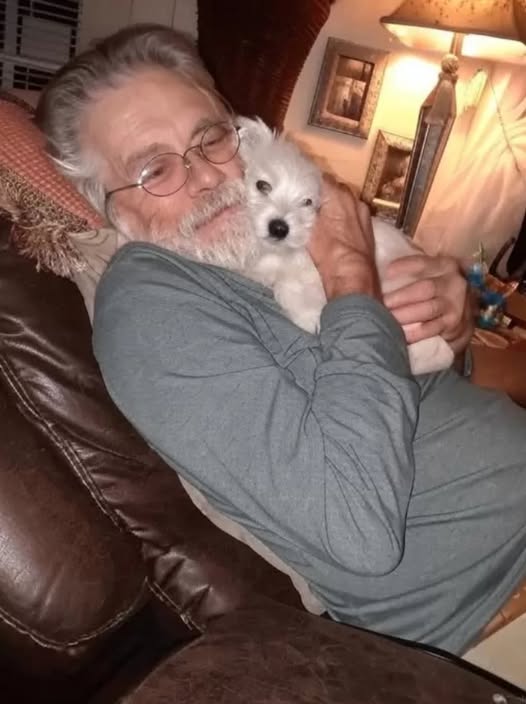
The television was on. There was sound in the room. More importantly, Karl was speaking again, not into silence, but to a companion resting with him.
“Later we’ll watch the game together, alright?” he said softly.
Bruno was curled up asleep on his lap.
The image said everything that needed to be said. The dog who had once hidden in a shelter corner was now sleeping peacefully, secure enough to rest in complete trust.
The man who had once stared down the street as though waiting for life to return was now making plans for the evening, even if those plans were as simple as watching a game with a dog beside him.
It was not a grand transformation built on dramatic words. It was a return of routine, comfort, and gentle connection.
That is often how healing appears in everyday life. It arrives quietly and reveals itself through small details: a television turned on, a sentence spoken to someone nearby, the weight of a sleeping dog across a lap.
The Meaning of Being Seen Again
There is something deeply powerful about being noticed at a moment when the world seems to have moved on. Bruno had been one of the shelter animals least likely to draw quick interest.
His age worked against him. His fear worked against him. His lack of outward energy made him easy to miss.
Karl, too, had been living in a form of quiet invisibility. Grief often narrows a person’s world, and neighbors may see only fragments of what remains after loss.
Yet each of them responded immediately to the presence of the other. Bruno did not recoil from Karl. Karl did not hold back from Bruno.
The connection between them did not depend on excitement or novelty. It was built on recognition.
That may be why their meeting felt so natural. They were not trying to impress one another or fill a temporary gap. They simply understood something unspoken.
Both needed company. Both needed comfort. Both needed proof that they still mattered.
A Small Porch, A Lasting Change
It all began on a small veranda, with a volunteer, an elderly neighbor, and a dog who had nearly disappeared into himself. Nothing about the setting suggested that it would become a turning point.
There were no grand declarations and no complicated arrangements at the beginning. There was only a quiet introduction and an unexpected moment of trust.
Yet that was enough. Bruno crossed the porch and reached out. Karl answered with laughter and tenderness.
From there, a new chapter opened for both of them. The dog gained a home. The man gained a companion.
The volunteer who first carried Bruno out of the shelter witnessed something difficult to define but easy to feel: the moment when two lives, each marked by abandonment in different forms, moved toward one another and changed direction.
Today, their story stands as a reminder that healing does not always arrive through large gestures. Sometimes it begins with a simple act of presence.
A frightened old dog and a grieving old man met on a quiet porch and, without ceremony, restored something in one another that had nearly gone dark.
In the end, it is hard to say who rescued whom. What is clear is that neither of them is facing the silence alone anymore.