
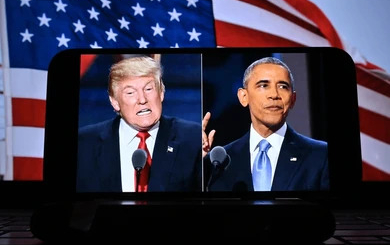
Hypothetical 2028 Showdown Between Donald Trump and Barack Obama Sparks Debate Over Third Term Possibility
Questions Surrounding a Third Presidential Term
Donald Trump has publicly kept open the possibility of seeking another term in the White House in 2028, despite clear constitutional limits.
The 22nd Amendment to the United States Constitution prohibits any individual from being elected president more than twice.
Still, comments made in recent months have reignited discussion about what such a scenario might look like if the rules were different.
In October, Trump said he would “love to run,” and when reporters asked whether he was ruling out the idea, he responded, “Am I not ruling it out? I mean, you’ll have to tell me.”
Those remarks prompted renewed attention around the legal boundaries of presidential terms and the theoretical possibility of change.
Support and Speculation From Allies
Trump’s former chief strategist, Steve Bannon, has also voiced support for another presidential bid.
In an interview with The Economist, Bannon stated that there is a “plan” to get around the 22nd Amendment.
He did not provide details about what that plan might involve.
However, he said there are “many different alternatives” and suggested that specifics would be revealed “at the appropriate time.”
Those statements have fueled speculation, though no formal legal mechanism has been outlined publicly.
What the Constitution Says
The 22nd Amendment clearly states, “No person shall be elected to the office of the President more than twice, and no person who has held the office of President, or acted as President, for more than two years of a term to which some other person was elected President shall be elected to the office of the President more than once.”
Under the current legal framework, this language prevents any president, including Trump, from seeking a third elected term.
As it stands, Trump, who is completing his second term, would not be eligible to run again in 2028.
A Hypothetical Scenario Emerges
Despite the constitutional restriction, some commentators have explored what a third-term race might look like if the rules were different.
A popular YouTube channel called I Ask AI conducted a thought experiment, asking artificial intelligence to predict the outcome of a hypothetical 2028 race.
The host introduced the discussion by saying, “So for the next 15 minutes, forget all about the 22nd Amendment. Just put it aside or somewhere.”
The premise was simple: imagine a political landscape in which term limits no longer applied.
Trump Versus Obama
In that imagined scenario, one name surfaced repeatedly in connection with Trump’s potential candidacy: former President Barack Obama.
The host observed that “every time Trump talks about a third term, Barack Obama’s name comes up instantly.”
The discussion framed the matchup as a theoretical rematch between two highly recognizable political figures with sharply contrasting styles.
Both men have already served two terms in office under the current constitutional structure.
As with Trump, Obama would also be barred from seeking another term under existing law.
How the AI Modeled the Campaign
According to the AI-generated analysis featured in the video, an Obama campaign would likely position itself in direct contrast to Trump’s leadership record.
The AI predicted that Obama would focus on addressing what he might characterize as the “damage from an extended Trump era.”
It suggested that Obama would present himself as a stabilizing force in opposition to Trump’s more confrontational political style.
“He would present himself as the counterweight, steady where Trump is confrontational… making the race a direct referendum on two very different governing styles,” the AI stated.
The analysis emphasized that the campaign would likely center on competing visions for governance and national direction.
A Changing Political Landscape
The video also argued that traditional incumbency advantages might diminish in a climate marked by controversy and division.
It described a nation potentially fatigued by scandals, protests, and ongoing political tension.
In such an environment, voter priorities could shift toward stability and clarity.
The AI assessment suggested that these conditions would influence how voters evaluated both candidates.
The Predicted Outcome
In its final projection, the AI forecasted a clear victory for Obama rather than a closely contested race.
“In that environment, I wouldn’t see this as razor thin. I’d lean toward a fairly confident Obama win,” the AI concluded.
The analysis did not suggest a narrow margin, instead indicating that broader national sentiment might favor Obama in that particular scenario.
It is important to note that this conclusion was generated within a purely hypothetical framework.
Reality Versus Theory
Under current law, neither Trump nor Obama is eligible to run for a third elected term.
The constitutional language of the 22nd Amendment remains clear and binding.
Any change to that framework would require significant legal and political action.
As of now, no formal proposal to amend the Constitution in this regard has advanced.
The discussion remains speculative and theoretical.
Public Reaction and Ongoing Debate
The idea of a third presidential term has historically been considered unlikely within the American political system.
However, recent statements and online thought experiments have brought the topic back into public conversation.
Supporters and critics alike have expressed opinions about whether term limits should remain unchanged.
The debate touches on broader questions about constitutional tradition, political stability, and executive power.
While the hypothetical matchup between Trump and Obama has generated interest, it remains a scenario confined to speculation.
Looking Ahead to 2028
As the next election cycle approaches, attention will likely continue to focus on potential candidates who meet constitutional eligibility requirements.
The 22nd Amendment currently defines the boundaries of presidential service.
Any discussion of third terms must be considered within that legal reality.
For now, the AI-generated forecast serves primarily as a reflection of how technology can model political possibilities rather than predict actual outcomes.
Whether the national conversation shifts toward formal changes or remains hypothetical will depend on future political developments.
Until then, the constitutional limits on presidential terms remain firmly in place.