
Part 2 of 2
By the time Bea Benaderet’s health began to fail, Petticoat Junction had already become deeply associated with her.
As Kate Bradley, she was the emotional center of the Shady Rest Hotel.
She was the mother.
The practical voice.
The person who made Hooterville feel like home.
That made her illness especially difficult for the series to absorb.
Benaderet was diagnosed with lung cancer and underwent treatment while the show was still in production.
For a time, producers worked around her absences.
Scripts were adjusted.
Other characters were given more responsibility.
There was still hope that she would recover enough to return more regularly.
She did come back briefly.
But her health had deteriorated significantly.
Her final appearances were limited.
In one of the most poignant examples of television hiding reality from its audience, Benaderet’s voice was used while a stand-in was filmed from behind.
To viewers, Kate Bradley was still there.
But behind the scenes, the actress playing her was too ill to continue normally.
Benaderet died in October 1968.
Her death created a problem the show could not fully solve.
Kate Bradley was too central to simply replace.
So instead of recasting the role, the series tried to reshape itself around her absence.
June Lockhart joined the cast as Dr. Janet Craig.
Her character helped fill some of the stabilizing adult presence that had disappeared with Kate.
But the tone was never exactly the same.
For longtime viewers, Hooterville had lost one of the people who made it feel complete.
At the same time, the series continued leaning into Betty Jo’s growing family life.
Linda Kaye Henning remained central to the show.
Her character married Steve Elliott, played by Mike Minor.
What made that storyline even more memorable was that the romance did not remain fictional.
Henning and Minor also married in real life.
The connection between fiction and reality became one of the most charming behind-the-scenes facts associated with the series.
For fans, it made Betty Jo and Steve’s relationship feel even more personal.
It also reflected something unusual about Petticoat Junction.
The show often blurred the line between its small-town fantasy and the real lives of the people making it.
Sometimes that produced romance.
Sometimes it produced sadness.
And sometimes it created simple continuity mistakes that viewers still notice decades later.
The Hooterville Cannonball remains one of the best examples.
To the audience, it was one familiar train running the same familiar route.
Behind the scenes, different locomotives, exterior footage and studio setups could be used depending on what production required.
Its identifying number even changed.
In earlier footage, viewers could see the number 3.
Later, the train appeared as number 8.
No explanation was needed inside Hooterville.
The world simply kept going.
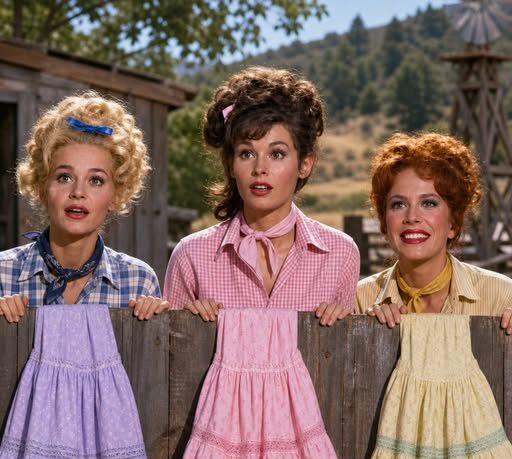
The same was true of the Bradley sisters.
Billie Jo changed actresses more than once.
Bobbie Jo changed too.
And some opening-credit footage continued showing an earlier actress after the role had already been recast.
Modern television audiences might expect such changes to be carefully explained.
In the 1960s, viewers were often expected simply to accept them.
That flexibility helped Petticoat Junction survive major cast changes.
But eventually, the larger television industry changed around it.
By the end of the 1960s, network priorities were shifting.
CBS in particular began moving away from the rural comedies that had dominated parts of its schedule.
Shows centered on farms, small towns and country life increasingly seemed out of step with the younger, more urban audiences networks wanted to attract.
Petticoat Junction ended in 1970 after seven seasons.
Its cancellation came just before the broader wave of rural programming cuts that would later become famous as the “rural purge.”
Other shows connected to the same television world would also disappear.
The change marked the end of an era.
For years, audiences had visited places like Hooterville because they offered something simple.
Familiar characters.
Predictable warmth.
Problems that rarely stayed problems for long.
But behind that comforting image, Petticoat Junction had never been quite as simple as it looked.
Its cast changed repeatedly.
Credits sometimes preserved people who were no longer playing the roles.
The famous train changed identities.
A future star almost became one of the Bradley sisters.
A television romance became a real marriage.
And one of the show’s most beloved actresses continued appearing even as serious illness was taking away her ability to perform.
Those details do not ruin the illusion of Hooterville.
They make it more interesting.
They show what classic television really was.
Not a perfect little world.
But a production held together by actors, writers, compromises, substitutions, last-minute changes and very real human lives.
That is why Petticoat Junction remains so fascinating today: the mistakes, recastings, romances and heartbreak behind the camera were often just as memorable as anything happening at the Shady Rest Hotel.