
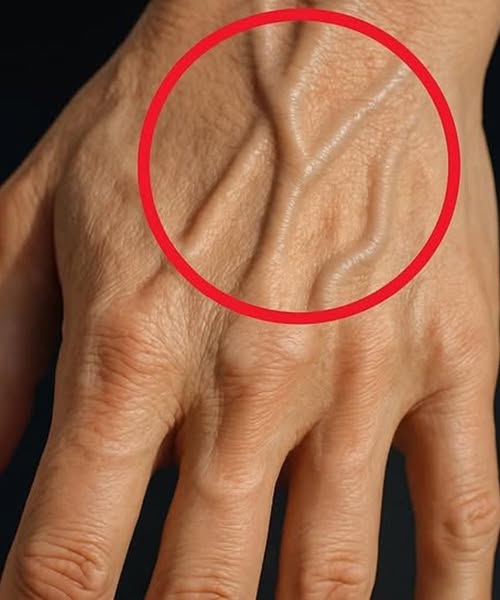
Do Prominent Hand Veins Signal Kidney Problems? Understanding the Medical Facts
Why Visible Veins Can Raise Questions
Noticing raised, bluish, or more pronounced veins on your hands can understandably prompt concern.
Online discussions sometimes suggest that visible veins may point to hidden kidney disease.
However, medical science does not support the idea that prominent hand veins are a direct indicator of kidney dysfunction.
Understanding what visible veins truly mean requires separating assumption from evidence.
Common Reasons Veins Become More Noticeable
In most cases, visible hand veins are entirely normal.
Several everyday factors influence how pronounced veins appear.
Aging is one of the most common causes, as the skin gradually thins and loses collagen over time.
When the skin becomes thinner, the veins underneath naturally become more visible.
Body composition also plays a role.
Individuals with lower body fat have less tissue covering their veins, which can make vascular structures stand out more clearly.
This is especially noticeable in people with lean builds.
Genetics contribute as well.
Some individuals naturally have more visible veins due to inherited vascular patterns.
This variation is considered a normal anatomical difference rather than a health concern.
Physical activity temporarily increases blood flow, which can make veins appear more prominent during or after exercise.
Heat exposure has a similar effect, as warmth dilates blood vessels and enhances visibility.
Dehydration can also make veins appear more pronounced.
When fluid levels drop, the volume of plasma in the bloodstream decreases slightly, allowing veins to stand out more.
This effect is usually temporary and reversible with adequate hydration.
Importantly, visible veins alone are not recognized as a sign of kidney disease.
How Kidney Disease Typically Presents
The kidneys perform several essential functions within the body.
They filter waste from the bloodstream, regulate fluid levels, control blood pressure, and maintain electrolyte balance.
When kidney function declines, symptoms usually develop gradually and involve internal physiological changes.
In chronic kidney disease (CKD), individuals may experience swelling in the feet, ankles, hands, or around the eyes due to fluid retention.
Persistent fatigue is also common, as waste products accumulate in the bloodstream.
Changes in urination are another hallmark sign.
This may include alterations in frequency or volume.
Foamy urine can occur when protein leaks into the urine.
High blood pressure often accompanies kidney dysfunction, since the kidneys play a major role in regulating vascular pressure.
Other symptoms may include nausea or a reduced appetite.
Notice what does not appear on this list: prominent hand veins.
Kidney disease typically leads to fluid retention, not increased vein visibility.
Fluid Balance and Vein Appearance
The kidneys are central to maintaining proper fluid balance.
When kidney function declines, the body tends to retain excess fluid.
This retention can cause puffiness and swelling.
Swelling often makes veins appear less visible rather than more noticeable.
In contrast, dehydration reduces plasma volume in the bloodstream.
That reduction can temporarily make veins appear more pronounced.
Mild dehydration is common and usually corrected by increasing fluid intake.
While severe or repeated dehydration can stress the kidneys over time, visible veins alone do not indicate kidney damage.
To clarify:
Swelling from fluid retention often makes veins appear less noticeable.
Dehydration can make veins appear more noticeable.
Neither situation by itself confirms kidney disease.
When Veins and Kidney Disease Are Connected
There is one situation in which visible veins are associated with kidney conditions, but the relationship is indirect.
In advanced kidney failure, including end-stage renal disease (ESRD), patients may require dialysis.
To make dialysis possible, surgeons create an arteriovenous (AV) fistula in the arm.
This procedure connects an artery directly to a vein.
The increased blood flow causes the vein to enlarge so it can withstand repeated needle access.
As a result, these veins often become thicker, more visible, and slightly raised.
However, this change is caused by a surgical procedure.
It is not a symptom of kidney disease itself.
Symptoms That Warrant Medical Attention
Rather than focusing on vein visibility, attention should be directed toward symptoms medically linked to kidney problems.
Persistent swelling, especially in the lower extremities or around the eyes, deserves evaluation.
Noticeable changes in urination patterns should not be ignored.
Foamy or dark urine may indicate protein leakage or blood in the urine.
Ongoing fatigue that does not improve with rest can be a warning sign.
High or difficult-to-control blood pressure also warrants medical assessment.
Shortness of breath may develop if fluid accumulates in the lungs due to severe fluid retention.
Unexplained nausea or reduced appetite may also accompany declining kidney function.
If visible veins are accompanied by pain, sudden swelling, discoloration, or circulation changes, vascular conditions may require evaluation.
These concerns are separate from kidney disease and involve different diagnostic pathways.
The Importance of Clinical Testing
Kidney health cannot be determined through visual observation alone.
Diagnosis relies on measurable laboratory values and clinical assessments.
Blood tests measuring creatinine levels and estimated glomerular filtration rate provide insight into kidney function.
Urine analysis can detect protein, blood, or other abnormalities.
Blood pressure monitoring is also essential, since hypertension both contributes to and results from kidney dysfunction.
Consultation with a healthcare professional ensures that symptoms are evaluated appropriately.
Normal Variations Versus Medical Conditions
Prominent hand veins are most often a normal anatomical variation.
They frequently reflect aging, body composition, hydration status, or temperature changes.
These variations are common and typically harmless.
They do not serve as reliable indicators of kidney health.
Kidney disease reveals itself through internal biochemical changes, not through visible vein prominence.
Fluid retention, laboratory abnormalities, and blood pressure changes provide meaningful diagnostic clues.
Understanding the Bigger Picture
It is natural to become concerned when physical changes are noticed.
However, context is essential.
Visible veins on the hands rarely signal an underlying kidney problem.
They are far more likely to represent benign and common physiological variations.
Maintaining adequate hydration, monitoring blood pressure, and seeking routine medical care are practical steps toward overall health.
When kidney concerns arise, proper testing provides clarity and reassurance.
The Bottom Line
Prominent veins on the hands are usually normal.
They may reflect aging, reduced body fat, genetics, exercise, heat exposure, or temporary dehydration.
They are not recognized as a reliable sign of kidney disease.
Kidney dysfunction is identified through clinical symptoms and laboratory testing, not through vein visibility alone.
If concerns about kidney health persist, evaluation should include blood tests, urine testing, blood pressure monitoring, and consultation with a healthcare professional.
Your hands can reveal information about circulation, hydration, and skin changes.
But assessing kidney function requires medical assessment rather than visual interpretation.