
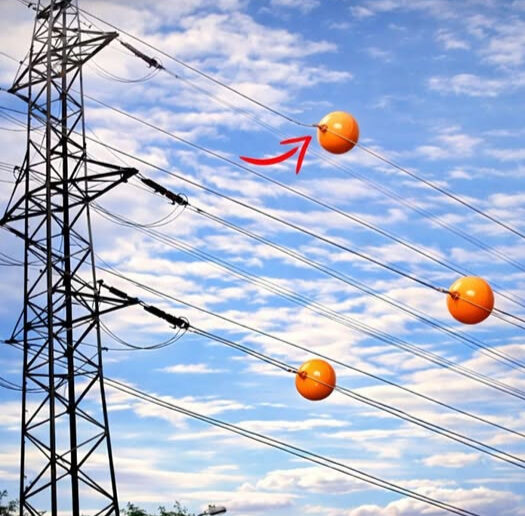
Why You See Colorful Balls on Power Lines
Have you ever looked up and noticed colorful balls placed along power lines stretching across the sky?
At first glance, they might seem unusual—or even decorative. In reality, these bright objects serve an important safety purpose that many people are unaware of.
They are not random.
They are not decoration.
They are designed to improve safety.
Let’s take a closer look at what they are and why they matter.
1. What Are These Colorful Balls?
The colorful balls on power lines are known as aerial marker balls, also called visibility markers.
Their primary purpose is simple:
To make power lines easier to see for low-flying aircraft.
Power lines can be difficult to spot from the air, especially in areas such as:
- Mountains
- Rivers and lakes
- Valleys
- Areas near airports
These markers act as visual indicators, helping pilots recognize and avoid overhead lines.
2. Why Are They Important?
When aircraft fly at lower altitudes, visibility becomes especially important. Power lines are thin and can blend into the background, making them harder to notice from a distance.
To improve safety, aviation authorities recommend or require these markers in locations where visibility may be reduced.
They are commonly used to support safe navigation for:
- Helicopters
- Small aircraft
- Emergency and service flights
In short, they help reduce risk and improve awareness for pilots.
3. Why Are They Bright Colors?
You’ve probably noticed that these markers are often bright colors such as:
- Orange
- Yellow
- White
These colors are carefully chosen to:
- Stand out against the sky
- Remain visible in different weather conditions
- Provide strong contrast against clouds and landscapes
The goal is to make them easy to notice from a distance.
4. What Are They Made Of?
Although they may look solid, these marker balls are typically made from specialized, durable plastic materials.
This material is used because it:
- Does not conduct electricity
- Is lightweight
- Can withstand weather conditions
- Does not interfere with power transmission
This ensures both safety and long-term reliability.
5. Size and Weight
From the ground, these markers may appear small, but they are actually quite large.
Typical specifications include:
- Diameter: approximately 20 to 36 inches
- Weight: around 11 to 17 pounds
This size helps ensure they are visible from a distance.
6. How Did They Start?
The use of aerial marker balls developed as awareness grew around the need for better visibility of overhead lines in certain environments.
Over time, engineers and safety organizations worked together to create a practical solution that would improve visibility without affecting power systems.
The result was the introduction of these brightly colored markers that are now widely used.
Why Most People Don’t Notice Them
Even though these markers are quite common, many people don’t pay much attention to them.
This is because they blend into everyday surroundings and are often seen as part of the background.
However, once you notice them, you may begin to see them more frequently in different locations.
And now you know—they serve a clear and practical purpose.
Final Thoughts
The next time you see colorful balls on power lines, you’ll understand their role.
They are not decorative features.
They are not placed randomly.
They are simple tools designed to improve visibility and support safety in the air.
Sometimes, everyday objects have functions that are easy to overlook but play an important role.
FAQ
What are the colored balls on power lines called?
They are called aerial marker balls or visibility markers.
Why are they placed on power lines?
They help make power lines more visible to pilots.
Why are they brightly colored?
Bright colors improve visibility in different lighting and weather conditions.
Are they electrified?
No, they are made from non-conductive materials and are designed to be safe.