
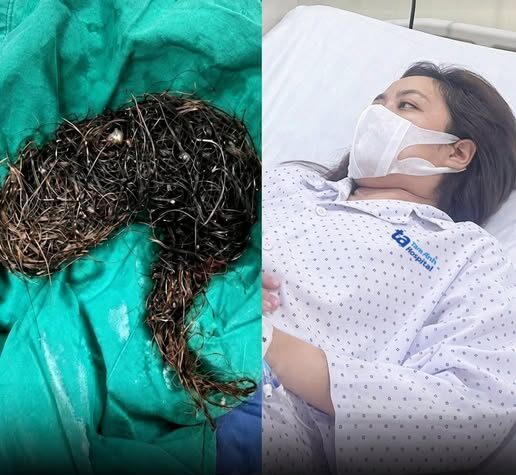
14-Year-Old Girl’s Months of Stomach Pain Lead to Alarming Surgery Story — What Families Should Know About This Rare Condition
A Disturbing Story Raises Important Questions About Persistent Abdominal Pain
For any parent, watching a child struggle with unexplained pain can be deeply worrying.
When that discomfort continues for weeks or months, the uncertainty can become just as distressing as the symptoms themselves.
A story circulating online describes a 14-year-old girl who reportedly experienced abdominal pain for six months before undergoing surgery.
According to the account, doctors made an unexpected discovery during the procedure.
However, an important detail must be made clear: the story does not provide an identifiable hospital report, published medical case, or independently verified diagnosis.
What surgeons allegedly discovered in this particular girl’s stomach therefore remains unconfirmed.
Nevertheless, the account has drawn attention to a genuine medical condition that many families may never have heard of.
It involves unusual masses of material that can accumulate inside the digestive system, sometimes remaining unnoticed until symptoms become difficult to ignore.
These masses are known as bezoars.
What Is a Bezoar?
A bezoar is a compact collection of material that accumulates within the digestive tract, most commonly in the stomach.
Unlike ordinary food, which is normally broken down and moved through the digestive system, certain materials may resist digestion and gradually collect.
Over time, these materials can form a dense mass.
The composition of a bezoar varies depending on what has accumulated.
Some are made from indigestible plant fibers, while others contain different substances that the digestive system cannot process effectively.
One particularly unusual type is called a trichobezoar.
This form consists primarily of swallowed hair.
Although the condition is uncommon, it is medically recognized and has been documented in clinical literature.
Understanding how it develops helps explain why some cases may remain undetected for a considerable period.
How Can Hair Accumulate Inside the Stomach?
Human hair is made primarily of keratin, a tough structural protein that the digestive system cannot readily break down.
When hair is swallowed repeatedly, some strands may remain in the stomach rather than passing normally through the digestive tract.
Over time, those strands can become entangled with one another and collect additional material.
As the accumulation grows, it may form a compact mass.
This does not mean that accidentally swallowing an occasional hair will necessarily cause a medical problem.
Trichobezoars are rare and are more closely associated with repeated hair ingestion.
The condition can sometimes occur alongside behaviors involving hair pulling or hair swallowing, although these behaviors are not present in every patient with a bezoar.
Because the subject can be sensitive, especially for children and teenagers, it is important to approach it without judgment or embarrassment.
Why Symptoms Can Be Difficult to Recognize
One of the challenges associated with bezoars is that symptoms may not immediately point toward an unusual accumulation inside the stomach.
A person may experience abdominal discomfort, nausea, reduced appetite, or a feeling of fullness after eating only a small amount.
These symptoms can also occur with many other digestive conditions.
That overlap makes it difficult for families to determine the cause based on symptoms alone.
Some bezoars may cause relatively mild discomfort, while larger masses can interfere more significantly with normal digestion.
In certain cases, the problem may progress before its underlying cause becomes clear.
This is one reason persistent or unexplained abdominal symptoms deserve appropriate medical evaluation rather than repeated assumptions about what might be causing them.
Why Six Months of Abdominal Pain Should Not Be Ignored
The circulating account describes a teenager who allegedly endured stomach pain for approximately six months.
Although that timeline has not been independently verified, prolonged abdominal discomfort in a child is a legitimate reason to seek medical advice.
Occasional stomachaches are common during childhood.
They can arise for many reasons, including temporary digestive disturbances and other generally manageable conditions.
But recurring pain that affects daily life is different from an isolated episode of discomfort.
If a child repeatedly misses school, struggles to sleep, avoids meals, or stops participating in normal activities because of abdominal pain, those changes deserve attention.
Parents and caregivers should not assume that persistent symptoms are harmless simply because they appear and disappear.
Nor should they assume that a rare condition such as a bezoar is responsible.
The appropriate next step is a medical assessment that considers the child’s symptoms and overall health.
Signs That May Accompany a Gastric Bezoar
Symptoms associated with bezoars can vary depending on the size, location, and effect of the accumulated material.
Abdominal discomfort is one possible complaint.
Some patients may experience nausea or vomiting.
Others may notice that they feel unusually full after eating small portions of food.
A reduced appetite may also develop.
When a mass becomes large enough to interfere with the normal movement of stomach contents, symptoms can become more significant.
However, none of these symptoms confirms the presence of a bezoar.
They overlap with many other gastrointestinal conditions, some common and others less frequent.
A healthcare professional may need to investigate further to identify the actual cause.
When Abdominal Pain Requires Urgent Medical Attention
Not every stomachache is an emergency, but certain warning signs should never be overlooked.
Severe or worsening abdominal pain requires urgent medical assessment, particularly when it is accompanied by repeated vomiting or signs of significant illness.
Persistent vomiting can also increase the risk of dehydration.
Blood in the stool is another warning sign that needs prompt medical attention.
Unexplained weight loss should be evaluated rather than dismissed as a temporary change in appetite.
A child who cannot keep fluids down, appears unusually weak, or develops symptoms suggesting a possible intestinal obstruction may need immediate care.
These concerns apply regardless of whether a bezoar is suspected.
The most important principle is to respond to the severity and persistence of symptoms rather than waiting for a particular diagnosis to become obvious.
How Doctors Investigate an Unusual Stomach Mass
When a child presents with persistent abdominal symptoms, clinicians begin by considering the medical history and performing an appropriate examination.
They may ask about the location and duration of the pain, eating habits, vomiting, bowel movements, and other relevant symptoms.
Depending on the findings, further testing may be recommended.
Imaging studies can sometimes help identify an abnormal mass or signs of an obstruction.
In other situations, doctors may use an upper gastrointestinal endoscopy, a procedure that allows them to examine the inside of the upper digestive tract with a specialized instrument.
The choice of investigation depends on the individual patient and the suspected cause.
There is no single test that every child with abdominal pain automatically needs.
For the teenager described in the circulating account, the absence of verified medical documentation means it is impossible to establish which examinations were performed or what they revealed.
Can a Bezoar Become Dangerous?
Although some bezoars may be discovered before they cause serious complications, larger masses can create significant medical problems.
A substantial accumulation may interfere with the stomach’s ability to empty normally.
It can also contribute to irritation, discomfort, or obstruction within the digestive tract.
In more serious cases, complications may require hospital treatment.
The potential severity depends on factors such as the material involved, the size of the mass, and its location.
This is why suspected bezoars should be assessed by qualified medical professionals.
Attempting to diagnose or manage a possible obstruction at home can delay appropriate treatment.
Fortunately, recognizing the problem allows clinicians to determine which treatment approach is most suitable.
Why Surgery Is Sometimes Necessary
Not every bezoar requires surgery.
Treatment depends on the type of material involved, the size of the accumulation, and whether complications are present.
Some bezoars may be managed using nonsurgical approaches under medical supervision.
Others can sometimes be removed through endoscopic procedures.
However, large or tightly compacted trichobezoars may be difficult to remove without an operation.
When a mass causes significant obstruction or cannot be safely removed by other methods, surgery may be necessary.
The decision is made according to the patient’s clinical condition and the findings of medical investigations.
In the circulating story about the 14-year-old girl, surgery is mentioned, but the available account does not establish that a trichobezoar was actually found.
It would therefore be misleading to present that diagnosis as a confirmed fact about her.
The Emotional Side of Hair Swallowing Behaviors
When a trichobezoar is associated with repeated hair swallowing, medical treatment may address more than the physical mass.
Some individuals experience behaviors involving hair pulling or swallowing that can be difficult to discuss openly.
These behaviors should not automatically be interpreted as deliberate misbehavior or an attempt to attract attention.
They may occur in connection with behavioral or psychological difficulties that deserve compassionate assessment.
Children and teenagers may already feel embarrassed or frightened by symptoms they do not understand.
Harsh criticism or blame can make honest conversations more difficult.
A supportive approach encourages the child to speak openly and allows healthcare professionals to evaluate whether additional behavioral or mental health support is appropriate.
Addressing contributing behaviors, when present, can be an important part of reducing the risk of recurrence after treatment.
Why Listening to Children Matters
Children do not always have the vocabulary to describe what is happening inside their bodies.
A younger child may simply say that their stomach hurts.
A teenager might minimize discomfort because they do not want to miss school, worry their family, or undergo medical examinations.
Parents may also find it difficult to judge the seriousness of symptoms when a child seems otherwise healthy.
That uncertainty is understandable.
What matters is noticing patterns.
Recurring pain, changes in appetite, difficulty eating, disrupted sleep, or unexplained changes in weight are all reasons to consider a professional evaluation.
Listening carefully does not mean assuming the worst.
It means taking a child’s experience seriously while allowing medical evidence to guide the next steps.
Why Viral Medical Stories Need Careful Verification
Unusual medical stories often attract attention because they combine fear, surprise, and the possibility of a dramatic discovery.
But an emotionally compelling account is not the same as a documented clinical case.
The story about the 14-year-old girl does not identify a hospital, treating physician, published case report, or medical record that would allow the alleged discovery to be independently confirmed.
Without those details, readers cannot reliably determine the girl’s diagnosis, the nature of the operation, or the outcome.
It is therefore important to separate the unverified story from the established medical information surrounding bezoars.
Trichobezoars are real.
They can cause gastrointestinal symptoms and sometimes require surgery.
But those facts do not prove that this particular teenager experienced the condition.
Responsible health information should make that distinction clear.
Most Childhood Stomachaches Are Not Caused by Rare Masses
Stories involving unusual medical discoveries can make rare conditions seem much more common than they actually are.
In reality, most childhood abdominal pain is not caused by a bezoar.
There are numerous possible explanations for digestive discomfort, and many are far more common.
For that reason, parents should avoid interpreting an ordinary stomachache as evidence of a hidden mass.
At the same time, repeated or worsening symptoms should not be ignored simply because serious causes are less common.
The goal is balanced awareness.
Families benefit from recognizing warning signs, seeking medical advice when appropriate, and avoiding unnecessary fear based on sensational online claims.
Accurate information is more useful than speculation.
What Families Can Learn From This Account
Even though the teenager’s reported medical experience remains unverified, the broader discussion offers several meaningful lessons.
Persistent abdominal symptoms deserve attention, particularly when they interfere with eating, sleeping, school, or ordinary activities.
Rare digestive conditions can sometimes produce symptoms that resemble more familiar problems.
Medical evaluation is essential for distinguishing among possible causes.
And when a condition involves sensitive behaviors, compassion is just as important as identifying the physical problem.
Parents do not need to become medical experts to respond appropriately.
They need to listen, observe changes, and seek professional guidance when symptoms persist or become concerning.
The Most Important Message Is Awareness, Not Fear
The circulating account of a 14-year-old girl’s prolonged abdominal pain is unsettling, but its medical claims have not been independently confirmed.
What is known is that bezoars are genuine digestive conditions, and trichobezoars can develop when swallowed hair accumulates inside the stomach.
These masses may cause discomfort, nausea, reduced appetite, or early fullness, and larger ones can sometimes require surgical removal.
However, the condition is uncommon, and similar symptoms can have many other explanations.
Families should remain attentive to recurring abdominal pain without assuming that every unexplained stomachache signals something rare or dangerous.
Severe pain, persistent vomiting, signs of dehydration, blood in the stool, or unexplained weight loss warrant timely medical attention.
Above all, children deserve to have their symptoms heard and taken seriously.
Six months of suffering should never be dismissed as an ordinary part of growing up.
The lasting lesson is not to fear an unusual diagnosis, but to recognize that compassionate listening, appropriate medical assessment, and early attention to concerning symptoms can make a meaningful difference in a child’s well-being.