
White Mushrooms Suddenly Appearing in Your Lawn? Here’s What They May Be Telling You
Those White Caps Are Often a Sign of What Is Happening Underground
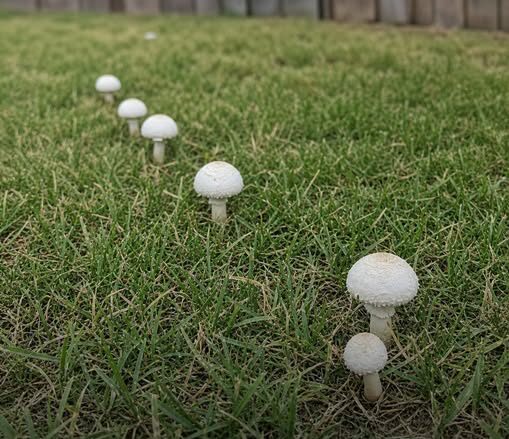
Seeing small white mushrooms suddenly appear across a lawn can be unsettling.
They seem to arrive overnight, scattered through otherwise ordinary grass, and their presence can make it feel as though something is going wrong beneath the surface.
Sometimes that concern is justified.
Other times, however, mushrooms are simply evidence that the soil beneath your lawn is biologically active.
The important part is learning how to interpret what they are telling you.
Mushrooms Are Only the Visible Part of a Much Larger System
The white caps you see above the grass are only one small part of a fungal organism.
Much of the activity happens underground, where fungal structures interact with soil, moisture, organic matter, roots, and decaying material.
That means mushrooms should not automatically be viewed as isolated weeds or random intruders.
They may be signs of a much larger process taking place below the lawn.
In Many Cases, Mushrooms Can Be a Positive Sign
One of the most common reasons mushrooms appear is the presence of decomposing organic matter.
Buried pieces of old wood, tree roots, mulch, leaf litter, and compost can all provide material for fungi to break down.
That decomposition helps return nutrients to the soil.
In this sense, mushrooms may indicate that natural recycling is actively taking place.
Buried Wood Can Trigger Sudden Mushroom Growth
If a tree was removed years ago, pieces of roots or wood may still remain beneath the grass.
Those materials can continue decomposing long after the visible tree is gone.
Fungi may feed on that buried material, and mushrooms can eventually appear above the exact area where decomposition is happening.
This is one reason mushrooms sometimes seem to emerge in the same section of a yard repeatedly.
Mulch and Leaf Litter Can Feed Fungal Activity
Organic material does not need to come from a large tree.
Mulch, fallen leaves, grass clippings, and compost can also encourage fungal growth as they break down.
In a healthy soil system, these materials are constantly being transformed.
Fungi are part of that process.
The appearance of mushrooms may therefore reflect a lawn rich in organic matter rather than one that is necessarily unhealthy.
Some Fungi Form Beneficial Relationships With Plants
Not all fungi are simply decomposers.
Some participate in underground relationships with plant roots.
These networks are often described as mycorrhizal connections.
They can help plants interact with water and nutrients in the soil while the fungi receive resources from the plants.
This complex underground network is sometimes informally called the “wood wide web.”
A Living Lawn Is More Complicated Than It Looks
From above, a lawn may appear to be nothing more than grass.
Below the surface, however, roots, microorganisms, fungi, decaying matter, insects, and soil organisms are constantly interacting.
Mushrooms can be one visible clue that this hidden ecosystem is active.
That is why removing the caps alone does not necessarily change what is happening underground.
Fairy Rings Can Look Strange but Often Reflect Large Fungal Colonies
Mushrooms sometimes appear in circles or arcs across a lawn.
These formations are often called fairy rings.
The circular pattern can seem mysterious, but it may simply reflect the way a fungal colony is expanding through the soil.
As the underground network grows outward, mushrooms may appear along its active edges.
Fairy Rings Can Change the Grass Around Them
Although the appearance can be striking, the mushrooms themselves are only one part of the effect.
Fungal activity can alter the chemistry and moisture conditions of the soil.
That can sometimes produce visible changes in the grass, including darker or differently growing sections.
The ring pattern therefore provides another example of how fungal growth below the soil can influence what is visible above it.
But Mushrooms Can Also Be a Warning Sign
Not every sudden mushroom outbreak should be interpreted as a positive sign.
The conditions that allow fungi to thrive can sometimes point to underlying lawn problems.
Large numbers of mushrooms appearing quickly may indicate excessive moisture, poor drainage, compacted soil, or accumulating organic material.
The key is to look at what else is happening around them.
Chronic Overwatering Is One of the First Things to Check
Fungi generally thrive in moist environments.
If a lawn remains wet for extended periods, mushroom growth may increase dramatically.
Frequent irrigation can keep the soil damp even when the grass does not actually need more water.
When mushrooms appear alongside consistently soggy ground, watering practices deserve attention.
Watering Too Often Can Create More Than a Mushroom Problem
Constant moisture can affect the entire lawn environment.
It may encourage shallow rooting, reduce oxygen in the soil, and create conditions favorable to unwanted fungal activity.
Simply mowing down the mushrooms without correcting the moisture problem will not address the underlying cause.
Adjusting irrigation may be far more useful.
Compacted Soil Can Keep Moisture Trapped
High-traffic parts of a yard can gradually become compacted.
Repeated foot traffic, pets, equipment, or vehicles can compress the soil.
When this happens, water may drain more slowly and air movement through the soil can decrease.
The combination of moisture and reduced airflow may create conditions where fungi become more visible.
Aeration Can Help in Compacted Areas
If mushroom growth repeatedly appears in sections of lawn that are heavily walked on, soil compaction may be worth considering.
Aeration can help create more open space within the soil.
This can improve movement of air and water and reduce some of the conditions that contribute to persistent dampness.
The goal is not simply to eliminate mushrooms but to improve the soil environment overall.
Heavy Thatch Can Also Contribute
Thatch is the layer of accumulated organic material that can form between living grass and the soil surface.
A small amount is not necessarily a problem.
But when that layer becomes excessive, it can hold moisture and provide material for fungal growth.
Mushrooms appearing in a lawn with heavy thatch may be a sign that the surface layer needs attention.
Dethatching May Improve Conditions
If thatch is thick enough to interfere with water movement or airflow, reducing it may help improve the lawn environment.
Dethatching is not about removing every trace of organic material.
It is about preventing excessive buildup from creating persistent moisture and other stress conditions.
Pet Waste Can Create Localized Hotspots
Mushrooms do not always appear evenly across a yard.
Sometimes they concentrate in small patches.
One possible explanation is a localized increase in organic material and nitrogen, including areas where pets repeatedly relieve themselves.
These hotspots can change soil conditions enough to encourage unusual growth patterns.
Cleaning Up Waste Can Reduce One Source of Excess Nutrients
Regularly removing pet waste is useful for more than appearance.
It can help prevent concentrated organic material from accumulating in the same parts of the lawn.
If mushrooms repeatedly appear in specific pet-use areas, that pattern may be worth noting.
Mushrooms Around Trees Deserve Extra Attention
One of the more important situations involves mushrooms appearing around the base of a tree or tracing its root zone.
Sometimes fungi are simply breaking down old organic matter.
But mushrooms associated with tree roots can also indicate decay.
If the tree itself appears unhealthy, the combination should not be ignored.
Look at the Condition of the Tree, Not Just the Mushrooms
Pay attention to thinning foliage, dead branches, unusual leaning, damaged bark, or other signs of decline.
Mushrooms alone do not automatically prove that a tree is dangerous.
But mushrooms appearing together with visible tree stress can justify a closer professional assessment.
An Arborist May Be the Right Person to Call
If fungal growth appears repeatedly around a mature tree and the tree also seems weakened, an arborist can evaluate the situation more carefully.
The concern is not simply cosmetic.
Hidden root or wood decay can affect structural stability.
A professional assessment can help determine whether the mushrooms are related to harmless decomposition or something more serious.
Some Lawn Diseases Can Also Be Associated With Fungal Activity
Fungi are part of healthy soil, but certain fungal conditions can also contribute to turf problems.
Fairy ring and snow mold are examples of issues that may affect grass appearance under certain conditions.
The presence of mushrooms does not automatically mean a serious disease is present.
However, thinning, discoloration, or dying grass alongside unusual fungal growth should be investigated more closely.
Do Not Diagnose a Lawn Disease From Mushrooms Alone
It can be tempting to assume every mushroom outbreak represents a dangerous infection.
That approach can lead to unnecessary treatments.
Instead, observe the surrounding grass.
Look for consistent patterns of decline, unusual discoloration, dead zones, excessive moisture, or repeated seasonal problems.
The mushrooms are a clue, not always the complete diagnosis.
The Smartest Response Starts With Observation
Before reaching for chemicals or trying to remove every mushroom, take a few minutes to study the area.
Is the soil constantly wet?
Is there buried wood nearby?
Is the grass healthy or thinning?
Are the mushrooms concentrated around tree roots?
Do they appear in a ring?
Patterns can reveal much more than the mushrooms themselves.
Adjust Watering When the Lawn Stays Too Wet
If excessive moisture appears to be the main problem, reduce unnecessary irrigation.
Allowing the soil more time to dry between watering can make the environment less favorable for constant mushroom growth.
It can also encourage healthier root development in the grass.
The objective is balanced moisture rather than keeping the lawn continuously wet.
Aerate Areas That Stay Compacted
Compacted sections can benefit from improved airflow and drainage.
If mushrooms repeatedly appear in pathways, play areas, or other high-traffic zones, aeration may help improve those conditions.
The effect is broader than mushroom control.
Better soil structure can support healthier grass as well.
Reduce Excess Thatch When Necessary
Heavy thatch can trap moisture near the soil surface.
If a thick layer has developed, reducing it may help the lawn dry more evenly.
This can reduce some of the conditions that support repeated fungal fruiting.
Remove Decaying Material When Practical
If mushrooms repeatedly emerge above buried wood or rotting organic debris, removing that material may reduce future growth.
This is not always easy or necessary.
Large buried roots may remain underground for years while slowly decomposing.
In those cases, repeated mushrooms may simply continue until the food source is exhausted.
Mowing the Caps Does Not Remove the Fungus
Cutting or pulling mushrooms can improve appearance temporarily.
But it usually does not eliminate the underground fungal network producing them.
New mushrooms may appear when moisture and temperature conditions become favorable again.
This is another reason to focus on the underlying environment rather than only the visible caps.
White Mushrooms Can Be More Informative Than They Look
A cluster of small mushrooms may initially seem like a minor nuisance.
But their location and timing can provide useful information about the lawn.
They can point toward decomposition, excess moisture, compacted soil, organic buildup, or changes around tree roots.
In some cases, they may simply indicate a healthy underground ecosystem doing exactly what it is supposed to do.
Healthy Soil Is Full of Fungal Activity
A completely fungus-free yard is not necessarily a healthy goal.
Fungi play important roles in breaking down organic material and interacting with plant roots.
The presence of mushrooms can therefore reflect natural soil activity.
The question is whether the surrounding lawn and plants also appear healthy.
Context Is More Important Than the Mushroom Alone
If the grass is thick and healthy, the soil drains normally, and the mushrooms appear after rain around decomposing material, there may be little reason for concern.
If the mushrooms appear alongside dying grass, saturated soil, or declining trees, the situation deserves closer attention.
The surrounding conditions provide the context needed to interpret the signal.
When Professional Advice Makes Sense
If mushrooms appear together with severe turf decline or suspected tree problems, outside help may be useful.
An arborist can evaluate potentially compromised trees.
A local extension specialist can help identify unusual lawn or fungal conditions.
This can prevent unnecessary treatment while also making sure a real problem is not ignored.
Do Not Panic at the First White Cap
Most mushroom appearances do not require an emergency response.
The sight can be surprising, especially when dozens seem to emerge overnight.
But the better response is observation rather than panic.
Look beneath the obvious visual effect and ask what conditions may have encouraged the growth.
Your Lawn May Be Sending You a Message
Mushrooms are often indicators rather than the central problem themselves.
They may be telling you that organic material is decomposing.
They may be revealing that the soil remains wetter than expected.
They may point toward compacted ground or an aging root system beneath a tree.
Understanding that distinction makes them far more useful.
Those White Caps Can Become an Early-Warning System
Instead of treating every mushroom as an unwanted invader, use its appearance as an opportunity to inspect the lawn more carefully.
Check drainage.
Look for thatch.
Watch the condition of nearby trees.
Notice whether the grass is healthy or thinning.
Clean up excess organic waste and adjust watering if the soil remains persistently wet.
Sometimes the Best Response Is Simply to Let Nature Work
If the lawn appears healthy and the mushrooms are associated with normal decomposition, there may be no urgent problem to solve.
The fungi may simply be breaking down material and returning nutrients to the soil.
Once moisture or food conditions change, the visible mushrooms may disappear on their own.
Learn to Read What Is Happening Beneath the Grass
The most useful lesson is that a lawn is not just a green surface.
It is a living system.
Mushrooms offer one of the few visible glimpses into what is happening underground.
Sometimes that underground activity is beneficial.
Sometimes it reveals stress.
And sometimes it warns that a closer look is needed.
White Mushrooms Are Not Always the Enemy
The next time scattered white caps appear across your yard, resist the urge to assume the worst.
Look at the entire environment first.
Healthy grass, decomposing organic matter, and occasional mushrooms may simply represent a functioning ecosystem.
Persistent saturation, dying turf, or declining trees may suggest something that deserves attention.
The mushrooms themselves are only part of the story.
Learning to understand the conditions behind them can turn an unsettling sight into useful information about the health of your entire yard.