
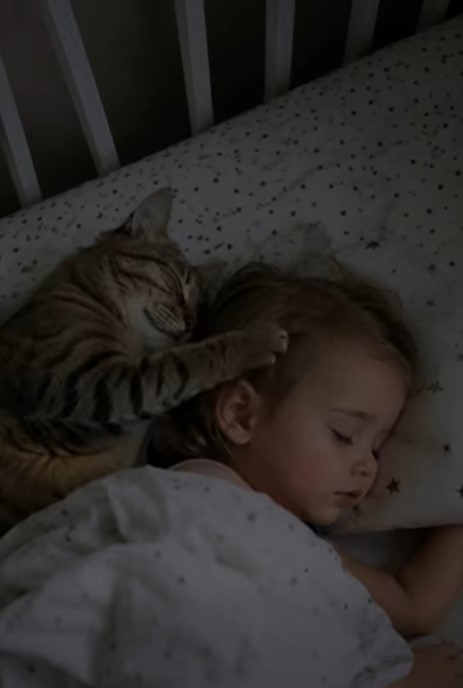
Cat’s Nightly Habit Around Toddler Leads Parents to a Frightening Discovery
A Beloved Family Pet Becomes a Source of Concern
Before their daughter was born, the family’s ginger cat, Barsik, had been one of the most loved members of the household.
He was gentle, quiet, and deeply attached to his owners. He never showed aggression, never scratched, and never gave the family any reason to fear him.
For years, Barsik had been the calm presence in the home. He followed his owners from room to room, rested near them in the evenings, and seemed content simply being close to the people he trusted.
When the couple welcomed their baby girl, their feelings toward the cat changed slightly. Like many new parents, they became cautious.
They worried about whether it was safe to let a pet near such a small child. At first, they watched every interaction closely.
But Barsik quickly showed that he understood how fragile the baby was. He never climbed into the crib aggressively, never startled her, and never tried to play roughly.
Instead, he often lay nearby, quietly watching her as she slept. His behavior seemed protective rather than dangerous.
The Cat’s Unusual Nighttime Habit
As the little girl grew older, Barsik became even more attached to her. By the time she was two years old, the cat had developed a nightly routine.
Every evening, he would go into the child’s room and curl up beside her. The parents found it touching at first.
There was one detail that made the habit unusual. Barsik often placed one front paw gently on the child’s forehead or cheek while she slept.
The gesture looked tender. It seemed as though the cat was comforting the girl or keeping close to her in his own quiet way.
The parents did not think of it as a problem. Barsik had never behaved violently, and the child appeared comfortable around him.
Because the cat was calm and the girl slept peacefully, the family accepted the routine as something sweet and harmless.
For a while, nothing about the situation seemed alarming. The parents continued their evenings as usual, trusting that Barsik was simply showing affection.
A Terrifying Sound in the Night
One night, the mother woke suddenly after hearing a strange noise coming from her daughter’s bedroom.
At first, she thought the child might be restless or having a bad dream. But then she heard something that made her fully alert.
The girl’s breathing sounded heavy and uneven. It was not the normal rhythm of sleep.
The mother got out of bed and hurried toward the room. The sound grew more noticeable as she approached the door.
When she opened it, she froze.
Her daughter was lying in bed, breathing with difficulty. Barsik was beside her, apparently calm, with his paw resting on the little girl’s face.
Part of the child’s nose appeared to be covered by the cat’s paw.
“My God!” the mother cried, immediately pulling the cat away from the child.
As soon as Barsik was moved, the girl took a deep breath and then continued sleeping quietly.
The father rushed into the room after hearing the commotion.
“What happened?”
The mother was shaken and frightened by what she had seen.
“He almost suffocated our daughter! Look what he did!”
The Parents Decide Barsik Must Leave
The father looked from the child to the cat, unsure of what to believe.
Barsik sat quietly beside the bed. He did not seem frightened, guilty, or aggressive.
He appeared confused by the sudden panic in the room.
But for the parents, the scene had been too disturbing to ignore. Their daughter had been struggling to breathe, and the cat’s paw had been on her face.
That night, neither parent slept properly. They kept checking on their daughter, worried that something terrible could happen again.
By morning, the mother had made up her mind.
“We can’t keep him here anymore,” the mother said. “Today we’re taking him to a shelter.”
The decision was painful, but fear had overtaken their affection for the pet.
The mother brought out the carrier and placed it near the door. She began gathering Barsik’s belongings, preparing to remove him from the home.
Barsik did not understand what was happening. He remained nearby, calm and trusting, unaware that the family was preparing to send him away.
A Call to the Pediatrician Changes Everything
Before taking Barsik to the shelter, the parents decided to call the pediatrician.
They wanted to make sure their daughter had not been harmed during the night. They also wanted reassurance that her breathing was normal.
Within an hour, the doctor arrived and examined the little girl carefully.
He listened to her breathing, checked her condition, and measured the oxygen level in her blood.
As the examination continued, his expression changed. He became more serious.
“Tell me honestly,” the doctor asked, “has this heavy breathing at night happened before?”
The father admitted that it had happened occasionally.
“Sometimes,” the father replied. “But we thought it was just an ordinary cold.”
The doctor did not agree with that explanation.
“There is no cold here,” the doctor said calmly. “I want you to take the child to the hospital today for additional tests.”
The parents immediately became worried.
“Is it serious?”
The doctor’s answer was careful but firm.
“Very possibly.”
Hospital Tests Reveal the Real Problem
A few hours later, the little girl was examined by specialists.
The parents waited anxiously, still thinking about the scene from the night before. They had believed the cat was the danger.
Now, they were beginning to understand that something else might have been happening.
After the tests were completed, the doctor invited the parents into his office.
He explained that their daughter was experiencing brief pauses in breathing during sleep.
At that stage, the condition was not described as immediately dangerous, but it required treatment and regular monitoring.
The mother turned pale when she heard the explanation. What they had dismissed as occasional nighttime breathing trouble was actually something that needed medical attention.
Then one question remained.
“But what does our cat have to do with this?”
The doctor smiled slightly before answering.
“I think it was because of him that you noticed the problem at all.”
The parents were stunned.
The Cat May Have Been Trying to Help
The doctor explained that animals can notice changes in breathing and heart rhythm before people do.
Barsik’s behavior may not have been dangerous after all. Instead, it may have been a response to the child’s breathing becoming weak or irregular.
“What do you mean?”
The doctor told the parents that the cat may have been touching the girl’s face to wake her or encourage a deeper breath.
To the parents, the gesture looked like the cat was blocking her breathing. But the doctor suggested that Barsik may have been reacting to the breathing problem, not causing it.
The realization left the couple silent.
The same action that had terrified them might have been the very reason they noticed their daughter’s condition.
If the mother had not awakened that night and heard the heavy breathing, the problem may have remained hidden much longer.
The doctor explained that, over time, an unnoticed breathing condition could become more serious.
The parents began to understand that Barsik had not been the threat they feared. He may have been watching over the child in the only way he knew how.
Barsik Returns to the Child’s Side
When the family returned home, the carrier was still near the door.
The mother looked at it differently now. Only hours earlier, she had been ready to take Barsik away forever.
Now, she opened the carrier and let him out.
The cat walked straight toward the little girl. He rubbed against her legs and then calmly lay down beside her again.
The mother crouched next to him, stroked his head, and spoke softly.
“Forgive us… We wanted to send you away, while you may have been trying to help our daughter all this time.”
From that day forward, Barsik was no longer chased out of the child’s room.
The parents did not ignore the risks, but they also no longer blamed the cat for what had happened.
They installed a video camera and a special breathing sensor so they could monitor their daughter carefully each night.
The new setup allowed them to protect their child while also observing Barsik’s behavior more clearly.
A Chilling Detail on the Recordings
Weeks later, the father reviewed the nighttime recordings.
What he saw made the family even more emotional.
Every time the little girl’s breathing became too rare, Barsik woke up before the sensor alarm sounded.
He would gently touch her face with his paw, just as he had done before.
Only after that would the device begin to sound the alarm.
The detail sent a chill through the father. Barsik was reacting before the machine.
The cat’s nightly habit, once seen as a danger, now looked like an act of instinctive protection.
For the parents, the experience changed everything. They had nearly removed a loyal pet from their home because they misunderstood what he was doing.
Instead, Barsik had helped draw attention to a hidden medical issue that needed care.
From then on, the family watched their daughter closely, followed the medical guidance they had received, and never again treated Barsik as a threat.
The ginger cat remained beside the little girl at night, no longer seen as a risk, but as a quiet guardian who had sensed something the parents could not see.