
The Scarred Rescue Horse Recognized a Silent Boy—and Exposed a Multimillion-Dollar Secret
The Name Hidden on an Old Photograph
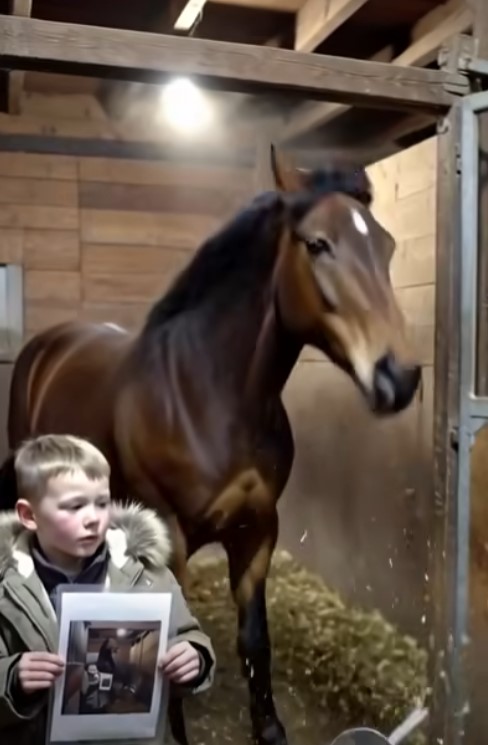
I stood in the frozen barn aisle with a faded Polaroid trembling between my fingers. Only minutes earlier, the enormous bay gelding inside stall four had attacked the heavy door with enough force to shake the entire building.
Now the same horse stood quietly behind the iron bars. His scarred muzzle rested against the cold metal while his deep breathing filled the otherwise silent barn.
I turned the photograph over. Written across its yellowed cardboard backing in careful blue handwriting were the words: Elena, Leo, and Jericho. First Birthday.
“Jericho,” I said.
The horse immediately lifted his head. His ears turned toward me, and a low nicker rose from his chest.
He had reacted to the name.
Beside me stood seven-year-old Leo, wrapped in a coat far too large for him. He had barely spoken since my sister Nora, a family-services caseworker, brought him to the rescue that morning.
Leo did not approach the animal. He simply watched with the solemn concentration of someone who already understood what I was only beginning to discover.
“Come on, Leo,” I said gently. “Let’s get you that hot chocolate.”
After securing the steel latch, I led him into the tack room and prepared a mug of instant cocoa. While he held it between both hands, I examined the state seizure document that had arrived with the gelding.
A Record That Made No Sense
The paperwork identified the animal as County Seizure 44. It claimed he was an unhandled four-year-old horse removed from an illegal breeding operation in West Texas.
The form also described him as dangerously aggressive and recommended immediate euthanasia if no suitable placement could be found.
The document had been signed by Mark Halpern, a field investigator with the State Department of Agriculture.
But the photograph contradicted the official record. Leo had been a baby when the picture was taken, meaning the horse beside him could not possibly be four years old.
The facial markings matched perfectly. The jagged white star on the horse’s forehead was unmistakable.
I called Nora while she was entering family court.
“Sarah, I am literally walking through the metal detectors at family court. Is the boy okay? Did he run off?”
“He’s fine. He’s sitting right in front of me,” I said. “Nora, I need you to tell me about his mother. Did Elena Vance own a farm?”
Nora initially refused to discuss confidential details. Her position changed when I explained that the supposedly feral seizure horse appeared in a photograph with Leo and his mother.
“That’s impossible,” Nora whispered.
Elena had spent her final years in a deteriorating trailer near the county line. She had suffered from congestive heart failure and survived on disability payments.
However, Nora remembered that Elena had once worked in the equine industry. She promised to investigate her employment history after the hearing.
The Brand Beneath the Mud
After ending the call, I returned to stall four with a stiff grooming brush. I did not open the main door. Instead, I reached through the smaller feed opening and carefully brushed the mud from the gelding’s left shoulder.
Beneath his thick winter coat was a faint white freeze brand. It showed a stylized letter S crossed by a riding crop.
I recognized it immediately.
The symbol belonged to Sterling Ridge Equestrian, one of the wealthiest show-jumping operations in the region.
Its owner, Arthur Sterling, also served on the board of my rescue, Safe Haven Equine. For months, he had argued that the struggling sanctuary should be closed because its financial problems threatened nearby property values.
Sterling Ridge bred and trained elite warmbloods. Its horses were carefully documented, registered and insured. A branded animal could not simply disappear without someone noticing.
Before I could decide what to do next, tires crunched across the gravel outside.
A white Department of Agriculture truck stopped beside the loading chute. Mark Halpern climbed out carrying a thick lead rope fitted with a brass stud chain.
He walked into the barn without offering a greeting.
“Sarah,” Halpern said. “Looks like my transport driver made a clerical error this morning. He dropped Seizure 44 at your facility instead of the county livestock yard.”
Halpern claimed the gelding was scheduled for immediate behavioral disposal. He wanted to load the horse and take him to a rendering facility before the end of his shift.
I told him the animal had been sedated and placed under a mandatory veterinary hold. It was not true, but it prevented him from entering the stall.
Halpern reminded me that the horse was state property and threatened the rescue’s funding. I responded that a quarantined animal could not be moved without veterinary clearance.
His professional manner disappeared.
“You’re running this sanctuary on life support,” he said. “The board is looking for any excuse to pull your liability insurance.”
I refused to release the horse without a court order and a veterinarian’s signature.
As Halpern turned to leave, he noticed Leo through the open tack-room doorway.
“Who’s the kid?” Halpern asked.
“My nephew,” I lied.
He said he would return at eight the following morning. Then he drove away so quickly that gravel scattered beneath his tires.
When I turned around, Leo was standing in the aisle with his hands clenched at his sides.
“He’s not feral,” Leo said. “He’s Jericho. And he belongs to my mom.”
The Boy Finally Spoke
I knelt so that Leo and I were at the same height. He explained that his mother had always cared for Jericho.
“Where did she keep him? Your Aunt Nora said you guys didn’t have a barn at your house.”
“At Uncle Marcus’s,” Leo whispered. “In the back. Behind the pallets. Mom walked there every morning to feed him before she got sick.”
His voice broke, and he withdrew into silence again.
I took him to the farmhouse, made him a grilled cheese sandwich and called Dr. Evans, the rescue’s veterinarian.
I asked him to return after dark with a universal microchip scanner. I also requested that he keep the visit out of his digital log until we understood what was happening.
“What exactly is going on in your barn, Sarah?”
I told him that Halpern had attempted to remove the gelding almost immediately after delivering him. Then I revealed the Sterling Ridge brand.
Evans agreed to return at six that evening.
Elena Vance’s Ruined Career
Nora arrived before sunset carrying a thick folder from the courthouse.
She had uncovered Elena’s employment history. Elena had not merely worked as a groom. She had supervised the young-horse development program and managed the import quarantine barn at Sterling Ridge.
She had been dismissed six years earlier, near the time the photograph was taken.
Arthur Sterling had accused Elena of causing a transport accident on Interstate 80. A commercial horse trailer had caught fire, and two imported Grand Prix prospects were declared dead.
Sterling sued Elena for gross negligence. The case destroyed her finances and effectively ended her career in the equine industry.
The insurance company paid Sterling $2.5 million for the two horses.
The truth appeared to be very different.
Elena had likely discovered that the fire was part of an insurance scheme. She had saved Jericho before the trailer burned and then hidden him on her brother Marcus’s property for six years.
When Marcus was arrested for stealing copper wire, authorities searched his property and discovered the horse. Halpern recognized the Sterling Ridge brand and created a false seizure record so the animal could be destroyed before his identity was confirmed.
Elena was dead. Marcus was in jail. Leo was the only witness who could connect Jericho to his past.
The Microchip Revealed the Truth
Night had fallen by the time Dr. Evans arrived. He parked behind the hay shed so his truck could not be easily seen from the road.
Inside the barn, Jericho stood quietly in the dim light. Evans immediately observed that the gelding was much older than the seizure form claimed.
The horse had gray hairs around his muzzle, significant muscle loss along his back and clear signs of previous training. He was not feral. He was starved, frightened and exhausted.
I entered the stall and carefully took hold of his halter. Evans switched on the scanner, causing the horse to flinch at the electronic sound.
“Easy, Jericho,” I said. “Easy, boy. You’re okay.”
At the sound of his name, the gelding stopped struggling.
Evans moved the scanner along the left side of the horse’s neck. The device remained silent during the first pass.
On the second attempt, it beeped.
A fifteen-digit identification number appeared on the display.
I entered the number into the equestrian registry. The result confirmed that the horse was registered as Sterling’s Royal, with the barn name Valiant.
Arthur Sterling was listed as the owner.
The registry also stated that the horse had died six years earlier on November 14.
Jericho was one of the animals supposedly killed in the Interstate 80 trailer fire.
Evans instructed me to save the registry information in several locations. He planned to prepare a formal veterinary affidavit documenting the microchip scan before Halpern returned.
Moments after the veterinarian left, the motion-activated security light above the loading chute turned on.
A black Range Rover was parked outside.
Arthur Sterling stepped from the vehicle wearing a tailored wool overcoat.
A Fifty-Thousand-Dollar Offer
Sterling entered through the side door and approached me with the controlled confidence of a man accustomed to getting whatever he wanted.
He repeated Halpern’s claim that the delivery had been a clerical mistake. He then warned that keeping an aggressive horse could destroy the rescue.
Sterling removed a checkbook from his coat.
He offered Safe Haven Equine an emergency grant of $50,000. The money would cover feed, fencing repairs and overdue bills.
There was only one condition: I had to step aside and allow Halpern to take the horse that night.
“Fifty thousand dollars is a lot of money for a feral piece of meat from Texas,” I said.
The friendliness vanished from Sterling’s expression.
“Take the money, Sarah. Let Halpern do his job.”
I refused and mentioned the $2.5 million insurance payment.
For several seconds, Sterling said nothing.
“I don’t know what you’re talking about,” he said.
I recited the horse’s bloodline, registration, microchip information and official identity. I also told him that Elena had preserved the living evidence of his fraud.
Sterling denied everything. He described Elena as negligent and insisted that no one would believe a financially troubled rescue owner over him.
Then Nora stepped from the tack-room shadows.
She was holding her county identification and a cellphone.
Nora explained that Leo had identified the horse and that Dr. Evans had documented the microchip. She also said the State Police Financial Crimes unit had been contacted.
Sterling attempted to dismiss Leo’s testimony because of his age, but he could not dismiss the veterinary evidence.
The Horse Remembered Him
Sterling turned toward stall four and reached for the steel latch.
Jericho reacted before his hand reached the door.
The gelding lunged at the bars, snapping his teeth inches from Sterling’s face. His chest struck the wooden planks with enough force to rattle the barn.
Sterling stumbled backward and raised his arms.
The fear in his expression was immediate and unmistakable.
Jericho was not attacking a stranger. He recognized the man who had once tried to make him disappear.
“Get off my property, Arthur,” I said quietly. “Before I unlock the door.”
Sterling looked from Nora to me and then back at the horse. Realizing that the evidence could no longer be contained, he left without another word.
His Range Rover disappeared down the gravel driveway moments later.
The Investigation Began at Sunrise
Mark Halpern never returned at eight the next morning.
Three State Police cruisers and an official agricultural transport unit arrived instead. Investigators secured the rescue while Dr. Evans delivered his signed affidavit.
Faced with the microchip record and veterinary evidence, Halpern cooperated with investigators. He admitted that he had falsified the seizure documents and had been paid to destroy the horse before anyone could verify his identity.
Arthur Sterling was later indicted on charges involving wire fraud, animal cruelty and conspiracy.
The Safe Haven Equine board removed him from his position during an emergency meeting.
A restitution agreement connected to the fraudulent insurance payment eliminated the rescue’s financial crisis. The sanctuary was able to repair its fences, purchase enough hay for the season and hire two full-time barn workers.
For the first time in years, the future of the farm was secure.
A Permanent Home for Leo and Jericho
The most meaningful outcome did not involve money.
Leo had no suitable relatives available to care for him. Marcus faced a lengthy prison sentence, and no other family placement could be found.
I asked to become Leo’s permanent guardian.
The process required three months of inspections, background checks, interviews and court proceedings. Eventually, a family court judge approved the placement.
By spring, the frozen ground had softened and new grass covered the pasture.
Jericho’s neglected winter coat had shed away, revealing a deep bay color that shone in the afternoon sunlight. His ribs were no longer visible, and healthy muscle had returned along his back and shoulders.
He looked like the champion he had once been expected to become.
But Jericho would never return to competition. Safe Haven Equine was his permanent sanctuary.
One afternoon, Leo entered the pasture wearing a fitted denim jacket and mud-covered paddock boots. He carried a red grooming tote in one hand.
Jericho stopped grazing and lifted his head.
The horse gave a low nicker before walking slowly toward the boy.
Leo placed the tote on the ground and held out his hand. Jericho lowered his muzzle into the child’s open palm.
The faded Polaroid was no longer inside Leo’s coat. It had been framed and placed beside his bed in the farmhouse.
He no longer needed the photograph to prove that Jericho belonged with him.
Leo wrapped his arms around the gelding’s neck and buried his face in the dark mane. Jericho closed his eyes and stood completely still.
From the fence, I watched the boy and the horse who had both survived loss, fear and abandonment.
The sanctuary gates were locked. The debts were gone. Jericho was safe, and Leo finally had a home.
A Bond That Survived Everything
The bond between a person and an animal can endure separation, hardship and time. Jericho had spent six years hidden from the world, while Leo had lost the mother who protected them both.
Their reunion did more than expose a crime. It gave a frightened child the courage to speak, saved an innocent horse from destruction and transformed a struggling sanctuary into a permanent home.
For the first time in a very long time, everyone at Safe Haven Equine was exactly where they belonged.