
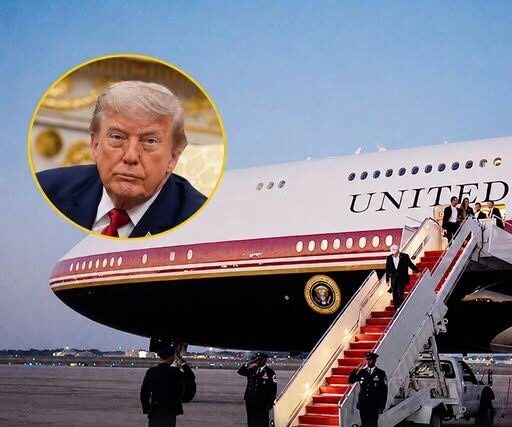
Trump’s High-Profile Boeing 747 Faces New Scrutiny Over Security, Ethics, and Readiness
A Presidential Aircraft Introduced as a Symbol of Strength
The aircraft was intended to project authority long before it carried a president into the sky. The lavish Boeing 747, valued at approximately $400 million and donated by the Qatari royal family, was presented as a future centerpiece of American presidential travel.
Donald Trump publicly celebrated the aircraft and described it as “maybe the greatest commercial plane ever built.” His enthusiastic response quickly elevated the jet from an aviation development into a major political event centered on prestige, visibility, and national power.
Plans initially called for the aircraft to make a prominent debut during a July 1 visit to North Dakota. The appearance was expected to reinforce the administration’s preferred image of confidence, achievement, and forward movement.
For a short period, the presentation appeared to work exactly as planned. The enormous aircraft attracted widespread attention, dominated photographs, and became a central subject across television coverage and political discussion.
Standing near its polished exterior, Trump treated the Boeing 747 as something greater than a transportation asset. It became part of the broader public image he has repeatedly built around large-scale displays, unmistakable branding, and highly visible symbols of success.
Questions Replaced the Initial Excitement
The celebratory atmosphere did not last. As interest in the aircraft increased, new questions emerged about whether it was actually prepared to perform the demanding responsibilities associated with Air Force One.
A presidential aircraft must meet standards far beyond those required of even the most luxurious commercial jet. It is expected to serve not only as a method of travel but also as a secure airborne command center capable of supporting the president during ordinary trips and extraordinary national emergencies.
Concerns focused on military modifications that had not yet been fully completed. These included specialized defensive protections and secure communications systems considered essential for an aircraft carrying the commander in chief.
Specific details involving presidential aviation security remain highly sensitive. Even so, the growing discussion changed the public focus almost immediately.
The aircraft’s size, interior features, and visual impact became secondary. The central issue was whether the jet’s public presentation had advanced more quickly than the technical work needed to make it safe and operational.
The debate therefore moved from luxury to readiness. What had been introduced as a dramatic symbol of presidential strength began raising questions about preparation, certification, and the responsibilities involved in protecting the nation’s highest office.
Why Air Force One Requires More Than Luxury
Presidential aircraft are built to operate under conditions that ordinary passenger planes are never expected to encounter. Every major system must be evaluated to ensure reliability, security, and continuous communication.
The president must remain connected to military leaders, government agencies, and senior officials while traveling. That responsibility requires protected communications networks that can function securely during routine flights as well as moments of national crisis.
Defensive capabilities are equally important. A presidential aircraft must be prepared for potential threats while maintaining the ability to continue operating under highly unusual circumstances.
These requirements help explain why a Boeing 747 cannot become Air Force One simply because it is expensive, impressive, or mechanically capable of flight. The aircraft must first undergo extensive modifications, testing, and certification before it can be trusted with such a sensitive mission.
The standards exist because the consequences of failure would extend far beyond a delayed journey. The aircraft must support the continuity of presidential leadership while protecting everyone aboard.
Appearance may shape public perception, but operational readiness determines whether a plane can fulfill the role. The contrast between those two realities became a defining feature of the controversy.
A Foreign Gift Raises Constitutional Concerns
Technical readiness was not the only issue surrounding the Boeing 747. The aircraft’s origin as a donation from a foreign royal family also revived questions about constitutional ethics and the acceptance of exceptionally valuable gifts from overseas governments.
The reported value of roughly $400 million made the arrangement extraordinary. Critics questioned whether an asset of that scale could be accepted without creating concerns involving influence, transparency, and public confidence.
The aircraft’s connection to the Qatari royal family placed the debate within the wider relationship between diplomacy and presidential authority. Even when an arrangement is presented as practical or beneficial, its foreign origin can create difficult questions about obligations and appearances.
Supporters viewed the donation as an opportunity to obtain a valuable aircraft that could eventually strengthen presidential transportation. From that perspective, the jet represented a major asset that could be modified for national use.
Critics viewed the situation differently. They argued that accepting such a costly gift from a foreign monarchy created a constitutional dilemma that could not be dismissed simply because the aircraft might serve an official purpose.
The disagreement reflected a broader concern about whether public officials can accept major benefits from foreign governments without weakening trust. Even in the absence of a simple answer, the scale of the gift ensured that the ethical debate would remain closely connected to the aircraft’s future.
The White House Describes the Delay as Routine
The White House rejected the suggestion that the aircraft’s withdrawal revealed a serious failure. Officials presented the move as a normal part of the certification and modification process required before the jet could perform presidential duties.
The explanation emphasized that additional work was necessary to bring the aircraft in line with the demanding operational requirements of Air Force One. The jet had reached the limits of what it could currently provide and needed further upgrades before entering service.
Under that interpretation, the delay demonstrated caution rather than crisis. Removing the plane from public activity allowed specialists to continue preparing it without compromising the safety or security of presidential travel.
That reasoning was consistent with the unusually high standards applied to an aircraft carrying the president. No matter how attractive or valuable the plane might be, it could not be treated as operational until every required system had been completed and tested.
However, official explanations did not immediately erase the political impact. The jet had already been presented with considerable fanfare, creating expectations that it was close to becoming a visible part of presidential travel.
Once those expectations were established, its quiet disappearance for additional work appeared to contradict the confident introduction that had preceded it.
The Older Presidential Jet Returns to Center Stage
While the Boeing 747 underwent more modifications, Trump resumed traveling aboard an older presidential aircraft. The contrast between the two planes became difficult to overlook.
The newer jet had been promoted as a bold representation of a new era. Its size, value, and international origin had made it a powerful visual element in the administration’s public messaging.
Yet the familiar presidential aircraft remained responsible for the actual mission. It continued carrying the president while the widely publicized replacement stayed out of view.
That reversal created a different kind of symbolism. The aircraft intended to demonstrate progress and dominance was temporarily replaced by the established plane it was expected to succeed.
The older jet’s continued use also illustrated the importance of proven reliability. Presidential transportation cannot depend solely on the appeal of something new, particularly when security and communications systems remain unfinished.
In that sense, the return to the existing aircraft was not merely a logistical decision. It became a visible reminder that trusted systems often remain necessary until a replacement has satisfied every requirement.
When Political Presentation Meets Operational Reality
The controversy gradually became less about the Boeing 747 itself and more about the tension between political presentation and institutional responsibility.
Large public events can create immediate excitement. A dramatic aircraft, a carefully planned appearance, and confident statements can all shape a powerful story within a matter of hours.
Security preparation moves differently. It depends on technical reviews, protected information, detailed modifications, and testing that may take place far from cameras.
The two timelines do not always align. Political messaging rewards speed and visibility, while national security requires patience and caution.
The aircraft exposed that conflict in unusually clear terms. Its public introduction suggested readiness, but the need for continued upgrades demonstrated that a presidential jet cannot be judged by its exterior or its monetary value.
The episode also showed how quickly a symbol can change meaning. The same plane that initially represented prestige soon became associated with unresolved security questions, constitutional concerns, and doubts about whether the rollout had come too early.
Competing Views of Power and Responsibility
Supporters continue to view the aircraft as a worthwhile investment in the future of presidential transportation. They see its scale and visibility as consistent with Trump’s preference for strong and recognizable demonstrations of American power.
For those supporters, temporary delays do not erase the potential value of the jet. Additional modifications can be understood as necessary steps toward preparing a major national asset for long-term service.
Critics believe the controversy reveals the danger of allowing political symbolism to move ahead of careful governance. They argue that the aircraft was celebrated before the public had a clear understanding of its readiness, cost, security requirements, or ethical complications.
Both positions reflect the intensely divided environment surrounding presidential decisions. Nearly every development is evaluated not only by what it accomplishes but also by the message it sends.
The Boeing 747 therefore became a test of more than aviation policy. It became part of a broader argument over transparency, judgment, diplomatic influence, and the use of spectacle in public leadership.
An Aircraft With an Uncertain Political Legacy
For now, the plane remains outside public view as additional work continues. Its ultimate role will depend on whether it can meet the full operational and security standards required of a presidential aircraft.
It may eventually enter service and fulfill the original vision presented during its high-profile introduction. If that happens, the current controversy could be remembered as an early obstacle in a much longer period of presidential use.
It is also possible that the debate surrounding the aircraft will remain a central part of its public identity. Questions about its foreign origin, unfinished modifications, and dramatic rollout have already transformed the jet into something far more politically significant than an ordinary plane.
The aircraft now stands at the intersection of national security, constitutional debate, diplomatic relationships, and political theater. Each of those issues carries consequences that extend beyond the technical process of preparing a Boeing 747 for flight.
The episode has demonstrated that presidential power depends on more than impressive imagery. It requires secure systems, institutional trust, legal clarity, and decisions that can withstand intense public examination.
The gleaming aircraft was originally expected to deliver a straightforward image of dominance and success. Instead, it became a more complicated symbol of the distance between presentation and preparation.
Its future remains unresolved, but its political meaning is already clear. In Washington, even a luxury aircraft can become a national argument about power, security, ethics, and the responsibilities that exist behind every public display.