
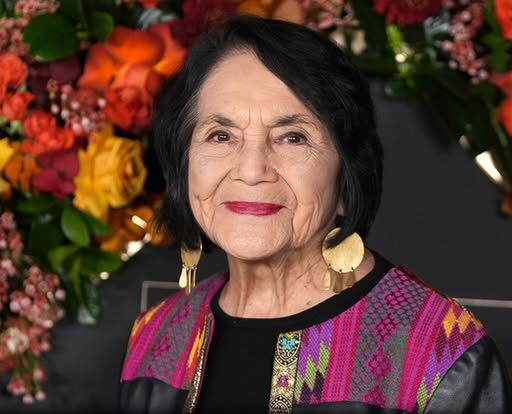
Dolores Huerta Dies at 96: Remembering the Civil Rights Pioneer Behind “Sí, Se Puede”
Dolores Huerta’s Family Confirms Her Passing as America Remembers Her 70-Year Fight for Civil Rights
Dolores Huerta, the pioneering labor organizer and civil rights activist whose work helped transform the lives of American farmworkers, has died at the age of 96, according to an announcement shared by her family.
For more than seven decades, Huerta dedicated her life to advocating for workers, families, and communities whose voices were often overlooked. Her efforts helped establish organized farm labor as a major force in the struggle for fair wages, safer working conditions, and equal rights.
She was also responsible for one of the most recognizable rallying cries in American activism: “Sí, se puede,” meaning “Yes, we can.”
The phrase became associated with movements far beyond the farmworker campaigns where it originated, inspiring generations of organizers and political leaders.
Huerta’s family announced her passing in a Facebook post on Wednesday, October 28, expressing deep sadness over the loss of their beloved mother.
Tributes followed from leaders across California and throughout the United States, reflecting the influence she had built over a lifetime of public service and activism.
Dolores Huerta’s Family Announces Her Death at 96
The announcement of Huerta’s death marked the end of a remarkable chapter in American labor and civil rights history.
Her family shared the news publicly, describing their sorrow at losing a woman whose commitment to helping others had defined much of her life.
Although Huerta became internationally recognized for her activism, her work was rooted in the everyday struggles of families seeking better opportunities and more secure livelihoods.
She spent decades participating in demonstrations, negotiating for workers, organizing communities, and encouraging people to demand fair treatment.
Her determination remained evident well into her later years, when she continued participating in public campaigns rather than withdrawing from activism.
For supporters, her death represents the loss of a leader whose influence extended across generations.
Her legacy includes both the organizations she helped build and the belief that ordinary people could achieve meaningful change through collective action.
From a Small Mining Town to a Lifetime of Activism
Dolores Clara Fernández was born on April 10, 1930, in Dawson, New Mexico, a small mining community.
Her family background exposed her to the importance of labor organizing and political participation from an early age.
Her father worked as a miner and was active in union organizing before later winning a seat in the New Mexico state legislature.
That combination of labor advocacy and public service became an important part of the environment in which Huerta grew up.
Her later career would reflect a similar understanding of how workplace conditions, political decisions, and community well-being were closely connected.
Rather than viewing economic hardship as an isolated problem affecting individual families, she came to see it as something that could be addressed through organized action.
That perspective would guide her work for decades.
Why Dolores Huerta Left Teaching to Help Struggling Families
Before becoming one of the country’s most prominent labor organizers, Huerta worked as a teacher in rural California.
She began teaching in 1954, entering a profession that allowed her to work directly with children and their families.
However, what she witnessed in the classroom deeply affected her.
Some students arrived at school hungry, while others lacked adequate shoes.
Huerta understood that their difficulties extended beyond education. The conditions affecting their families also shaped their ability to learn and thrive.
After only one year, she decided to leave teaching.
Her decision was not a rejection of the importance of education. Instead, it reflected her belief that she could do more to help children by addressing the economic circumstances of their parents.
She turned her attention toward community organizing, seeking ways to improve the lives of working families.
That change in direction became one of the defining decisions of her life.
The Beginning of Her Community Organizing Career
In 1955, Huerta co-founded the Stockton chapter of the Community Service Organization.
The organization provided a setting in which she could work directly with communities and develop the organizing skills that would later become central to her career.
Her efforts focused on helping people recognize the importance of collective participation in decisions affecting their lives.
For Huerta, organizing was not simply about making demands. It involved building relationships, encouraging participation, and helping individuals understand that their concerns deserved attention.
Those principles would remain central to her work as she moved into farm labor advocacy.
She believed that people facing difficult economic conditions could become effective advocates for themselves when they worked together.
Her early community work also helped establish the foundation for the larger labor movement she would soon help lead.
Joining Forces With César Chávez to Organize Farmworkers
In the early 1960s, Huerta joined César Chávez in establishing the labor organization that would eventually become the United Farm Workers.
Their collaboration became one of the most significant partnerships in the history of American agricultural labor organizing.
Farmworkers faced difficult conditions, and the movement sought to secure improvements in wages, workplace safety, and basic treatment.
Huerta and Chávez worked to organize agricultural workers and strengthen their ability to negotiate collectively.
Their efforts required persistence, public demonstrations, and sustained engagement with communities whose livelihoods depended on agricultural employment.
For Huerta, the movement was about more than financial compensation.
It was also about ensuring that the people responsible for harvesting and producing food received dignity and respect.
She continued advocating for these principles throughout her career, even as her work expanded into broader civil rights issues.
How “Sí, Se Puede” Became a Historic Rallying Cry
One of Huerta’s most enduring contributions was the phrase “Sí, se puede.”
Translated into English as “Yes, we can,” the slogan became a powerful expression of determination and collective possibility.
Its simplicity made it accessible, while its message reflected the central idea behind Huerta’s organizing philosophy.
People who felt powerless could work together to challenge difficult circumstances and pursue meaningful improvements.
Over time, the phrase spread beyond farm labor campaigns and became familiar to activists involved in other causes.
Its influence eventually reached national politics.
Barack Obama later credited Huerta as an inspiration for the “Yes, we can” slogan associated with his first presidential campaign.
The connection demonstrated how language developed within a labor movement could influence a much wider public conversation.
For many supporters, the phrase remains inseparable from Huerta’s legacy.
Decades of Demonstrations and 22 Arrests
Huerta’s activism frequently placed her at the center of public demonstrations and confrontations over workers’ rights.
Throughout her career, she was jailed 22 times in connection with union demonstrations.
Her willingness to risk arrest reflected the seriousness with which she approached the causes she supported.
She continued organizing despite the personal and professional difficulties that such activities could create.
For Huerta, demonstrations were a way to bring public attention to problems that might otherwise remain overlooked.
Her repeated arrests became part of the story of a career defined by sustained participation rather than occasional public statements.
Even as she gained recognition as a national civil rights figure, she remained closely associated with direct organizing and protest.
Her approach emphasized that lasting change often required persistence over many years.
The 1988 San Francisco Protest That Left Her Seriously Injured
One of the most difficult moments in Huerta’s activism occurred in 1988 during a peaceful protest in San Francisco.
During the demonstration, she was badly beaten by a police officer using a baton.
The incident left her with serious injuries and required an extended period of recovery.
It was a painful episode in a career already marked by arrests and confrontations connected to public demonstrations.
Her injuries demonstrated the personal risks that could accompany the type of activism she pursued.
Nevertheless, the experience did not bring her public work to an end.
She continued advocating for labor and civil rights, maintaining the commitment that had guided her since the 1950s.
Her recovery and continued participation became further examples of the resilience for which she was widely known.
Founding the Dolores Huerta Foundation in 2002
In 2002, Huerta established the Dolores Huerta Foundation.
The organization was created to support farmworkers and rural communities, extending the mission that had shaped much of her earlier work.
By founding an organization bearing her name, Huerta helped create a structure through which community advocacy could continue beyond individual campaigns.
The foundation reflected her longstanding belief in the importance of helping communities participate in decisions affecting their lives.
It also demonstrated that her activism was not limited to the labor struggles of the 1960s and subsequent decades.
She remained concerned with the challenges facing working families and the need for sustained community support.
Her efforts through the foundation became another important part of her later career.
Receiving the Presidential Medal of Freedom
Huerta’s contributions received national recognition in 2012 when she was awarded the Presidential Medal of Freedom.
The honor acknowledged her decades of work in labor organizing, civil rights advocacy, and community leadership.
It also reflected the growing recognition of her individual role in movements that had helped shape modern American history.
Although she was frequently associated with César Chávez and the United Farm Workers, her own contributions extended across numerous campaigns and organizations.
The award highlighted the influence of her leadership and the lasting importance of her efforts on behalf of working people.
For supporters, the recognition represented an acknowledgment of the work of farmworkers and the communities she had spent her life advocating for.
California Honors Her With Dolores Huerta Day
California also recognized Huerta’s legacy by designating April 10 as Dolores Huerta Day.
The date coincided with her birthday and provided an annual opportunity to acknowledge her contributions.
The designation reflected the importance of her work in a state closely associated with the history of American agricultural labor organizing.
Her activism had helped bring attention to the conditions experienced by workers whose labor supported California’s agricultural economy.
Through decades of advocacy, she had become a prominent figure in the state’s labor and civil rights history.
The annual recognition also helped introduce her story to people who had not witnessed the earlier farmworker movement firsthand.
It reinforced the idea that her influence extended beyond any single campaign or period.
Still Protesting at 89 Years Old
Huerta remained publicly active long after many people would have retired from demanding professional responsibilities.
At the age of 89, she was handcuffed and arrested during a California protest concerning pay for home care workers.
The incident demonstrated that her commitment to labor advocacy continued well into her later years.
Although her early career had focused heavily on agricultural workers, she also supported other groups seeking fair compensation and better working conditions.
Her participation in the protest showed that she remained willing to stand alongside workers rather than limiting her role to speeches or ceremonial appearances.
It was consistent with the approach she had followed for decades: organizing, demonstrating, and calling attention to economic inequality.
Even as she approached her nineties, she continued to identify with the struggles of working people.
Her Message to Activists Continued Until Her Final Months
Huerta’s public advocacy continued into the final months of her life.
She encouraged activists to keep speaking out and to remain engaged in efforts to improve their communities.
Her message reflected a belief that meaningful progress depended on sustained participation rather than the efforts of any one individual.
After more than 70 years of organizing, she had witnessed different generations take up causes involving labor rights and social equality.
Yet her central message remained remarkably consistent.
People could make a difference when they refused to remain silent about conditions they believed needed to change.
That conviction connected her earliest community work with the activism she continued in later life.
Remembering a Woman Who Helped Change American Labor History
Dolores Huerta’s life spanned decades of social and economic change in the United States.
From her beginnings in Dawson, New Mexico, to her work as a teacher and later as a national labor organizer, her career was shaped by a concern for families struggling to secure better opportunities.
Her partnership with César Chávez helped establish a farmworker movement that brought attention to wages, safety, and dignity in agricultural employment.
Her personal commitment was demonstrated through years of demonstrations, repeated arrests, and continued activism despite serious injuries.
She also helped ensure that her work would continue through the Dolores Huerta Foundation.
Recognition through the Presidential Medal of Freedom and Dolores Huerta Day acknowledged her importance in American public life.
Yet her most widely remembered contribution may remain the simple phrase she introduced to the movement: “Sí, se puede.”
Those three words captured the determination that guided her work and inspired people far beyond the communities where she began organizing.
As tributes continue following the announcement of her death at 96, Huerta is remembered not only for the causes she championed but also for the extraordinary persistence with which she pursued them.
Her legacy remains closely tied to the belief that workers deserve dignity, communities deserve a voice, and meaningful change is possible when people organize together.
For generations of activists, the message she helped make famous continues to express that enduring hope: “Sí, se puede.”