
Five-Letter Reference in Epstein Email Fuels Online Speculation and Political Confusion
A Short Message Becomes the Center of a Viral Controversy
A brief phrase contained in a private email became one of the most widely discussed elements surrounding the release of newly unsealed documents connected to Jeffrey Epstein.
The message, exchanged between two brothers in 2018, included the words “photos of Trump blowing Bubba,” and quickly triggered intense speculation across social media. Within hours, users began debating the identities of the people mentioned and whether the sentence referred to public figures.
The five-letter name “Bubba” became the central focus of the online reaction. Because Bill Clinton has long been associated with that nickname, many users immediately assumed the email was referring to the former president.
That interpretation spread rapidly despite a denial from Mark Epstein, who said the name did not refer to Clinton. He described the exchange as a private joke between brothers rather than a serious claim about political leaders.
His explanation did not end the controversy. Instead, the vague wording, the identities being discussed and the wider atmosphere surrounding the Epstein documents allowed the speculation to continue growing.
Document Release Creates More Questions Than Answers
The release of Epstein-related material had been expected to provide greater clarity about his relationships, communications and proximity to influential people. For many members of the public, however, the documents produced a new wave of unanswered questions.
Names including Donald Trump, Bill Clinton, Vladimir Putin and JD Vance were pulled into the resulting online discussion, although their appearances in the public conversation did not establish that they were connected to the disputed meaning of the email.
Social media users combined separate photographs, messages, past associations and political statements into a single rapidly developing narrative. In many cases, the resulting claims extended far beyond what the released material directly demonstrated.
The speed of the reaction showed how quickly an ambiguous line can dominate a major document release. Rather than focusing on the broader contents of the files, online attention narrowed around the meaning of one word.
The controversy also illustrated the difficulty of separating documented information from interpretation. Once the email began circulating without its full private context, readers supplied their own explanations for language that had not been clearly defined.
A Pool Photograph Returns to Public Attention
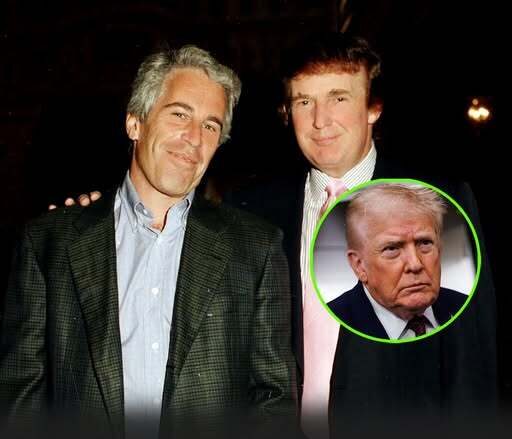
A photograph showing Jeffrey Epstein near Donald Trump and Ghislaine Maxwell also resurfaced during the discussion. The blurry poolside image was shared widely as users revisited questions about Epstein’s access to wealthy and powerful social circles.
The picture became part of a larger online effort to examine who had spent time around Epstein and what those individuals may have known. Its renewed circulation added visual weight to a debate already driven by uncertainty and suspicion.
However, a photograph of people occupying the same setting does not by itself explain the nature of every relationship or prove knowledge of criminal behavior. The image demonstrated proximity at a particular moment, but it did not resolve the questions raised by the files.
Despite that limitation, photographs often carry greater emotional force than written records. The pool image was repeatedly presented beside the controversial email, encouraging viewers to interpret two separate pieces of material as parts of one connected story.
This combination helped intensify the reaction. The email supplied provocative language, while the photograph offered a recognizable scene involving internationally known figures.
The Meaning of “Bubba” Drives the Debate
The most persistent theory centered on the word “Bubba.” Bill Clinton has commonly been associated with the nickname, making him the immediate subject of speculation for many readers.
The assumption spread before any definitive explanation of the email had been established. Screenshots and edited posts circulated rapidly, often presenting the interpretation as more certain than the underlying material allowed.
Mark Epstein rejected the claim that the reference concerned Clinton. His denial was direct, but it left another question unresolved: who or what the name actually referred to in the private exchange.
Because no alternative identity was publicly established in the text being discussed, the denial failed to satisfy users who were already convinced that the nickname carried political significance.
The absence of a full explanation created space for increasingly elaborate theories. Some users treated the ambiguity as evidence that information was being concealed, while others argued that a private joke had been removed from its original context and transformed into a national controversy.
The disagreement revealed how ambiguous language can become almost impossible to contain once it reaches a large online audience. Every denial, correction or clarification can generate further debate rather than bringing the discussion to an end.
Private Humor Collides With Public Scrutiny
Mark Epstein’s description of the message as a personal joke placed the email in a very different context from the one created online. Private conversations often contain nicknames, exaggerations and references that make sense only to the people involved.
Once such a message enters the public record, however, its original tone may become difficult to recover. Readers see only the words on the page and interpret them through their existing beliefs about the people named.
That problem was especially severe in this case because the email appeared within the wider universe of Epstein-related documents. Any unusual or provocative wording was likely to be examined as potential evidence rather than casual conversation.
The surrounding history made neutral interpretation difficult. Epstein’s criminal conduct, his social access and his connections to prominent individuals have created lasting public suspicion about what information remains undisclosed.
As a result, the email was not received as an isolated private exchange. It was treated as a possible clue within a much larger and deeply controversial story.
Political Communication Adds to the Confusion
Vice President JD Vance also became part of the discussion after acknowledging that the Trump administration “screwed up the comms” surrounding the release of the files.
The remark addressed the handling of public communication rather than confirming the internet’s interpretation of the disputed email. Even so, the statement was widely incorporated into the broader controversy.
For critics, the admission reinforced the belief that the rollout had been disorganized and that officials had failed to explain clearly what the public should expect from the documents.
For supporters, the comment was an acknowledgment of a messaging problem rather than evidence of wrongdoing. They viewed the confusion as the result of poor communication, heightened expectations and uncontrolled speculation.
The distinction was often lost online. A statement about the administration’s communication strategy became blended with unrelated theories concerning photographs, nicknames and private emails.
This blending of separate issues allowed the controversy to expand beyond the contents of any single document. Political reactions became part of the evidence cited by users even when those reactions did not directly address the claim under debate.
Social Media Accelerates an Unverified Narrative
Memes, screenshots and short video clips transformed the email into a viral political spectacle. The most sensational interpretation was easy to summarize and share, giving it an advantage over more cautious explanations.
Users who encountered the phrase without context were often exposed first to jokes or accusations rather than the denial that followed. By the time clarification appeared, the original theory had already reached a much larger audience.
The structure of social platforms encouraged the most provocative version of the story. A shocking sentence attracted reactions immediately, while a careful discussion of ambiguity required more time and attention.
As the phrase spread, it became detached from the full exchange between the brothers. Many posts presented only the most explosive words, leaving readers without information about the private nature of the conversation or the denial involving Clinton.
The controversy therefore became less about what could be firmly established and more about which interpretation generated the strongest emotional response.
Trump, Clinton, Putin and Vance were drawn into the same digital discussion even though the reasons for their inclusion differed. Their names became symbols within a broader conflict over secrecy, political loyalty and institutional credibility.
A Release Shaped by Public Distrust
The reaction reflected a deeper lack of confidence in political institutions and official explanations. Many people approached the documents already believing that powerful individuals had been protected from scrutiny.
In that atmosphere, vague language was unlikely to be dismissed as meaningless. Readers searched for hidden significance in every name, joke, photograph and incomplete sentence.
Mark Epstein’s denial faced the same distrust. Those who believed the email referred to Clinton viewed the clarification not as a correction, but as another reason to suspect that the full story was being withheld.
The administration’s admission of communication failures further weakened efforts to control the narrative. When officials do not establish a clear explanation early, speculation can fill the gap and become difficult to reverse.
The resulting debate showed that document releases do not automatically create public clarity. Without context, organization and careful explanation, they can produce competing narratives that move faster than the underlying facts.
One Word Becomes a Symbol of a Larger Divide
The word “Bubba” ultimately carried more weight in the public debate than its five letters would normally suggest. It became a symbol of unresolved suspicion surrounding Epstein’s relationships and the political figures discussed in connection with him.
For some readers, the email appeared to confirm long-held concerns about elite networks and hidden misconduct. For others, it demonstrated how quickly private humor can be misrepresented when placed inside a highly charged political controversy.
The available explanation established that Mark Epstein denied referring to Bill Clinton. It did not provide a publicly confirmed alternative meaning within the material being debated.
That unresolved space allowed the argument to continue. Each side interpreted the lack of certainty in a way that supported its existing position.
The episode also demonstrated the risks of treating online popularity as proof. A claim can dominate public conversation because it is shocking, memorable or politically useful, even when its central interpretation remains disputed.
The Files Leave a Fragmented Public Conversation
Instead of producing a shared understanding, the newly unsealed material intensified existing divisions. People viewed the same email, photograph and political response through sharply different assumptions.
The debate moved far beyond the original exchange between the Epstein brothers. It became a broader argument about transparency, political accountability, media behavior and the public’s willingness to trust official statements.
A single phrase was enough to pull several major political names into one volatile narrative. The reaction showed how easily unrelated details can be connected when a story involves secrecy, celebrity and allegations surrounding powerful people.
At the center of the controversy remained an ambiguous private joke, a disputed nickname and a denial that failed to stop the speculation.
The episode did not settle the questions surrounding the Epstein documents. Instead, it demonstrated how quickly uncertainty can become certainty in the public imagination, especially when institutions are already viewed with suspicion.
What began as one line in a 2018 email became a national example of how information spreads in a divided political environment. The meaning of the word remained contested, but its impact was unmistakable.