
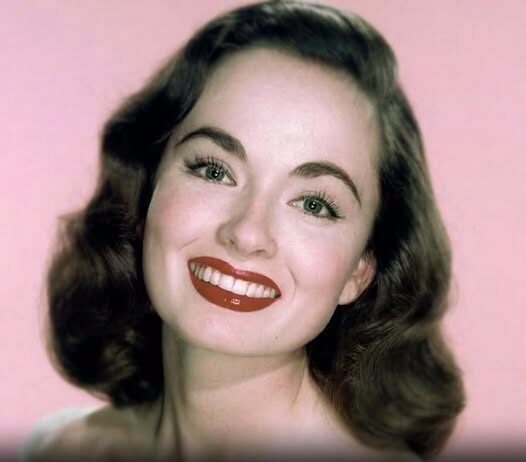
She Terrified Hollywood at Just 16 — Then a Devastating Accident Nearly Ended Her Rising Career
Ann Blyth Earned an Oscar Nomination for Playing One of Cinema’s Most Unforgettable Daughters, but Her Greatest Test Came After the Cameras Stopped Rolling
At just sixteen, Ann Blyth delivered a performance so convincing that audiences could hardly believe the actress behind it was still a teenager. Playing the ruthless Veda Pierce opposite Joan Crawford in the 1945 classic Mildred Pierce, she became one of Hollywood’s most promising young talents almost overnight.
Her character was manipulative, ambitious, and capable of extraordinary cruelty toward her devoted mother. Viewers remembered Veda’s coldness long after leaving the theater, while critics recognized the remarkable control Blyth brought to the role.
The performance earned her an Academy Award nomination for Best Supporting Actress, an extraordinary achievement for someone so young.
But just as Hollywood seemed ready to offer her a remarkable future, an unexpected accident threatened everything she had worked to achieve.
Shortly after completing Mildred Pierce, Blyth suffered a serious back injury in a tobogganing accident. The consequences forced her away from the screen at a moment when her career was gathering momentum.
What followed was a difficult period of recovery that revealed a very different kind of strength from the calculating character that had made her famous.
Ann Blyth’s Childhood Was Filled With Music and Ambition
Ann Blyth was born on August 16, 1928, in Mount Kisco, New York. Long before she became a familiar face on movie screens, she showed a remarkable talent for singing and performing.
Her early years were shaped by music, and she began developing her abilities while still a child. Blessed with a clear soprano voice, she found opportunities to perform on radio, where her musical talent attracted attention.
Unlike many performers who discovered acting later in life, Blyth entered the entertainment world at an age when most children were still exploring their interests.
Her talent eventually brought her to Broadway, where she appeared in the production Watch on the Rhine while still in her early teens.
The experience introduced her to the discipline of professional theater, including rehearsals, demanding schedules, and performing before live audiences.
These early opportunities helped her develop the confidence and technical skills that would later distinguish her work in Hollywood.
By the time film studios began taking notice, Blyth was already an experienced young performer with both acting and musical abilities.
Hollywood Discovered a Young Actress With Unusual Range
During the early 1940s, Hollywood studios were constantly searching for talented young performers who could appeal to audiences through drama, comedy, and music.
Blyth’s combination of acting ability, expressive features, and impressive singing voice made her an attractive prospect.
She began appearing in films during her teenage years, gradually gaining experience in front of the camera.
Her early screen work helped establish her as a capable young actress, but it did not immediately reveal the dramatic intensity she would later demonstrate.
That changed when she was cast in Mildred Pierce, the Warner Bros. drama directed by Michael Curtiz and starring Joan Crawford.
The film would become a defining achievement in both actresses’ careers.
For Crawford, it represented a major professional triumph and eventually earned her the Academy Award for Best Actress.
For Blyth, it offered an opportunity to play a character dramatically different from her gentle public image.
It was a challenge that would transform her career.
Her Performance as Veda Pierce Shocked Audiences
Released in 1945, Mildred Pierce tells the story of a determined mother who works tirelessly to provide a better life for her daughters.
Joan Crawford portrays Mildred, a woman whose devotion to her family becomes increasingly complicated by her relationship with her eldest daughter, Veda.
Blyth’s character is ambitious, materialistic, and frequently cruel toward the mother who sacrifices so much for her.
Rather than presenting Veda as a simple villain, Blyth gave the character an unsettling mixture of youthful charm and emotional coldness.
Her performance made the conflict between mother and daughter one of the film’s most memorable elements.
Audiences watched as Veda repeatedly manipulated Mildred, rejecting her mother’s efforts while pursuing wealth and social status.
For a teenage actress, the role demanded considerable emotional control and the ability to hold her own opposite an established Hollywood star.
Blyth succeeded so convincingly that Veda became one of the most recognizable antagonistic daughters in classic American cinema.
The contrast between the actress and her character was particularly striking. Away from the screen, Blyth was known for a far more reserved and gracious personality.
That difference highlighted the strength of her acting rather than any resemblance between her private life and the character she portrayed.
An Oscar Nomination at an Extraordinary Age
Blyth’s performance in Mildred Pierce earned her a nomination for Best Supporting Actress at the 18th Academy Awards, held in 1946.
She was only seventeen when the ceremony took place, making the recognition especially remarkable.
Although she did not win the award, the nomination established her as one of Hollywood’s most promising young dramatic performers.
At an age when many aspiring actors were still hoping for their first professional opportunity, Blyth had already delivered a performance that would remain associated with her name for decades.
The film itself became an important part of Hollywood history, blending family drama with elements of film noir.
Its enduring reputation ensured that new generations of viewers would continue discovering Blyth’s work long after its original release.
However, the excitement surrounding her success was soon overshadowed by a frightening personal setback.
A Tobogganing Accident Threatened Her Future
After filming Mildred Pierce, Blyth suffered a serious accident while tobogganing.
The accident left her with a broken back, an injury that threatened to interrupt the career she had worked so hard to establish.
For any young person, such an injury would have been frightening. For an actress whose professional life depended on movement, physical stamina, and the ability to work on demanding film sets, the uncertainty was especially significant.
Her recovery required time away from the screen, and she had to confront the possibility that her career might not continue as she had imagined.
The injury came at an unfortunate moment, just as her acclaimed performance had created new professional opportunities.
Instead of immediately building on the attention generated by Mildred Pierce, Blyth had to concentrate on recovering.
The experience became one of the defining challenges of her early adulthood.
Although the public knew her as the young actress who could portray extraordinary cruelty, her private struggle required patience, determination, and resilience.
Her Return Proved She Was More Than One Famous Role
Blyth eventually recovered sufficiently to resume her acting career, demonstrating that her Hollywood future had not ended with the accident.
Her return was particularly important because she had already achieved recognition for such a distinctive character.
Actors who become closely associated with a single memorable role can sometimes struggle to convince audiences that they are capable of portraying different personalities.
Blyth faced that challenge while also rebuilding her career after a serious injury.
Rather than limiting herself to characters resembling Veda Pierce, she pursued a variety of projects across different genres.
Her later performances demonstrated that the intensity she brought to Mildred Pierce represented only one part of her abilities.
She could portray vulnerability, warmth, romantic longing, and musical elegance as convincingly as she had portrayed Veda’s ruthless ambition.
That versatility helped her establish a career that extended well beyond her teenage breakthrough.
From Brute Force to Mr. Peabody and the Mermaid
In 1947, Blyth appeared in Brute Force, a prison drama starring Burt Lancaster.
The film offered another opportunity to participate in serious dramatic storytelling, reinforcing her reputation as an actress capable of handling emotionally demanding material.
The following year, she appeared in Mr. Peabody and the Mermaid, a fantasy comedy starring William Powell.
The film presented a very different kind of performance, allowing Blyth to explore a whimsical character within an imaginative story.
Her ability to move between dark drama and lighter fantasy demonstrated the range that had initially attracted Hollywood’s attention.
These projects also helped separate her public identity from the disturbing character of Veda Pierce.
While audiences continued to remember her work opposite Joan Crawford, Blyth was gradually building a filmography that reflected her broader interests and abilities.
Her talent for singing would soon become an increasingly important part of that career.
Her Beautiful Soprano Voice Opened Another Door
Although many viewers remember Blyth primarily for her acting, she was also an accomplished singer.
Her musical training began during childhood, long before her Academy Award nomination introduced her to a wider film audience.
As her career developed, Hollywood musicals provided an opportunity to combine her acting experience with her soprano voice.
In 1951, she appeared in The Great Caruso opposite Mario Lanza, portraying Dorothy Benjamin.
The film became an important entry in her career, introducing her to audiences who appreciated musical storytelling.
She later appeared in Rose Marie in 1954 and Kismet in 1955, further demonstrating her ability to work in musical productions.
These films required a different kind of screen presence from the dramatic tension of Mildred Pierce.
Instead of portraying an emotionally destructive daughter, Blyth could embrace romance, melody, and the expressive qualities of musical performance.
Her singing background made those roles a natural extension of the skills she had developed as a child.
It also ensured that her Hollywood career could not be defined by one character alone.
She Chose a Family Life Away From Hollywood’s Constant Attention
While her professional achievements attracted public attention, Blyth also built a private life that became deeply important to her.
In 1953, she married physician James McNulty.
The couple went on to have five children, creating a large family while Blyth continued navigating the demands of her entertainment career.
Balancing acting with motherhood required decisions about how much time she wanted to devote to film productions and public appearances.
As the years passed, family responsibilities became an increasingly important part of her life.
Unlike performers who pursued continuous publicity, Blyth maintained a comparatively private personal life.
Her marriage and family provided a different kind of fulfillment from the applause and recognition she received as an actress.
Although her career eventually became less focused on major Hollywood films, she did not abandon performing entirely.
Instead, she continued finding opportunities to work in theater and television.
Her Career Continued Beyond the Golden Age of Hollywood
As Hollywood changed during the 1950s and 1960s, many performers from the studio era adapted to new forms of entertainment.
Television was becoming increasingly influential, while stage productions continued offering opportunities for experienced actors and singers.
Blyth explored both areas during the later stages of her professional life.
Her background in Broadway theater made live performance a familiar environment, and her musical abilities remained valuable in stage productions.
Television appearances also allowed her to remain connected with audiences who remembered her earlier films.
Although she never completely escaped the association with Veda Pierce, her career reflected a much wider range of achievements.
She had performed as a child singer, worked on Broadway, earned an Academy Award nomination, appeared in major dramas, and starred in Hollywood musicals.
Few performers could claim such varied experience while having begun their professional careers at such a young age.
Why Veda Pierce Remains One of Cinema’s Most Memorable Daughters
More than eight decades after Mildred Pierce was released, the character of Veda continues to attract attention from classic film enthusiasts.
Part of the performance’s lasting power comes from the uncomfortable relationship between Veda and her mother.
Mildred works tirelessly to provide opportunities for her daughter, yet Veda repeatedly responds with contempt and manipulation.
The emotional conflict feels particularly painful because it involves a parent whose love is frequently taken for granted.
Blyth’s performance captures that cruelty without reducing the character to a simple caricature.
Her expressions, delivery, and controlled emotional shifts help explain why the role made such a strong impression on audiences.
The fact that she was still a teenager when she portrayed Veda makes the achievement even more remarkable.
Yet the character’s enduring reputation has sometimes overshadowed the actress’s other accomplishments.
Looking at Blyth’s full career reveals a performer whose talents extended far beyond the role that first brought her major recognition.
The Woman Behind the Character Was Very Different
One of the most interesting aspects of Ann Blyth’s career is the contrast between her most famous screen character and her public reputation.
Veda Pierce is remembered for selfishness, emotional manipulation, and a willingness to hurt those closest to her.
Blyth, by contrast, was known for a reserved demeanor and a personal life centered on family.
This difference illustrates an essential part of acting: the ability to portray personalities and behavior that bear little resemblance to the performer.
Her convincing portrayal of Veda was not evidence that she shared the character’s personality. It was evidence of her skill.
Similarly, her recovery from a serious injury demonstrated personal determination that audiences could not necessarily see in her films.
Behind the polished Hollywood image was a woman who had experienced uncertainty, physical hardship, and the challenge of rebuilding her professional future.
Those experiences form an important part of her story.
A Hollywood Legacy Built on Talent and Resilience
Ann Blyth’s journey from childhood radio performances to Broadway and Hollywood represents an extraordinary chapter in American entertainment history.
She achieved major recognition while still in her teens, delivered one of the most memorable performances in a classic Hollywood drama, and overcame a serious accident at a crucial moment in her career.
Her later work demonstrated an impressive ability to move between different genres, including crime dramas, fantasy films, and musicals.
At the same time, she built a family life with her husband, James McNulty, and their five children.
Although Mildred Pierce remains the film most closely associated with her name, it tells only part of the story.
Her career was also shaped by musical talent, professional adaptability, and the determination to continue after an injury threatened her future.
For generations of classic film fans, Blyth will always be remembered as the young actress who made Veda Pierce unforgettable.
But beyond that famous performance was a woman whose real-life resilience deserved recognition of its own.
At sixteen, she showed Hollywood how convincingly she could portray a ruthless daughter. In the years that followed, she demonstrated that her greatest strength was not limited to the characters she played.
Her enduring legacy is a reminder that even the most iconic screen performance cannot fully define the person behind it.