
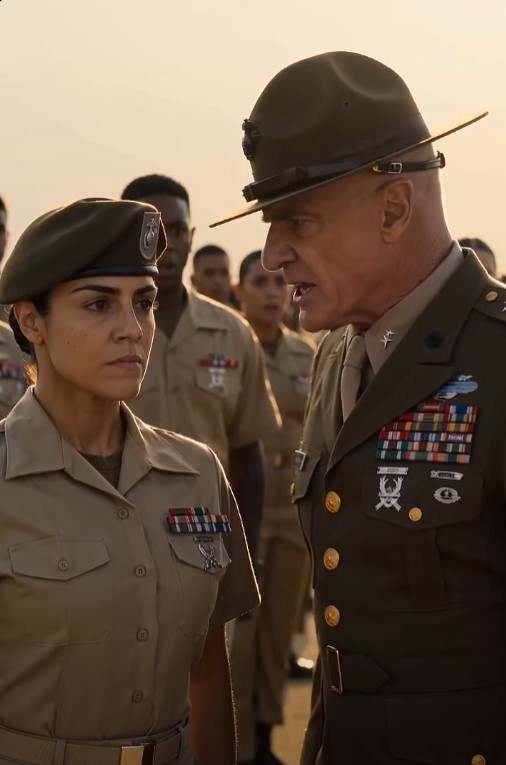
Colonel Cuts Female Recruit’s Braid in Front of the Unit—Then a General Reveals the Truth
The Formation Before Sunrise
Every soldier in the unit was ordered onto the parade ground before sunrise.
No official explanation was given, but everyone understood that this was not a routine inspection.
The soldiers stood in perfectly aligned rows beneath the growing morning light. Their boots were together, their backs were straight, and their faces remained expressionless.
No one spoke.
No one coughed.
Even the movement of fabric in the wind seemed too loud.
At the center of the courtyard stood Colonel Viktor Voronov and a young recruit named Anna Torres.
Anna had been assigned to the unit less than a week earlier.
She was twenty-six years old and had graduated near the top of her class at the military academy. Her records showed outstanding results in precision shooting, physical conditioning, and operational procedures.
She had completed every assignment without requesting special treatment.
Still, Voronov had viewed her as a problem almost from the moment she arrived.
The Order Anna Refused to Follow
The conflict began during an obstacle-course exercise.
The platoon had been instructed to cross a wooden structure, jump from an elevated platform, and continue toward a firing position.
During the drill, soldier Daniel Ruiz fell from the structure.
His body struck the ground with a heavy impact.
Daniel attempted to rise, but his legs did not respond.
“I can’t feel my feet!” Daniel shouted.
An instructor immediately requested that the exercise be stopped.
Colonel Voronov raised one hand.
“The exercise continues.”
The soldiers hesitated.
Anna could see that Daniel’s face had lost its color and that he was unable to move his lower body.
“Colonel, you may have a spinal injury,” Anna warned.
Voronov looked down from the platform.
“Return to your position.”
Daniel groaned on the ground.
“He needs a doctor,” she insisted.
The colonel repeated the order more forcefully.
Anna looked at Daniel and then back at Voronov.
She made her decision.
A Recruit Chooses Her Injured Comrade
Anna stepped out of formation and ran toward Daniel.
She knelt beside him and warned the other soldiers not to lift or move him.
“Don’t close your eyes,” she told him. “Breathe slowly.”
Voronov descended from the platform and approached her.
“Recruit Torres, you have just disobeyed a direct order.”
Anna did not turn around.
“And you are ignoring a medical emergency.”
More than one hundred soldiers heard her response.
For years, few officers had openly questioned Voronov, even when they privately believed he was wrong.
The colonel leaned closer.
“Their role is not to question me.”
“My duty is also to protect a wounded comrade.”
“Your obligation is to obey.”
“Not when obeying can leave you paralyzed.”
The military ambulance arrived several minutes later.
Medical personnel immobilized Daniel and transported him to the hospital.
The Medical Report the Unit Never Saw
Doctors later confirmed that Daniel had suffered a fractured vertebra.
Anna’s decision to keep him still had been correct.
Attempting to force him back into the exercise or moving him without proper stabilization could have caused permanent damage.
The medical findings were circulated among senior officers.
They were never presented to the soldiers who had witnessed the incident.
Voronov ordered the report filed away.
From that moment, his treatment of Anna changed.
He assigned her the most demanding guard shifts. He made her repeat exercises she had already completed correctly and publicly questioned her judgment.
Anna did not complain.
She completed every assignment and refused to react to his provocations.
Her silence did not calm the colonel.
It appeared to anger him even more.
Voronov was not satisfied with obedience to lawful commands.
He wanted submission.
The Braid Her Mother Had Made
Four days after Daniel’s fall, Voronov ordered the entire unit to assemble in the courtyard.
Anna was called forward.
Her uniform was perfectly arranged, and her posture remained firm.
A long, dark braid extended almost to her waist.
Most soldiers knew that Anna took unusual care of her hair, but only her roommate, Maya Lewis, understood why.
Anna’s mother had braided it for her throughout childhood.
Before she died, she had repeated the same words each morning.
“Keep your head high, even if the world tries to bend you.”
Anna kept her hair long as a reminder of those mornings and of the hands that had once braided it.
When Voronov stepped into the courtyard carrying a large pair of metal scissors, Maya immediately understood what he intended to do.
A Punishment Designed to Humiliate
A nervous murmur moved through the formation.
Voronov walked slowly around Anna.
“This recruit believes she can decide which orders deserve to be obeyed.”
No one answered.
“He believes his feelings are above the chain of command.”
Anna continued staring straight ahead.
“Today you will learn that we all sacrifice something when we enter this institution.”
The colonel stepped behind her and took hold of the braid.
Anna felt the pull against her scalp but did not move.
“This will teach him not to argue with his superiors.”
The blades closed.
The sound was brief.
The thick braid fell into the dust.
The entire courtyard became silent.
Several soldiers lowered their eyes. Maya tightened her hands into fists.
Daniel remained in the hospital, but everyone present remembered why Anna had disobeyed the colonel.
She had prevented his injuries from becoming worse.
The Reaction Voronov Wanted Never Came
Voronov lifted the severed braid so the entire unit could see it.
He expected Anna to cry, shout, or beg him to stop.
She did none of those things.
Her remaining hair fell unevenly around her shoulders. Loose strands moved across her face in the wind.
Her expression remained calm.
The colonel dropped the braid beside his boots.
“Now she looks like a real soldier.”
Anna continued looking forward.
Her refusal to react appeared to frustrate him.
He called her an ordinary recruit and warned that people like her often broke faster than others.
Anna remained motionless.
Voronov moved directly in front of her.
“Without that hair, she no longer looks like a spoiled little girl.”
An uncomfortable murmur moved across the ranks.
The colonel raised his voice and ordered Anna to remember her place.
Anna Finally Looks Him in the Eyes
Anna slowly turned her head.
For the first time since the punishment began, she looked directly at Voronov.
There were no tears in her eyes.
There was no visible hatred.
Only controlled determination.
“You can cut my hair,” she said. “But I won’t let you play with my honor.”
Voronov smiled.
“And what do you plan to do about it?”
Anna did not answer.
The colonel grabbed her shoulder and attempted to turn her toward the formation.
The movement was sudden and forceful.
Anna reacted through training rather than anger.
The Colonel Falls in Front of His Soldiers
Anna caught Voronov’s wrist.
She turned on one foot, shifted her weight, and redirected the force of his movement.
The maneuver took less than two seconds.
Voronov lost his balance and fell backward into the dust.
A collective gasp swept across the courtyard.
Hundreds of soldiers stared at their commanding officer lying on the ground in front of a recruit whose hair he had just cut.
Anna released him immediately.
She stepped back and returned to the position of attention.
She did not raise her fists, attempt to strike him, or celebrate his fall.
It had been a controlled defensive response.
Voronov sat up with humiliation visible across his face.
“Arrest her!”
Two officers began moving forward.
Then a firm voice came from the rear of the courtyard.
“Nobody moves.”
The General Who Witnessed Everything
General Esteban Salazar entered the parade ground accompanied by two military inspectors.
He had arrived without warning to evaluate the unit.
For several minutes, he had remained near the administrative building.
He had seen the formation, heard the colonel’s remarks, witnessed the haircut, and observed who initiated the physical contact.
Salazar stopped in front of Voronov.
“Explain to me why you publicly humiliated a subordinate.”
The colonel struggled to regain his breath.
“It was a disciplinary measure.”
The general asked to see the written order authorizing it.
Voronov remained silent.
Salazar then asked which regulation permitted a commander to cut a soldier’s hair as a public punishment.
Voronov attempted to justify his actions by referring to Anna’s refusal to obey during the exercise.
The Doctor Is Ordered to Tell the Truth
The general turned toward Anna.
He asked why she had disobeyed the order.
“A colleague had fallen and couldn’t feel his legs, sir.”
Salazar looked toward the unit’s doctor.
“Was the soldier injured?”
The doctor hesitated and briefly looked toward Voronov.
The general noticed.
“Answer without looking at the colonel.”
The doctor finally responded.
“Yes, sir. Stable vertebral fracture. Recruit Torres prevented him from being moved without immobilization.”
A murmur spread across the formation.
The truth that had been hidden in the medical report was now spoken openly before the entire unit.
Salazar looked back at Voronov.
“Then he punished a soldier for preventing a greater injury.”
Voronov insisted that Anna had questioned his authority.
The general rejected the argument.
“Your authority is not above the lives of your subordinates.”
The Difference Between Discipline and Humiliation
General Salazar looked down at the colonel, whose uniform was covered in dust.
He acknowledged that soldiers were required to respect rank.
Then he pointed toward the severed braid.
“But a commander must respect the dignity of those under his responsibility.”
The courtyard remained perfectly still.
“Discipline is not humiliation. Leadership is not fear. And a uniform does not give anyone the right to destroy another person to protect their pride.”
Voronov lowered his eyes.
For the first time in years, he appeared to have no answer.
The general instructed an officer to collect the scissors and the braid as evidence.
He ordered Voronov to surrender his service weapon and temporarily relinquish command while an investigation was opened.
The soldiers watched as the colonel removed his holster.
His expression showed both anger and shame.
A Final Threat Before His Removal
As Voronov was escorted from the courtyard, he passed close to Anna.
He stopped and spoke quietly.
“This is not over.”
General Salazar heard him.
“For you, Colonel, it’s just beginning.”
Voronov was led away.
Anna remained in formation until Maya received permission to approach.
Maya bent down and lifted the braid from the ground.
She held it carefully in both hands.
“I’m sorry,” she whispered.
Anna looked at the hair that had been part of her life for so many years.
For the first time that morning, tears filled her eyes.
The Memory Behind Her Tears
Anna was not crying because she believed her appearance had been ruined.
She remembered her mother’s hands.
She remembered sitting in her childhood room while her mother divided the strands of hair and formed the braid.
She remembered the voice telling her to keep her head high even when the world attempted to bend her.
Maya assumed Anna would want to preserve the braid.
Anna slowly shook her head.
“Take her to the hospital.”
Maya did not understand.
Anna explained that the hair could be donated and made into a wig for someone receiving cancer treatment.
She took a deep breath and looked toward the place where Voronov had been removed.
“He wanted to turn it into a humiliation.”
She paused.
“I don’t intend to allow it.”
A Call From Daniel’s Hospital Room
Before the unit could be dismissed, the doctor received a telephone call.
His expression changed as he listened.
The message concerned Daniel Ruiz.
Anna immediately turned toward him.
Daniel had awakened after surgery.
He was stable enough to speak.
However, the information he had given the medical team transformed the incident from a training accident into something far more serious.
Daniel claimed that his fall had not been accidental.
General Salazar, still standing nearby, demanded an explanation.
The doctor said Daniel believed someone had manipulated the wooden platform before the exercise.
The Punishment Begins to Look Different
Tension returned to the parade ground.
Anna looked toward the administrative building.
She thought about the colonel’s immediate refusal to stop the exercise.
She remembered how Voronov had ordered everyone to continue while Daniel lay unable to feel his legs.
She remembered the medical report being hidden and the increasing punishments that followed her decision to intervene.
The scissors and the public humiliation suddenly appeared to be part of something larger.
Perhaps Voronov had not targeted Anna simply because she had challenged his authority.
Perhaps her decision to protect Daniel had disrupted a plan.
Daniel had survived.
He could speak.
And he might know who altered the platform.
The Recruit Who Saved a Witness
Anna had believed she was protecting an injured soldier from permanent paralysis.
She now faced the possibility that she had also saved a witness.
If Daniel’s accusation was true, someone inside the unit had deliberately created the conditions for his fall.
Voronov’s determination to keep the exercise moving could no longer be dismissed as harsh leadership alone.
His decision to suppress the medical report and isolate Anna required closer examination.
The investigation into the colonel’s treatment of Anna was suddenly connected to a possible act of sabotage.
General Salazar ordered that the obstacle platform be secured immediately.
No one was permitted to enter the training area or remove equipment until military investigators examined it.
The officers who had accompanied the general left the parade ground and moved quickly toward the obstacle course.
The soldiers remained in formation, but the atmosphere had changed completely.
The morning had begun as an attempt to break Anna’s dignity in front of the unit.
It ended with the commanding officer removed, evidence collected, and questions surrounding an injured soldier’s fall.
She Kept Her Head High
Anna stood beneath the morning sun with uneven hair resting against her shoulders.
The braid her mother had once made was no longer part of her uniform.
Yet the lesson attached to it remained.
Voronov had tried to use the braid as proof that he could take something personal from her and turn it into shame.
Anna transformed it into a gift for someone facing cancer treatment.
He tried to punish her for protecting a wounded soldier.
The general recognized that her actions had prevented greater harm.
He attempted to use rank as protection from accountability.
Instead, his own behavior became evidence in an investigation.
Anna had lost part of her hair, but she had not lost her composure, her principles, or her honor.
As the unit was finally dismissed, the soldiers no longer looked at her as an inexperienced recruit who had challenged a colonel.
They looked at her as the person who had been willing to act when everyone else was too afraid to move.
And somewhere inside the military hospital, Daniel Ruiz was preparing to reveal why someone had wanted him silenced.