
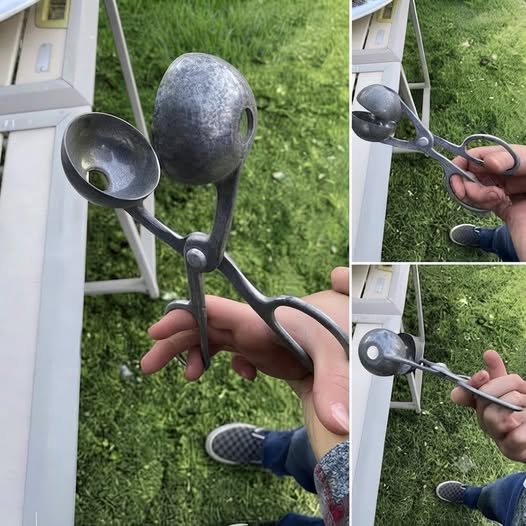
The Vintage Meatball Maker: A Timeless Kitchen Tool That Still Belongs in Every Home
A Simple Gadget From an Earlier Era
Long before modern kitchens were filled with air fryers, electric pressure cookers, food processors, and other high-tech appliances, home cooks depended on practical tools designed to perform one task well.
These utensils did not require electricity, batteries, digital displays, or complicated instructions. They were built from durable materials, used by hand, and often remained in service for many years.
One of those classic gadgets is the vintage meatball maker.
At first glance, the tool may appear unusual to anyone who has never seen one before. It is typically made from metal and features two rounded scoops connected to scissor-style handles.
When the handles are pressed together, the scoops close around a portion of meat mixture and shape it into a neat, rounded ball.
The design is simple, but its purpose is highly practical.
Instead of rolling every meatball by hand, the cook can use the tool to produce portions that are similar in size and shape.
This makes food preparation faster, cleaner, and more consistent, especially when a large batch is needed for a family meal or gathering.
Today, many people discover these old kitchen tools in antique shops, flea markets, secondhand stores, or storage boxes inherited from older relatives.
Others find them tucked inside a grandparent’s kitchen drawer beside other utensils that once played an important part in everyday cooking.
Although the meatball maker may look old-fashioned, its practical design continues to make sense in a modern kitchen.
Designed to Make Everyday Cooking Easier
Preparing meatballs by hand can be time-consuming.
The cook must divide the mixture into individual portions, roll each piece between the palms, and try to keep every meatball approximately the same size.
When only a few are being prepared, this process may not seem difficult.
However, making enough meatballs for a large family, celebration, or community meal can require a significant amount of time.
The vintage meatball maker was created to reduce that effort.
Its rounded scoops help form the mixture quickly, while the handles allow the cook to open and close the tool with a simple motion.
Because each portion is shaped inside the same mold, the finished meatballs are more uniform.
This consistency offers more than an attractive appearance.
Meatballs of similar size are more likely to cook at the same rate.
If some pieces are very large while others are small, the smaller ones may become overcooked before the larger ones are completely done.
Uniform portions reduce that problem and make it easier to estimate cooking time.
The tool also helps keep the cook’s hands cleaner.
Although some contact with the mixture may still be necessary, the scoops perform much of the shaping work.
For home cooks preparing several dozen meatballs, this can make the entire process feel more organized and efficient.
A Tool Connected to a Beloved Dish
The history of the meatball maker is closely connected to the long popularity of meatballs themselves.
Meatballs are often associated with Italian cooking, but similar dishes have appeared for centuries in many different cultures.
Versions have been prepared in Persia, China, Sweden, Turkey, and ancient Rome.
Each region developed its own approach based on available ingredients, local flavors, and family traditions.
Some recipes used different types of meat.
Others included grains, herbs, seasonings, or additional ingredients that gave the dish a distinct regional character.
Despite those differences, cooks in many places faced the same practical challenge.
The mixture needed to be divided into portions and shaped into pieces that would cook evenly.
That repeated task made a tool like the meatball maker useful in many kitchens.
Its design did not depend on one particular recipe.
It simply provided a reliable way to create rounded, evenly sized portions.
This made it suitable for traditional family recipes as well as new variations.
The tool’s usefulness came from solving a basic problem that remained the same regardless of the ingredients being used.
Why Uniform Portions Matter
Consistent size is one of the most important advantages offered by the meatball maker.
When every piece is shaped by hand, small differences are almost unavoidable.
One meatball may contain more mixture than another, while some may be packed more tightly or shaped less evenly.
These differences can affect both cooking and presentation.
Uniform meatballs tend to cook more predictably.
They can be arranged more neatly in a pan, placed evenly on a tray, or added to a pot without large variations in size.
This is especially helpful when preparing food for several people.
The finished dish also looks more polished when each portion has a similar appearance.
That visual consistency can make even a simple homemade meal feel more carefully prepared.
For cooks working with large quantities, the tool also provides a basic form of portion control.
Using the same scoop repeatedly makes it easier to estimate how many servings a mixture will produce.
The cook can divide the food more evenly among family members or guests.
The meatball maker therefore improves speed, appearance, cooking consistency, and portioning through one uncomplicated design.
A Familiar Part of Family Cooking
In many homes, older kitchen tools became part of family traditions.
They were used during weekly meals, holiday preparations, and gatherings where several generations worked together.
The meatball maker was especially suited to this kind of shared cooking.
One person could prepare the mixture, another could fill the scoops, and someone else could arrange the finished portions for cooking.
Children could also take part under adult supervision, allowing them to contribute to the meal without needing advanced cooking skills.
The repeated motion of opening, filling, closing, and releasing the tool made the task easy to understand.
This helped turn food preparation into a shared activity rather than a responsibility handled by one person alone.
For many people, discovering a vintage meatball maker brings back memories of homemade dinners and busy kitchens filled with conversation.
The object may remind them of a parent or grandparent preparing a familiar recipe.
Even when the original owner is no longer present, the tool can preserve a connection to those moments.
It becomes more than a metal utensil.
It becomes part of the story of how a family cooked, gathered, and passed traditions from one generation to the next.
A Design That Has Changed Very Little
One of the most impressive qualities of the meatball maker is how little its basic design has changed.
Modern manufacturers have introduced updated materials and added features, but the central idea remains the same.
Two rounded sections close together around a portion of mixture and shape it into a ball.
The reason for this continuity is simple.
The original design works.
There is little need to reinvent a tool that already performs its purpose effectively.
Modern versions are often made from stainless steel, which offers strength and durability.
Some include non-stick coatings intended to make the mixture easier to release.
Others have softer or more comfortable grips that reduce strain during repeated use.
Larger designs may include trays or multiple molds that allow several meatballs to be formed at the same time.
These changes can improve convenience, but they do not replace the basic mechanical principle of the vintage model.
The enduring design shows that a useful kitchen invention does not need to become complicated in order to remain relevant.
Useful for More Than Meatballs
Despite its name, the meatball maker can be used for many other recipes.
Any mixture that benefits from evenly sized rounded portions may be suitable for the tool.
Falafel is one example.
The prepared mixture can be divided into consistent pieces before cooking, helping each portion cook at a similar rate.
Cookie dough can also be portioned with a scoop-style tool, creating cookies that are more uniform in size.
This can help them bake more evenly and produce a tidier finished batch.
Cake pops, hush puppies, and rice balls are other foods that may benefit from consistent shaping.
The tool can reduce the time needed to portion each recipe and improve the overall appearance of the finished food.
Its rounded form is useful whenever a cook wants to create repeated portions without measuring each one separately.
The same principle extends beyond traditional home recipes.
Professional chefs use similar scoops to create consistent servings of mashed potatoes, risotto, and desserts.
In professional kitchens, consistency is especially important because customers expect each serving to look and feel similar.
A simple scoop can help create that reliability quickly.
This broader usefulness proves that the vintage meatball maker is not limited to one dish or one style of cooking.
Practical in Both Home and Professional Kitchens
The meatball maker demonstrates how the same basic tool can serve both home cooks and professionals.
In a family kitchen, it can make dinner preparation faster and more enjoyable.
In a professional setting, a similar utensil can support consistent portioning and presentation.
The needs may differ, but the tool solves the same problem.
It creates repeated portions with less effort.
Home cooks may appreciate the ability to prepare a large batch for freezing, serving at a gathering, or using throughout the week.
Professional cooks may value speed and consistency during busy service periods.
Because the tool is manual, it is easy to use wherever food preparation takes place.
There is no need to connect it to a power source or reserve a large amount of counter space.
It can be washed, dried, stored in a drawer, and used again whenever needed.
This straightforward convenience helps explain why the design has survived despite major changes in kitchen technology.
Built to Last for Many Years
Vintage kitchen utensils were often made with durability in mind.
Many were constructed from solid metal and designed to withstand frequent use.
A well-maintained meatball maker could remain useful for decades.
This is why original models still appear in flea markets, antique stores, and inherited collections.
Even after years of storage, many remain recognizable and functional.
Their continued survival reflects a time when kitchen tools were expected to perform reliably for a long period.
Unlike complicated appliances containing motors, wiring, or electronic controls, a manual meatball maker has very few parts that can fail.
Its usefulness depends primarily on the handles, hinge, and rounded scoops.
As long as those parts remain in good condition, the utensil can continue serving its purpose.
This lasting construction also gives vintage tools a practical advantage.
They can be reused rather than replaced frequently.
A utensil that remains functional across generations offers both sentimental and everyday value.
No Electricity or Complicated Technology Required
Modern appliances can make cooking faster, but they often require storage space, maintenance, and access to electricity.
The meatball maker avoids all of those complications.
It works entirely through hand pressure.
The user opens the handles, places the mixture inside, closes the scoops, and releases the formed portion.
There are no controls to learn.
There are no batteries to replace.
There are no programs, timers, or settings to adjust.
This simplicity makes the tool dependable.
It can be used during everyday cooking without preparation and cleaned after the task is complete.
It also takes up far less space than many modern appliances.
For cooks with limited storage, a compact manual utensil can be more practical than a specialized machine.
The tool offers an efficient result without adding unnecessary complexity to the kitchen.
A Connection Between Generations
The vintage meatball maker holds meaning beyond its practical function.
For many people, it represents a connection to earlier generations and the traditions they created around food.
Kitchen tools often carry memories because they are used during important family moments.
A utensil may be associated with a particular recipe, holiday, or person who prepared meals for the family.
Finding one years later can bring those memories back with surprising clarity.
The worn handles, polished metal, or familiar shape may recall afternoons spent helping in the kitchen.
Even someone who never used the original tool may appreciate it as a symbol of traditional home cooking.
It reflects an approach centered on patience, shared work, and meals prepared by hand.
Using the same type of tool today allows those traditions to continue in a practical way.
The meatball maker can still perform the task it was designed for while reminding the user of the people and meals that came before.
Vintage Charm With Modern Usefulness
Some vintage objects are admired mainly for decoration.
The meatball maker is different because it can still serve a real purpose.
An original model found at a flea market may be both an interesting collectible and a usable kitchen utensil, provided it is in suitable condition.
A modern version inspired by the classic design offers the same basic benefits with updated materials.
Both choices combine nostalgia with usefulness.
The tool’s appearance may reflect an earlier period, but the need it addresses has not disappeared.
Cooks still want to prepare food quickly, create uniform portions, and achieve consistent results.
The meatball maker continues to help with all three.
Its lasting appeal comes from the fact that it does not rely on novelty.
It remains useful because the design is efficient and easy to understand.
Why This Classic Tool Still Deserves a Place in the Kitchen
The vintage meatball maker proves that effective kitchen tools do not need advanced technology.
Its rounded scoops and scissor-style handles provide a practical solution to an everyday cooking task.
It saves time, creates consistent portions, supports even cooking, and improves presentation.
It can also be used for a wide range of foods beyond traditional meatballs.
Its durable construction allows it to remain useful for years, while its simple operation makes it accessible to cooks of different experience levels.
Just as importantly, the tool carries a sense of history.
It recalls family recipes, shared meals, and kitchens where durable utensils were used repeatedly rather than quickly replaced.
Whether discovered in an old drawer or purchased in a modern form, the meatball maker remains a practical addition to the home.
Its continued popularity reflects a larger truth about cooking.
Sometimes the simplest tools are the ones that endure.
They do not need screens, motors, or complicated features to deliver dependable results.
The vintage meatball maker continues to earn its place in the kitchen because it does exactly what it was designed to do.
It transforms a time-consuming task into a faster, cleaner, and more consistent process while preserving a small but meaningful connection to traditional home cooking.