

Inside Bruce Campbell’s Remarkable Boeing 727 Home in the Oregon Woods
A Vision That Began With an Unconventional Dream
Bruce Campbell has long been known for his fascination with transforming everyday objects into something completely unexpected. His curiosity about engineering and creative reuse led him to imagine a home that would stand apart from anything most people had ever seen.
In his early twenties, Campbell purchased 10 acres of forested land in Oregon for $23,000. At the time, he already had a bold idea about creating a living space unlike any traditional house.
His original concept involved using retired cargo ships as the structural foundation for his future home. The idea reflected his interest in repurposing large industrial structures that were built to last.
Although the concept seemed unusual, Campbell believed that reusing massive engineered structures could offer durability and creativity that conventional homes rarely provided.
Years passed as the idea developed, but the core vision remained the same: build a home that combined engineering, sustainability, and originality.
An Idea Inspired by an Unexpected Story
Nearly twenty years after he first imagined his unconventional home, Campbell came across a story that changed his plans in a surprising way.
He learned about Joanne Ussery, a hairdresser from Mississippi who had transformed a retired Boeing 727 into a residence after a fire destroyed her original house.
Her creative solution demonstrated that an aircraft could be more than just a machine designed for flight. With careful planning, it could also become a livable and practical structure.
The story immediately captured Campbell’s attention. Seeing how Ussery had adapted a commercial jet into a home inspired him to rethink his own project.
Instead of building with cargo ships as he had originally planned, Campbell decided to pursue an even more unusual direction. He would use an airplane as the centerpiece of his future home.
Purchasing a Retired Boeing 727
In 1999, Campbell took a major step toward making his dream a reality. He purchased a retired Boeing 727 from Olympic Airways for $100,000.
The aircraft had once been part of the global aviation network, carrying passengers across continents and oceans. Now, it was about to begin a completely different chapter of its existence.
Campbell envisioned placing the plane deep within his Oregon property, allowing the aircraft to rest among the surrounding trees.
However, purchasing the plane was only the beginning of a much more complicated process.
Transporting a commercial aircraft across continents and preparing it for use as a home required extensive planning and financial commitment.
The Challenge of Moving an Airplane Across the World
Moving a Boeing 727 from Athens, Greece, to Oregon was a complex logistical task. The aircraft could not simply be flown to the site and parked in the woods.
The transportation process involved careful coordination, specialized equipment, and significant expense.
The costs of transporting the aircraft alone reached $120,000. Combined with the original purchase price, Campbell’s total investment in the project reached $220,000.
Despite the financial challenges and complicated logistics, Campbell remained committed to his idea.
For him, the project represented far more than simply building a house. It was the realization of a creative vision that had taken decades to develop.
Transforming an Aircraft Into a Living Space
Once the Boeing 727 was successfully placed on Campbell’s Oregon property, the real work began. The aircraft had to be adapted to function as a comfortable and usable living space.
Campbell approached the project with a strong sense of respect for the plane’s original design. Rather than stripping away its identity, he preserved many of the aircraft’s defining features.
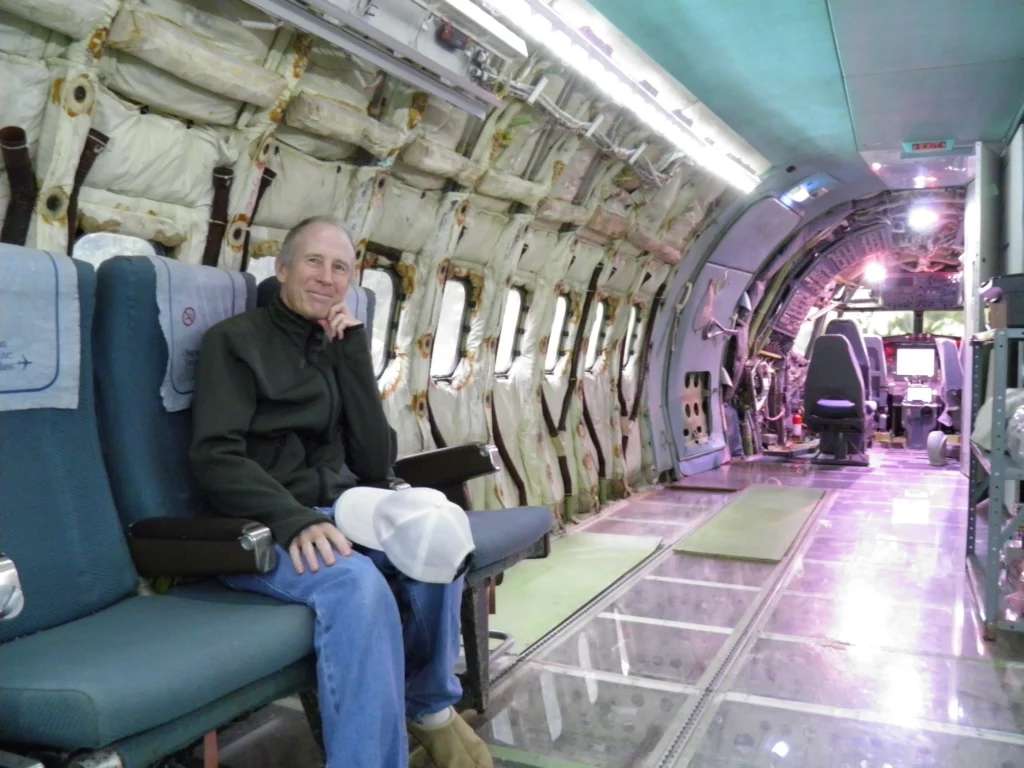
The passenger cabin, which once held rows of airline seats, became the central living area of the home.
Large windows that originally served airline passengers now provide natural light throughout the interior.
The aircraft’s fuselage creates a long and open interior space, giving the home a distinctive layout unlike that of traditional houses.
The Cockpit Remains a Historic Centerpiece
One of the most striking aspects of Campbell’s airplane home is the preserved cockpit. Rather than removing it, he kept the flight controls and instrument panels intact.
The cockpit now serves as both a historical feature and a unique focal point inside the aircraft.
Visitors to the plane often find the cockpit especially fascinating because it retains the character of the aircraft’s original purpose.
The preserved controls and displays serve as a reminder that the aircraft once traveled thousands of miles through the skies before becoming a stationary home.
This preservation reflects Campbell’s respect for the engineering and history behind the plane.
A Minimal but Functional Interior
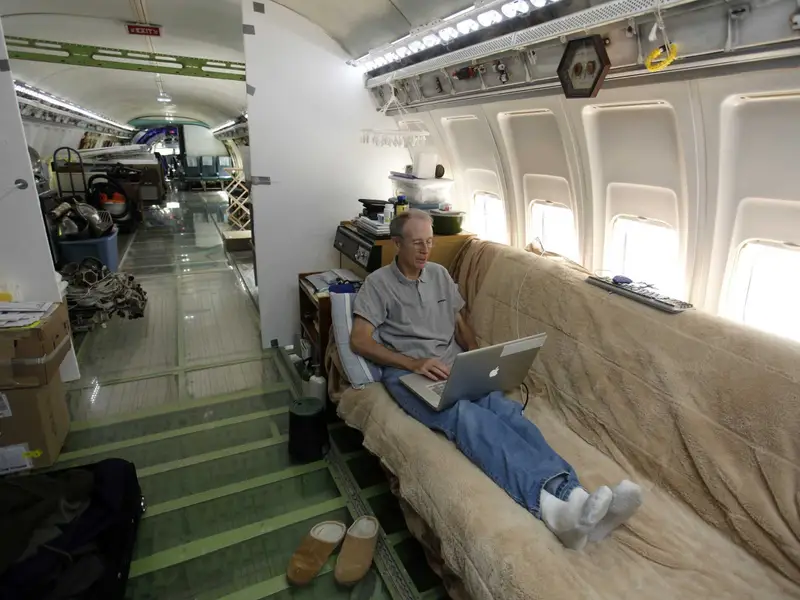
Inside the aircraft, Campbell designed a living environment that emphasizes simplicity and functionality.
The home includes essential amenities that allow him to live comfortably while maintaining the plane’s original structure.
A modest kitchen provides space for preparing meals.
A shower allows for daily hygiene, while a sleeping area offers a place to rest within the aircraft’s elongated interior.
Rather than heavily altering the structure, Campbell chose to work within the existing layout of the plane.
This approach preserved the aircraft’s identity while adapting it for practical daily use.
A Creative Approach to Sustainable Living
Beyond its unusual appearance, Campbell’s airplane home also represents an innovative example of sustainable thinking.
By repurposing a retired aircraft, he gave a second life to a structure that might otherwise have been dismantled or scrapped.
Airplanes are engineered to withstand extreme conditions and long operational lifespans. The materials used in their construction are designed for durability and structural strength.
These qualities make them surprisingly well suited for adaptation into permanent structures.
Campbell’s project demonstrates how repurposing existing structures can reduce waste while encouraging creative approaches to housing.

Overcoming Obstacles Along the Way
The process of turning an airplane into a home was far from simple. Campbell faced numerous challenges during the project.
Transporting the plane across continents required careful coordination and significant resources.
Once the aircraft reached Oregon, adapting its interior to function as a living environment presented its own set of technical difficulties.
Every step required patience, experimentation, and determination.
Despite these challenges, Campbell remained focused on completing the project exactly as he envisioned it.
Each obstacle became part of the journey toward building a home that reflected his creativity and persistence.
A Home That Reflects Individual Creativity
Today, Bruce Campbell’s Boeing 727 home stands quietly among the trees of his Oregon property.
The aircraft’s sleek aluminum structure contrasts with the surrounding forest, creating a striking visual scene.
Inside, the preserved aircraft interior tells a story of engineering history blended with personal innovation.
Every part of the plane, from the cockpit to the passenger cabin, reflects Campbell’s dedication to preserving its identity while transforming it into a livable environment.
The project highlights how unconventional thinking can produce remarkable results.
An Idea That Continues to Inspire
Campbell’s airplane home has drawn attention from people around the world who are intrigued by its originality.
The concept challenges traditional assumptions about what a home must look like.
By turning a retired Boeing 727 into a residence, Campbell demonstrated how creativity and determination can reshape even the most unexpected structures.
His work encourages others to consider new possibilities when it comes to architecture, sustainability, and design.
The aircraft that once traveled through the sky now rests peacefully in the Oregon woods, serving a completely different purpose.
For Bruce Campbell, the airplane is more than just a structure. It represents decades of imagination, persistence, and the fulfillment of an extraordinary vision.