
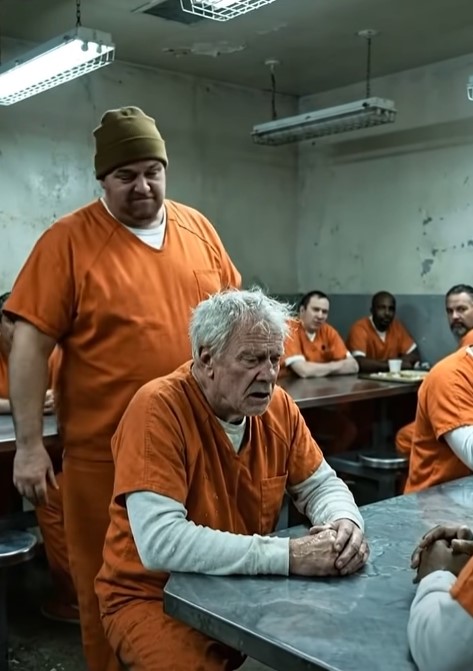
Powerful New Inmate Challenges Elderly Prisoner and Learns an Unexpected Lesson
Ivan Petrov Entered San Quentin Convinced Strength Would Make Him Untouchable
Ivan “The Russian” Petrov arrived at San Quentin prison with one belief firmly planted in his mind: physical strength determined who held power.
His imposing size immediately attracted attention. Ivan carried himself like a man accustomed to intimidating others, and he assumed the same strategy that had worked outside prison would quickly establish his position inside.
From the moment he entered the facility, he began studying the people around him. He watched the inmates, observed how they interacted and tried to determine who controlled the different areas of prison life.
Ivan believed he understood the system almost immediately.
The strongest men commanded respect. The weaker ones moved aside.
At least, that was what he expected.
Then he noticed Don Anselmo.
An Elderly Man Sat Alone at the Cafeteria’s Best Table
During mealtime, Ivan noticed an elderly prisoner sitting quietly at one of the most desirable tables in the cafeteria.
Don Anselmo did not appear physically intimidating. He was older than many of the inmates around him and seemed completely comfortable sitting alone.
What confused Ivan was the behavior of everyone else.
No one challenged the old man for the seat.
Prisoners who appeared stronger and younger simply left him alone. Even men who seemed comfortable confronting others showed no interest in disturbing Don Anselmo.
Ivan interpreted that silence incorrectly.
Instead of wondering why the elderly man received such unusual respect, he assumed the other inmates had simply failed to challenge someone obviously weaker.
To Ivan, the situation represented an opportunity.
If he forced Don Anselmo away from the table in front of everyone, the entire cafeteria would understand who the new dominant figure was.
Ivan Demands the Old Man’s Seat
Ivan approached the table with confidence and ordered Don Anselmo to move.
The elderly prisoner did not immediately react.
His calmness irritated Ivan.
He expected fear, hesitation or at least some acknowledgment of the threat standing over him. Instead, Don Anselmo remained composed.
Ivan interpreted the silence as weakness.
Determined to make his point publicly, he pushed the older man.
The cafeteria changed instantly.
Conversations became quieter.
Nearby prisoners stopped eating and began watching.
Even the guards appeared more attentive.
Ivan noticed the reaction but misunderstood it. He assumed everyone was waiting to see whether Don Anselmo would finally surrender his seat.
Then the elderly prisoner slowly stood.
A Tattoo Changes the Mood in the Entire Room
As Don Anselmo rose, part of a tattoo on his arm became visible.
The inmates immediately recognized it.
The atmosphere shifted from curiosity to nervous anticipation.
The tattoo identified Don Anselmo as the founder of a legendary organization known as “The Timeless Ones.”
The group carried a reputation powerful enough that even people who had never personally dealt with Don Anselmo understood what the symbol represented.
Ivan had no such understanding.
He was new to the prison and unfamiliar with the history surrounding the elderly man.
To the other inmates, Don Anselmo’s age did not make him weak. It meant he had survived long enough to earn a level of respect Ivan could not yet comprehend.
The guards also understood that the confrontation was becoming dangerous.
But Ivan remained convinced that reputation could not overcome size and strength.
Ivan Ignores Every Warning and Attacks
Rather than reconsidering his decision, Ivan prepared to attack.
He looked at the much older prisoner and saw what he believed would be an easy victory.
His confidence came from years of relying on physical force.
Ivan was larger, younger and visibly stronger. In his mind, those advantages settled the outcome before the confrontation had even begun.
He threw a powerful punch toward Don Anselmo.
What happened next shocked him.
Don Anselmo did not attempt to meet Ivan’s strength with equal force.
He simply moved.
With controlled timing, the elderly man avoided the punch and positioned himself where Ivan could no longer use his size effectively.
Then he struck Ivan in the throat.
The sudden movement disrupted Ivan’s attack and left him struggling to regain control.
Precision Defeats Brute Force
Before Ivan could recover, Don Anselmo used another calculated movement.
Rather than striking repeatedly, he applied pressure to a sensitive point on Ivan’s body.
The effect was immediate.
The much larger man found himself unable to continue the confrontation as he had planned.
Pain forced him downward.
Within moments, Ivan was on his knees in front of the elderly prisoner he had expected to humiliate.
The cafeteria remained silent.
Don Anselmo had not relied on speed, aggression or uncontrolled violence.
Every movement had been measured.
His response demonstrated a type of strength Ivan had never respected before: experience combined with discipline.
For the first time since entering San Quentin, Ivan realized that being physically powerful did not necessarily make him the most dangerous or respected person in the room.
Don Anselmo Explains What Power Really Means
With Ivan still humbled by the confrontation, Don Anselmo calmly explained the mistake he had made.
True authority inside prison, he told him, did not come simply from having the largest muscles or being willing to attack someone.
Power was built through history.
It was built through reputation.
Most importantly, it was built through respect.
Ivan had arrived believing fear and strength were the same thing.
Don Anselmo showed him otherwise.
A person could frighten others for a moment through intimidation, but genuine respect required something deeper.
The lesson struck Ivan harder than the physical confrontation.
His entire plan for establishing himself inside the prison had collapsed in front of everyone.
He had tried to demonstrate dominance and instead exposed his lack of understanding.
Ivan Believes He Will Be Punished for His Mistake
After the confrontation ended, Ivan expected consequences.
He now understood that Don Anselmo was not simply another elderly inmate.
The reputation of “The Timeless Ones” suggested that challenging the group’s founder could carry a severe price.
Ivan assumed retaliation would follow.
He believed the humiliation in the cafeteria was only the beginning.
During the hours that followed, he prepared himself for what he thought would happen next.
But Don Anselmo had something entirely different in mind.
The Next Day Brings a Surprise No One Expected
When Ivan entered the cafeteria the following day, Don Anselmo was once again sitting at his usual table.
Ivan expected hostility.
Instead, the older man invited him to sit down.
The gesture surprised not only Ivan but also the prisoners watching from nearby tables.
Don Anselmo had every opportunity to seek revenge.
He chose not to.
He explained that killing Ivan or arranging punishment would accomplish nothing meaningful.
Ivan would learn no lesson from simple revenge.
If Don Anselmo truly wanted to demonstrate leadership, he believed there was a better choice.
He decided to make Ivan his helper and protector.
The Man Who Expected Revenge Receives a Second Chance
Ivan initially struggled to understand Don Anselmo’s decision.
He had spent much of his life viewing relationships through the language of strength and submission.
Someone who defeated an opponent was supposed to punish him.
Someone who was humiliated was supposed to seek another opportunity for revenge.
Don Anselmo rejected that pattern completely.
Instead of destroying Ivan, he gave him responsibility.
The decision placed the younger man in a position where his physical abilities could serve a purpose beyond intimidation.
Ivan remained strong, but Don Anselmo began teaching him that strength was only useful when guided by judgment.
The process changed him gradually.
Don Anselmo Begins Teaching Ivan a Different Way to Live
Under Don Anselmo’s guidance, Ivan started learning things he had never considered important.
One of the most significant changes involved reading.
Ivan, who had previously relied almost entirely on physical presence to establish his identity, began developing skills unrelated to strength.
Learning required patience.
It required admitting that he did not know everything.
Those lessons challenged Ivan in ways fighting never had.
Don Anselmo did not attempt to change him overnight.
Instead, he offered guidance and allowed Ivan to slowly reconsider the choices that had shaped his behavior.
The former bully began paying closer attention to how his actions affected the people around him.
Ivan Stops Intimidating Weaker Prisoners
One of the clearest signs of Ivan’s transformation appeared in the way he treated inmates who could not defend themselves.
When he first arrived at San Quentin, Ivan viewed vulnerable prisoners as easy targets.
He believed intimidating them demonstrated power.
After spending time with Don Anselmo, his perspective changed.
Ivan began recognizing that attacking someone weaker proved very little.
There was no courage in using an obvious physical advantage to create fear.
Instead of targeting vulnerable inmates, he began helping them.
The same size that had once made him threatening now made him capable of discouraging others from bullying people who could not protect themselves.
Ivan gradually became known for intervening rather than intimidating.
His Strength Finds a New Purpose
Don Anselmo never asked Ivan to become physically weaker.
He taught him to use his strength differently.
That distinction became central to Ivan’s development.
Physical power was not inherently wrong. The problem had been the purpose behind it.
Ivan had once used his size to take seats, demand obedience and create fear.
Now he used the same physical presence to protect others and prevent unnecessary conflict.
Nothing about his appearance had changed.
The difference existed in the choices he made.
Other prisoners gradually noticed the transformation.
The aggressive newcomer who had challenged Don Anselmo no longer behaved like the man who had first entered the prison.
Three Years Transform Ivan Completely
Three years passed.
By then, Ivan’s relationship with Don Anselmo had become something far deeper than the arrangement that began after their confrontation.
Ivan remained close to the elderly prisoner as a loyal companion.
He assisted him, protected him and listened to the lessons Don Anselmo continued to share.
More importantly, Ivan had learned to control himself.
His greatest transformation was not visible in his muscles or appearance.
It was reflected in his behavior.
The man who once demanded respect now understood that respect could not simply be taken.
It had to be earned.
Ivan’s strength remained impressive, but it was no longer the most important thing about him.
Don Anselmo’s Greatest Victory Was Not in the Cafeteria
It would have been easy to view the original confrontation as Don Anselmo’s victory.
After all, an elderly man had defeated a much larger opponent using precision, experience and control.
But that physical moment was not his greatest achievement.
His real victory occurred during the years that followed.
Don Anselmo took a man who believed fear was the foundation of authority and showed him another way to live.
He demonstrated that leadership could be expressed through restraint rather than revenge.
By refusing to destroy Ivan after being challenged, he created an opportunity for change.
Ivan eventually became proof that the decision had worked.
The Old Prisoner Saw Potential Where Others Saw a Threat
Most people who encountered Ivan during his first days at San Quentin saw an aggressive and physically imposing newcomer.
Don Anselmo saw something else.
He recognized that the same strength Ivan used destructively could eventually be used to protect people.
That possibility would never have been realized if Don Anselmo had responded only with anger.
Instead, he combined authority with patience.
He allowed Ivan to experience humiliation without making humiliation the final chapter of his story.
That distinction changed everything.
Ivan did not become loyal because Don Anselmo frightened him into obedience.
His loyalty developed because the older man gave him a reason to rethink who he wanted to become.
A Lesson About Appearance, Wisdom and Respect
The story of Ivan and Don Anselmo began with a mistake based entirely on appearances.
Ivan looked at an elderly prisoner and saw weakness.
He looked at himself and saw strength.
From those two assumptions, he concluded that he automatically possessed greater power.
The cafeteria confrontation proved how incomplete that judgment was.
Don Anselmo’s age concealed decades of experience, discipline and reputation.
Ivan’s impressive physical strength concealed his lack of patience and understanding.
The moment the two men confronted each other, the difference became clear.
Wisdom allowed Don Anselmo to control a situation that brute force alone could not.
True Leadership Is Revealed in What Happens After Victory
Perhaps the most important part of the story came after Don Anselmo had already won.
He had nothing left to prove.
The entire cafeteria had witnessed what happened.
He could have used Ivan’s defeat to increase fear surrounding his name.
Instead, he chose to teach.
By inviting Ivan to sit beside him the following day, Don Anselmo demonstrated that leadership was not simply the ability to defeat an opponent.
It was the ability to influence what that opponent became afterward.
Ivan eventually learned to read, stopped bullying others and began protecting inmates who were vulnerable.
Those changes accomplished far more than revenge ever could have.
Ivan’s Final Transformation Redefines Strength
Years after arriving at San Quentin believing he would dominate everyone around him, Ivan remained beside the same elderly man he had once tried to push from a cafeteria table.
The relationship represented everything that had changed.
Ivan no longer needed to prove himself through intimidation.
He understood that self-control required more strength than uncontrolled aggression.
He had learned that protecting people could demand greater courage than frightening them.
Most importantly, he discovered that respect produced through fear rarely lasts.
Respect created through character can endure.
A Quiet Old Man Taught the Prison’s Strongest Newcomer the Meaning of Power
Ivan entered prison believing his body would determine his place in the hierarchy.
Don Anselmo showed him that history, wisdom and self-discipline mattered more.
The elderly prisoner defeated him physically in only moments, but changing Ivan required years of guidance.
That longer transformation became the true measure of Don Anselmo’s influence.
By the end, Ivan still possessed the strength that had once made him feared.
But he no longer used it to dominate.
He used it to help.
The man who had entered San Quentin determined to become its most intimidating inmate eventually became the loyal protector of the person he had once considered weak.
The experience taught him that appearances could deceive, physical power could disappear in an instant and fear was a poor substitute for genuine authority.
Don Anselmo did more than defeat Ivan.
He gave him the opportunity to become someone different.
And in doing so, he proved that the most powerful person is not always the one capable of causing the greatest harm.
Sometimes true strength belongs to the person who has enough wisdom and restraint to turn an enemy into a better man.