
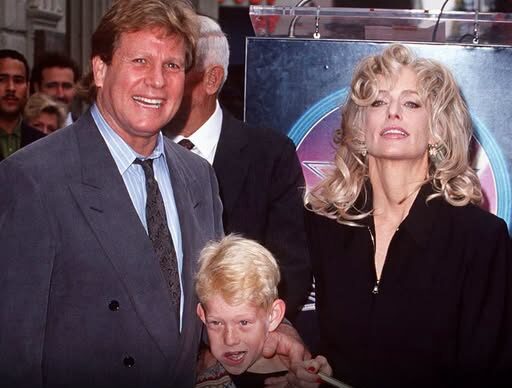
Farrah Fawcett’s Final Years Were Shaped by Her Deep Concern for Son Redmond O’Neal
The Television Icon’s Private Life Became Closely Tied to the Struggles of Her Only Child
Farrah Fawcett spent much of her life recognized as one of Hollywood’s most familiar faces. Her beauty, television success, and enduring place in popular culture made her an international star whose public image often appeared glamorous and effortless.
Behind that image, however, Fawcett faced years of deeply personal difficulty centered on the person she cared about most: her only child, Redmond O’Neal.
Redmond was born into a famous family as the son of Fawcett and actor Ryan O’Neal. From the beginning, his life unfolded under circumstances very different from those of most children, with celebrity, public attention, and his parents’ complicated relationship forming the background of his upbringing.
As he grew older, Redmond’s struggles increasingly became a source of fear and heartache for his mother.
A Mother and Son Bound by a Difficult Relationship
Fawcett’s relationship with Redmond became one of the most important parts of her private life. She loved her son intensely and remained concerned about his future even as his personal problems became increasingly difficult to control.
The world often saw Fawcett as the glamorous television star whose appearance had helped define an era. At home, she was also a mother trying to protect a son whose life was moving in a troubling direction.
Redmond faced problems involving addiction, legal trouble, treatment, and repeated attempts at rehabilitation. Those struggles unfolded publicly because of the fame surrounding both of his parents.
For Fawcett, the situation was intensely personal. She could offer support and try to guide her son, but she could not make his decisions for him or guarantee that treatment would permanently change his life.
The contrast between her public success and her private worry became increasingly painful as the years passed.
Redmond Grew Up Surrounded by Fame and Turmoil
Redmond entered the world as the child of two nationally recognized entertainers. His father, Ryan O’Neal, and his mother were both major Hollywood figures, placing their family under constant public attention.
Yet fame did not create stability.
Fawcett and Ryan O’Neal had a turbulent relationship that became associated with conflict, drugs, anger, and regret. The difficulties between the adults created an unstable environment around their son.
As Redmond became older, his own problems began attracting attention. Addiction became a persistent issue, and attempts to help him repeatedly became part of the family’s life.
Fawcett remained emotionally connected to him throughout those years. Even when circumstances became painful, her concern for her son never disappeared.
Farrah’s Health Crisis Changed the Family Again
While Redmond continued facing his own difficulties, Fawcett was confronted with a life-threatening challenge of her own.
She developed cancer, beginning a period in which her health became increasingly fragile. The actress who had spent decades in front of cameras was suddenly focused on treatment, survival, and the people closest to her.
Her illness did not erase her concern for Redmond. Instead, her declining health made the situation even more painful because she knew her ability to help him was becoming limited.
As Fawcett grew weaker, Redmond was dealing with serious legal problems. The circumstances created an extraordinary separation between a critically ill mother and the son she desperately wanted near her.
Redmond Was Allowed to See His Dying Mother
Near the end of Fawcett’s life, Redmond was permitted to visit his mother while in custody.
He was brought to her under restraints, creating a heartbreaking contrast between the intimacy of a final meeting between mother and son and the legal circumstances surrounding him.
For Fawcett, Redmond remained her child regardless of the arrests, addiction, or public controversies that had followed him.
Their final moments together became one of the most emotional chapters of her last days.
As her condition worsened, Fawcett’s attention reportedly remained focused on her son. The single word associated with her final moments was his name: “Redmond.”
For those who had followed her life, the moment captured the complicated bond that had defined so much of her later years.
Her Concern for Redmond Extended Beyond Her Lifetime
Fawcett’s efforts to protect her son did not end with emotional support during her lifetime.
Her estate arrangements were also structured with Redmond’s circumstances in mind. The goal was to provide for him while limiting the possibility that his personal problems could place his financial future at further risk.
It reflected the same conflict Fawcett had confronted for years as his mother.
She wanted to help him, yet she also understood that unrestricted access to money could create additional difficulties for someone struggling with addiction and instability.
It was another example of a mother attempting to care for an adult child whose life she could no longer control.
Fawcett’s Death Did Not End Redmond’s Struggles
After his mother died, Redmond continued facing serious personal and legal problems.
The hope that he might eventually escape the cycle that had defined so much of his younger life was repeatedly challenged by further arrests, treatment programs, and institutional care.
Rehabilitation became part of a continuing pattern rather than a single turning point.
At different stages, his circumstances involved correctional facilities, rehabilitation programs, and psychiatric treatment.
Each development drew renewed attention because Redmond remained connected to two of Hollywood’s best-known names.
But the person appearing in legal proceedings years later looked very different from the image many people might associate with the son of Farrah Fawcett and Ryan O’Neal.
A Later Courtroom Appearance Shocked Many Observers
Years after Fawcett’s death, photographs of Redmond during a courtroom appearance generated widespread attention.
His physical appearance had changed dramatically.
Among the most striking features were tattoos on his face, including designs resembling devil horns across his forehead. Other markings and visible changes contributed to an image that startled people familiar with the glamorous Hollywood family into which he had been born.
For some observers, the photographs represented the disturbing outcome of years of addiction, legal trouble, and psychological instability.
For others, they generated a more complicated reaction.
Behind the unsettling appearance was still the child whose mother had spent years trying to protect him and whose final thoughts had remained closely tied to his fate.
His Story Prompted Both Shock and Sympathy
Public reaction to Redmond’s later difficulties was never entirely uniform.
His behavior and legal problems understandably caused alarm, while his appearance in court reinforced the seriousness of his circumstances.
At the same time, some people viewed his life through the broader history of the family in which he had grown up.
He had been born into privilege and fame, but those advantages existed alongside addiction, instability, conflict, and intense public scrutiny.
That background did not remove personal responsibility for his actions, but it added another dimension to the story of how someone raised in extraordinary privilege could experience such profound personal decline.
Farrah Could Protect Him Only So Much
One of the most painful elements of Fawcett’s story is the limitation every parent eventually confronts when an adult child is struggling.
She could encourage Redmond to seek help. She could provide emotional and financial support. She could remain present during relapses and legal crises.
What she could not do was make recovery happen for him.
Her fame could not solve his addiction. Her money could not guarantee stability. Her devotion could not eliminate every influence and decision pulling him in another direction.
That reality became increasingly clear as Redmond continued struggling despite years of intervention.
The Glamour of Hollywood Could Not Shield the Family
Fawcett’s life remains closely associated with an era of television glamour, celebrity photography, and extraordinary fame.
Yet her family experience revealed how little those things can matter when private problems become overwhelming.
The celebrity status surrounding Fawcett, Ryan O’Neal, and Redmond brought resources that many families never have. It also placed their most painful moments before the public.
Problems that might normally have remained private became headlines, photographs, legal records, and public discussion.
Redmond’s arrests were followed. His treatment became news. His courtroom appearance was examined by people who had never met him.
Through it all, his connection to his mother remained impossible to separate from his story.
A Mother’s Final Concern Remained Her Son
Farrah Fawcett died after a life filled with achievements that had already secured her place in entertainment history.
She had been a television star, a cultural icon, and one of the most recognizable women of her generation.
But the final chapter of her life was not defined only by fame or career accomplishments.
It was also defined by illness and by her concern for the son she feared she would leave behind before his life had become stable.
Redmond’s continued difficulties after her death made that concern appear even more poignant.
The years that followed brought more legal trouble, more treatment, and images of a man whose life seemed far removed from the glamorous world into which he had been born.
A Family Story More Complicated Than Celebrity
The story of Farrah Fawcett and Redmond O’Neal is ultimately about far more than Hollywood fame.
It is the story of a parent confronting the limits of love when addiction and instability have taken hold of someone she desperately wants to protect.
Fawcett could offer support, structure her estate carefully, and remain emotionally attached to Redmond until the end of her life.
She could not guarantee what happened after she was gone.
Redmond’s later appearance and continuing struggles became a disturbing reminder of how complicated that battle had always been.
For many people who remember Fawcett only as the smiling television icon of her younger years, the private story behind that public image is considerably more painful.
Her career made her famous around the world, but in her final days, the person occupying her thoughts was not an audience, a television role, or Hollywood.
It was her son.