
A Lieutenant Colonel Ordered a Woman to Clean Up Her Coffee—Then Discovered She Was Colonel Carter
Fiction: A Cafeteria Confrontation Exposes an Officer’s Arrogance
The military base cafeteria was filled with the familiar sounds of a lunch break. Soldiers talked across tables, trays clattered against counters, and people moved through the room carrying meals and drinks.
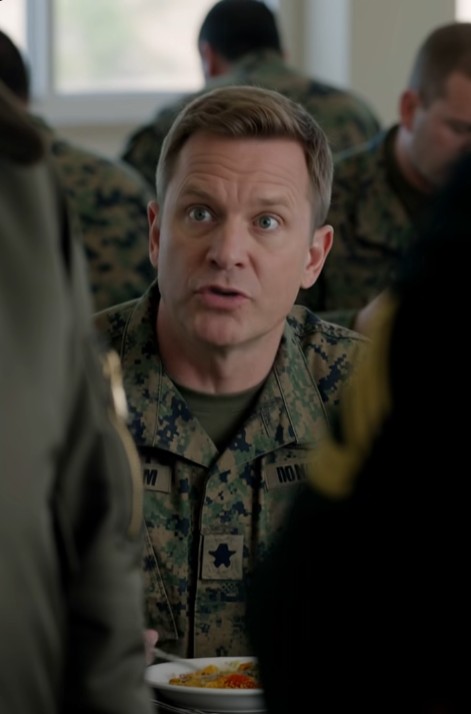
Near the serving area, a lieutenant colonel stood holding a glass coffee pot. Facing her was a woman in a dark military jacket, her hair tied back and her expression composed.
The lieutenant colonel had mistaken the woman for a cafeteria employee. Expecting to be served, she had become irritated when the stranger failed to respond as she thought she should.
It was an assumption she could have corrected with a question. Instead, she treated the absence of immediate service as a challenge to her authority.
The woman in the jacket remained where she was. She did not work behind the counter, and there was no reason for her to fetch the officer’s coffee.
What should have been a brief misunderstanding was about to become a public demonstration of how the lieutenant colonel treated someone she believed could not challenge her.
A Deliberate Spill Changes the Atmosphere
The lieutenant colonel tilted the pot, pouring coffee onto the floor in front of the other woman’s shoes. The spill spread across the walkway, creating a mess where moments earlier there had been none.
She set the pot down sharply. Then she delivered an order intended to end the disagreement on her terms.
“Clean that up.”
The woman looked down at the coffee. For several seconds, she studied the puddle without moving to obey.
Her stillness contrasted with the lieutenant colonel’s irritation. She did not step into an argument or respond with an insult, but neither did she accept responsibility for the mess.
When she raised her eyes, her attention returned directly to the officer.
“Did you spill that on purpose?” she asked.
The question gave the lieutenant colonel an opportunity to acknowledge what she had done. Instead, she offered an accusation as though it justified her behavior.
“You refused to serve me.”
The woman answered with the simple fact that should have resolved the situation before the coffee ever reached the floor.
“Because I don’t work here,” she replied calmly.
An Explanation the Officer Refuses to Accept
Around them, the ordinary rhythm of lunch began to falter. Nearby conversations stopped as soldiers realized the exchange was more than a disagreement about service.
The lieutenant colonel had deliberately created a mess and ordered someone else to remove it. Now she had been told that the woman was not even an employee.
Admitting the mistake would have required her to reconsider both the demand and the manner in which she had made it. She chose instead to defend the hierarchy she imagined stood between them.
She folded her arms and raised her chin.
“People beneath us need to know their place.”
The words carried farther than the earlier demand. Soldiers who had been watching discreetly now had little reason to misunderstand what was happening.
The problem was no longer simply mistaken identity. The officer had made clear that she considered perceived status a justification for humiliation.
Several people had stopped eating. They watched the woman in the jacket, waiting to see whether she would retreat, protest, or finally reach for something to clean the floor.
She did none of those things. Remaining upright, she asked a question that brought the officer’s reasoning into focus.
“Do you really care that much about rank?”
A Soldier Recognizes the Woman in the Jacket
The question unsettled the lieutenant colonel. She had expected compliance from someone she had already placed below herself, not a calm examination of the authority she was trying to exercise.
Until then, she had paid more attention to the woman’s apparent position than to the woman herself. The dark jacket had given her too little information, and she had filled the gap with certainty.
At one of the tables, a soldier looked up and recognized the stranger. His expression changed as he understood who was standing beside the counter.
He rose abruptly. The movement drew attention, but it was his warning that cut through the remaining conversation.
“Lieutenant Colonel! Stop!”
The officer froze. The urgency in his voice was impossible to ignore, and his reaction did not fit the situation as she understood it.
He was not treating the woman as an employee who had failed to follow an instruction. He was reacting to the lieutenant colonel’s conduct toward someone he recognized as a superior.
Other soldiers turned toward the counter. The room’s attention narrowed to the two women and the coffee lying between them.
The woman in the jacket reached for its zipper. She had no need to make a speech; the next movement would correct the assumption on which the entire confrontation had been built.
The Insignia Reveals Colonel Carter
She unzipped the jacket and opened it, revealing the official military uniform underneath. Her decorations and rank insignia were now visible.
The woman the lieutenant colonel had ordered to clean the floor was Colonel Carter.
Recognition transformed the officer’s face. Her eyes widened, her mouth opened, and the confidence with which she had delivered her orders disappeared.
Her crossed arms fell to her sides. Moments earlier, she had used her posture to emphasize authority; now she seemed uncertain what to do with her hands.
Behind her, the soldier who had intervened spoke again, this time quietly.
“My God… Colonel Carter.”
Carter remained composed. She did not shout, repeat the insult, or demand that the cafeteria witness a reversal of the humiliation.
Her rank settled the question the lieutenant colonel had considered so important. It also exposed how little care the officer had taken before deciding whom she could command.
The coffee remained on the floor. Revealing Carter’s identity had changed the officer’s understanding of the encounter, but it had not changed what she had done.
The Mistake Went Beyond Failing to Recognize a Superior
Everyone watching had seen the sequence clearly. The lieutenant colonel had assumed the woman worked in the cafeteria, ignored her explanation, and defended cruelty by invoking status.
Discovering Carter’s rank made the consequences more immediate for her. Yet the conduct would have been wrong even if her original assumption had been correct.
A cafeteria employee would not have deserved a deliberately spilled pot of coffee at her feet. Nor would a lower-ranking soldier have deserved to be humiliated for failing to satisfy an unreasonable demand.
Carter’s restraint left that point visible. By refusing to answer contempt with another public insult, she kept attention on the lieutenant colonel’s choices.
The officer could no longer dismiss the incident as a service problem. Her own explanation had shown that she believed authority entitled her to degrade another person.
Now she would have to answer for that behavior before people who had witnessed it. The story did not need an announced punishment to make the change in her position clear.
She had begun the exchange certain that the woman before her had no power. She ended it facing a superior who had heard every word and seen every deliberate action.
A Quiet Response Leaves the Strongest Impression
The most revealing moment had come before Carter opened her jacket. Told that the woman did not work there, the lieutenant colonel had still refused to reconsider her treatment of her.
The uniform revealed whom she had insulted. Her behavior had already revealed how she understood leadership.
For the soldiers in the cafeteria, the encounter offered two very different examples of authority. One officer had tried to establish it through embarrassment and intimidation; the other had maintained composure without surrendering her dignity.
Carter stood before the lieutenant colonel without turning the room into an audience for revenge. The silence allowed the officer’s earlier words to carry their own weight.
The puddle in the walkway remained a visible consequence of a needless decision. It had been created to make another person feel small, and it now marked the failure of the person who had created it.
What stayed with the witnesses was more than the surprise of discovering a colonel beneath a dark jacket. It was the reminder that the responsibility to treat someone respectfully begins before their rank, job, or influence is known.