
Kivalina Residents Face an Uncertain Future as Erosion Threatens Their Alaskan Village
A Coastal Community Confronts the Possibility of Relocation
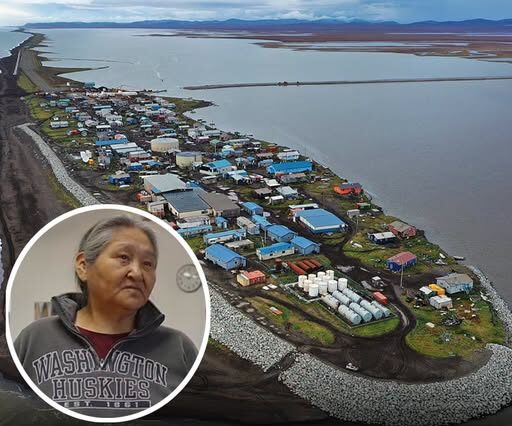
For generations, families in Kivalina have made their homes on a narrow barrier island between Kivalina Lagoon and the Chukchi Sea. Now, continuing coastal erosion and rising sea levels are placing the community’s future in doubt.
The village has spent years trying to protect the land beneath its homes and infrastructure. Although protective construction has improved safety, residents still face the possibility that remaining on the island will eventually become untenable.
Approximately 400 people were believed to live in Kivalina in 2020. At that time, estimates associated with agencies including the U.S. Army Corps of Engineers identified 2025 as a potential point at which the island could reach a critical level of uninhabitability.
That projected date has passed, but it should not be confused with confirmation that the entire village has already become uninhabitable. Residents remain there, navigating the gap between longstanding warnings and the practical realities of moving a community.
For those who have lived in Kivalina throughout their lives, relocation involves far more than selecting another place on a map. It means considering the future of a home shaped by generations of family experience while evaluating whether its coastline can continue to offer enough protection.
A Lifelong Resident Remembers the Early Warning Signs
Janet, a lifelong Kivalina resident, remembers coastal erosion becoming a more urgent concern decades ago. Her account places one important turning point in 1989, when efforts to reinforce the banks proved inadequate.
“1989 was the time when things started getting a little more intense with erosion. That was the first time they did sandbags, placing them by the banks. They just washed away, you know?”
The failure of those sandbags made the danger difficult to dismiss. A measure intended to hold back the water disappeared, leaving residents confronting the limits of what they could do at the shoreline.
“And there was nothing they could do. And that’s when we realized that we have a problem.”
Her recollection shows how long the community has been living with uncertainty. The present discussion about leaving the island follows years of watching protective efforts, enduring storms, and assessing what remained afterward.
For Janet, the earlier warning about 2025 now carries particular weight. Speaking about the village’s situation in 2026, she described relocation as something the community could no longer put aside.
“The Corps of Engineers gave us till 2025 to move out of here. They were pretty accurate. It’s 2026. Obviously, we got to move out of here.”
Storms Have Removed Substantial Sections of Shoreline
Kivalina’s position leaves it exposed to the forces acting on a narrow strip of coastal land. For years, thick winter sea ice helped provide a natural barrier between the settlement and the powerful ocean.
Increasingly damaging storms have placed that protection under pressure. Along vulnerable stretches of the coast, the consequences have included substantial losses of land and continuing threats to buildings and essential infrastructure.
One storm in 2004 demonstrated how quickly the shoreline could change. More than 12 meters of land disappeared along parts of the village’s coastline during that single event.
That figure describes losses in particular areas, rather than a uniform retreat around the whole island. Even so, it illustrates why individual storms have become central to residents’ concerns about the future.
The danger did not end after that storm. Further storms in subsequent years continued to threaten the community, adding to the difficulty of deciding how much protection could be achieved while residents remained in place.
Each protective measure must be considered against that history. Improving conditions in the present does not automatically resolve the longer-term question of whether a narrow, eroding island can remain a dependable home.
For Kivalina’s residents, the issue is therefore both immediate and ongoing. They must live with current conditions while considering warnings about what further coastal losses could mean.
Higher Ground Brings Its Own Concerns
Although moving away from the exposed island may appear to offer a straightforward answer, residents have concerns about the land available elsewhere. Higher ground comes with conditions that would affect everyday life.
Janet’s brother, Reppi, expressed reluctance to leave. His response also drew attention to mosquitoes in the area where residents could potentially relocate.
“Yeah, we’re staying… They’ll find out how much mosquitos is up there,” he said.
He also described the ground near the school as marshy. That observation highlights a practical concern about the character of the potential relocation area, beyond its elevation.
“It’s really marshy land up right where the school is.”
The siblings’ comments reveal different responses to the same threat. Janet spoke of moving as an increasingly unavoidable step, while Reppi emphasized reasons to remain and difficulties associated with an alternative location.
Those perspectives do not establish what the whole community will ultimately decide. They do show why relocation cannot be understood solely as a response to a projected date or a measurement of lost shoreline.
Residents must consider the conditions of the place they might move to alongside the dangers facing the place they know. The available account does not establish a final community-wide relocation timetable.
A Seawall and Mainland Connection Have Improved Safety
Kivalina has not faced these challenges without changes to its infrastructure. A massive rock seawall has been constructed to help protect the community from coastal forces.
A road and bridge completed in 2020 also connected the village to the mainland. Together, these developments have made Kivalina safer for now, even as the broader threat remains unresolved.
The distinction between improved safety and a permanent solution is important. Protective construction can address aspects of the village’s exposure without establishing that erosion will cease or that relocation will never be necessary.
The mainland connection is also a significant change in a community whose future has long been discussed in terms of its island location. However, the existence of a road and bridge does not itself settle where residents should eventually live.
These improvements form part of Kivalina’s response rather than the conclusion of its story. Residents continue to weigh the protection now available against the history of damaging storms and warnings about the island’s future.
Daily Life Continues Alongside an Unresolved Threat
A recent three-day visit by Thomas and Stefan brought renewed attention to life in Kivalina. Their conversations with residents illustrated how the possibility of losing a home exists alongside the routines of continuing to live there.
Janet’s memories of failed sandbags and Reppi’s concerns about higher ground offer a more personal view of an issue often described through dates and coastal measurements. Both are speaking about places that shape their daily lives.
The village’s situation remains uncertain. The earlier 2025 projection has passed, protective infrastructure is in place, and residents are still confronting the possibility of relocation.
For Kivalina, the unresolved question is whether those protections can provide enough security while a longer-term future is considered. Behind that question are families deciding what it will mean to preserve their community as the land around it continues to change.