
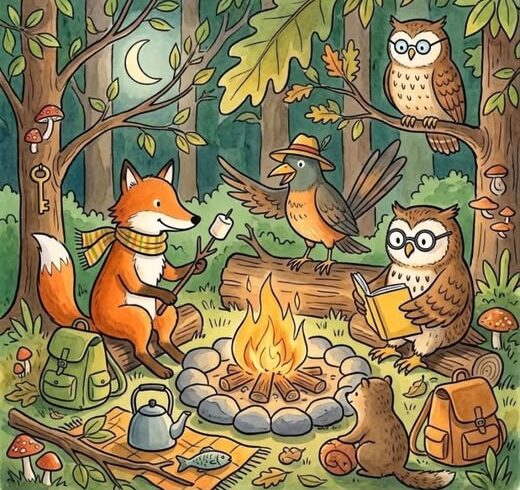
Can You Find the Key, Crescent Moon, and Fish Hidden in This Woodland Scene?
A Campfire Illustration Conceals Three Objects
A colorful woodland puzzle is drawing attention online with a challenge that sounds straightforward: find three objects concealed within a busy animal scene. The targets are a key, a crescent moon, and a fish.
The illustration depicts woodland animals gathered around a campfire. A fox, two owls, a bird, and a small squirrel fill the scene, giving viewers several characters and details to examine before the hidden-object search even begins.
At first glance, the picture appears to be an ordinary camping illustration. Its puzzle lies in the smaller shapes worked into the composition, where the three objects can be overlooked among the surrounding details.
The task requires viewers to look beyond the main subjects and examine how individual shapes fit together. Recognizing the animals is immediate; separating the concealed objects from the rest of the artwork takes more deliberate attention.
The Fish Presents the Greater Challenge
The key and crescent moon may be easier for some viewers to recognize. Finding the fish, however, calls for a closer examination of the illustration.
That difference gives the puzzle much of its appeal. Discovering one or two targets creates a sense of progress, while the remaining object encourages another careful look.
Viewers have been examining different corners of the scene, trying to locate all three without overlooking a small detail. The challenge is complete only when each target has been identified.
No precise locations or answer are provided here. The description establishes what to search for, but it does not reveal where the illustrator concealed the objects.
The Dementia Claim Is Not a Medical Conclusion
The illustration also carries a headline suggesting that finding the objects means a viewer has no risk of dementia. That claim should not be treated as a valid health assessment.
A hidden-object puzzle cannot diagnose dementia or rule it out. Successfully finding the key, crescent moon, and fish does not establish that someone is free of the condition.
Likewise, difficulty locating an object does not establish that a viewer has dementia. Performance on this particular illustration is not a medical finding.
The distinction matters because the puzzle’s entertainment value is separate from the health claim attached to it. The scene can provide an enjoyable observation challenge without supporting conclusions about a person’s medical status.
A Test of Observation Within One Illustration
Searching for concealed objects involves paying attention to visual details and recognizing familiar shapes within a larger composition. In this scene, the animals and campfire provide the setting, while the key, moon, and fish provide the task.
The satisfaction comes from noticing something that initially blended into the picture. An object that seemed absent can become recognizable after another look at the same details.
Some viewers may identify every target quickly, while others may spend longer searching for the final one. Neither outcome changes the limits of the activity: it is a visual puzzle, rather than a measure of overall cognitive health.
With that distinction clear, the woodland scene offers a simple challenge for anyone who enjoys searching an illustration for concealed shapes. Its reward is finding all three objects and understanding how they were hidden in plain sight.