
Rescue Dog Kept Escaping His New Home—Then His Owner Followed Him and Discovered the Heartbreaking Reason
Claire thought Bear was trying to leave her, but the 110-pound rescue dog was actually searching for someone he had never stopped loving
Bear had been living with Claire Donovan for only twenty-three days when she finally admitted something she did not want to believe.
Maybe adopting him had been a mistake.
The seven-year-old Pyrenees mix was enormous, weighing roughly 110 pounds, with a thick white coat, gray markings around his ears and the calm expression of a dog who seemed to spend most of his time quietly thinking.
Claire had first seen him at a county shelter outside Columbus, Ohio.
While younger dogs jumped against kennel doors and barked for attention, Bear sat quietly toward the back.
Something about that stillness drew her toward him.
Bear seemed almost perfect when he first came home
The shelter staff told Claire that Bear was gentle, house-trained and affectionate once he trusted someone.
Claire had recently lost her elderly Labrador and believed an older rescue might be exactly what she needed.
She signed the adoption papers, loaded Bear into her SUV and drove home hopeful that the hardest part was already behind them.
During the first few days, everything seemed surprisingly easy.
Bear followed Claire quietly from room to room.
When she cooked, he rested nearby.
When she watched television, he stretched across the carpet.
At night, he slept close to her bedroom door.
Then Bear disappeared
On the fifth day, Claire came home from work and discovered that the backyard gate was open.
Bear was gone.
She immediately contacted the shelter, searched the neighborhood and notified animal control.
Nearly three hours later, someone spotted a huge white dog near a closed grocery store more than four miles from Claire’s house.
When she arrived, Bear was sitting quietly beneath a tree.
He looked tired and dirty.
But the moment he saw Claire, he walked toward her and lowered his head.
She hugged him, took him home and repaired the gate.
Two days later, he escaped again
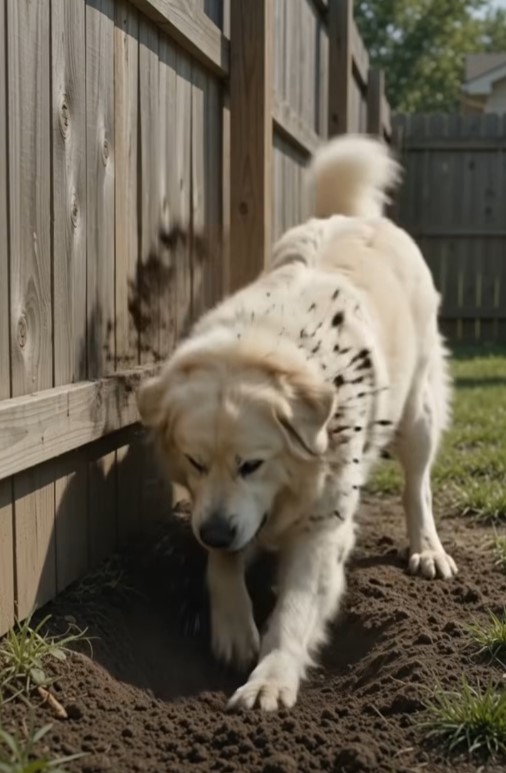
This time, Bear had dug underneath the fence.
The hole was so large that Claire stared at it in disbelief.
She reinforced the bottom of the fence with boards.
She installed another latch.
She bought a motion sensor and set up a camera.
She even asked her neighbor, Derek Malone, to check the yard while she was at work.
None of it solved the problem.
Animal control noticed something unusual
Bear escaped again and was eventually found almost six miles away.
He was muddy and limping slightly.
The animal control officer returning him made an observation Claire did not fully understand at the time.
Bear seemed to be traveling in the same general direction each time he disappeared.
“Maybe he’s trying to find something,” the officer suggested.
Claire laughed nervously.
She had no idea what Bear could possibly be searching for.
His escapes were too deliberate to look accidental
As the days passed, Claire studied the security footage.
Bear was not simply wandering through an open gate.
He seemed to plan his escapes.
Sometimes he dug beneath the fence.
Sometimes he pushed against weak points.
On one recording, Claire watched him slowly work his nose against the gate latch until it shifted enough for him to squeeze through.
He was calm and methodical.
That worried her more than frantic behavior would have.
Claire began believing Bear simply did not want her
One evening, after another exhausting search, Claire sat at her kitchen table with her younger brother, Evan Donovan.
Bear was lying peacefully near the fireplace.
Claire looked at the dog and admitted she could not continue living this way.
Evan suggested that perhaps Bear was unhappy.
The thought hurt.
Claire had tried everything she could think of.
She had bought him good food, a new bed, toys, blankets and a harness.
She had given him patience and space.
Yet almost every opportunity Bear received, he seemed determined to leave.
She decided to return him to the shelter
By the third week, Claire felt defeated.
She called the shelter and explained what had been happening.
The worker was understanding.
Older rescue dogs sometimes needed time, but repeated escapes also created a serious safety risk.
Claire decided she would keep Bear through the weekend and return him Monday morning.
The decision made her feel guilty.
It also brought a small amount of relief.
Perhaps another family would understand Bear better.
Saturday morning changed everything
Claire woke before sunrise to the sound of heavy footsteps in the hallway.
Bear was pacing.
He stopped beside the back door and scratched once.
Claire assumed he needed to go outside.
She opened the door.
But instead of immediately running into the yard, Bear stepped onto the porch and looked back at her.
That small glance made Claire hesitate.
She grabbed her coat.
For once, she decided not to stop him.
She would follow.
Bear seemed to know exactly where he was going
He moved through the neighborhood with his nose low and his pace steady.
Claire followed behind.
Bear did not wander toward other houses.
He did not chase animals.
He barely paused.
He crossed familiar streets and continued toward the outskirts of town.
The farther they traveled, the more certain Claire became that this was not random behavior.
Bear had a destination.
The journey continued for nearly an hour
Claire followed him across a busy highway and through a narrow section of woodland.
She climbed over a fallen tree and nearly lost sight of him twice.
Bear continued without hesitation.
Eventually, he reached an old rusted fence partly hidden behind trees.
Beyond it was a small cemetery Claire had never noticed before.
The grounds looked nearly abandoned.
Tall weeds surrounded many of the graves.
Several headstones had tilted or fallen.
The entrance gate hung crookedly from one hinge.
Bear walked directly to one grave
He slipped through an opening in the fence.
Claire followed.
Bear passed grave after grave without slowing.
Then, near the far corner of the cemetery, he stopped.
He lowered his head.
And lay down.
Claire approached slowly.
Bear had settled directly in front of a weathered headstone.
He looked calmer than she had seen him since bringing him home.
The name on the stone was Harold Bennett
Claire read the inscription.
Harold Bennett.
The dates indicated that he had died almost eighteen months earlier.
Claire looked at the headstone.
Then she looked at Bear.
Suddenly, the problem that had consumed her for three weeks looked completely different.
Bear had not been running without a reason.
He had been trying to reach this exact place.
Claire began searching for Harold’s name
She took out her phone and looked for information about Harold Bennett.
An older local article eventually appeared.
Harold had been seventy-one years old.
He had worked as a maintenance supervisor at a local manufacturing plant before retiring.
He lived alone outside town and had volunteered with a rural animal rescue organization.
Then Claire saw the photograph attached to the article.
Her breath caught.
Standing beside Harold was Bear.
There was no possibility she had mistaken the dog
The photograph showed the same huge white body.
The same gray markings.
The same distinctive dark patch near Bear’s left ear.
He looked younger and heavier in the picture.
Harold had one arm wrapped around his neck.
Claire stared at the image and felt tears beginning to form.
Bear had already had a person.
And he had loved him deeply.
More photographs revealed how close they had been
Claire continued searching.
She found old community posts showing Harold walking Bear.
Another photograph showed the dog lying beside him on a porch.
Former neighbors described the two as inseparable.
People remembered seeing Harold and Bear walking together almost every morning.
The relationship had clearly been far more than that of an owner and pet.
They had been companions.
The cemetery was not a random place either
Claire discovered that Harold’s wife had been buried there years earlier.
A former neighbor named Marjorie Ellis remembered Harold taking Bear along when he visited his wife’s grave.
As Harold grew older and became ill, the visits became less frequent.
But Bear still accompanied him when he could.
The route Bear had been following was one he already knew.
He had traveled it many times with Harold.
Everything suddenly made sense
Animal control had repeatedly found Bear traveling in roughly the same direction.
He had not been exploring.
He had been retracing a familiar path.
Claire had spent weeks believing he was rejecting her home.
In reality, Bear was searching for the person who had once represented home to him.
Harold’s house was no longer part of his life.
Harold himself was gone.
But the cemetery remained.
Claire sat beside him and apologized
She lowered herself into the grass.
“I’m sorry,” she whispered.
Bear slowly moved closer.
His enormous head came to rest against her leg.
Claire wrapped an arm around his neck.
For a long time, neither moved.
For the first time, Claire understood that she had not adopted a difficult dog.
She had adopted a grieving one.
The shelter had never known about Harold
Later that day, Claire called the county shelter.
She explained what she had discovered.
Bear had belonged to Harold Bennett.
His repeated escapes had been attempts to reach Harold’s grave.
The shelter worker fell quiet.
They had not known anything about that part of Bear’s history.
Claire admitted that she had not understood either.
Her plans for Monday immediately changed
Claire had intended to return Bear to the shelter.
She no longer could.
Nothing about his behavior meant he did not want her.
Bear was trying to understand a loss he could not explain.
Claire drove home that evening with him lying quietly in the back seat.
For the first time, she did not feel frustrated.
She felt heartbroken for him.
A trainer gave Claire a different way to understand Bear
Claire contacted Mason Carter, a professional trainer experienced with rescue dogs.
She described the escapes and what she had discovered at the cemetery.
After observing Bear, Mason gave her a simple explanation.
He did not believe Bear was a bad dog.
He believed Bear was grieving.
The repeated attempts to return to the cemetery may have been Bear’s way of reaching the last place strongly associated with Harold.
Mason told Claire not to erase Bear’s old bond
Claire asked what she should do.
Mason’s advice changed the way she thought about the entire adoption.
“Don’t erase the old bond,” he told her. “Build a new one.”
Claire had been approaching Bear’s history as though she needed to replace whatever came before her.
She now understood that replacement was neither necessary nor possible.
Harold would always be part of Bear’s life.
Claire could become part of what came next.
The following Saturday, Bear did not need to escape
Claire placed his harness on him herself.
She opened the door.
Bear stepped outside.
Then he stopped and looked back.
Claire smiled.
“Go ahead. I’ll come with you.”
Together, they followed the familiar route toward the cemetery.
This time, Bear did not need to dig under a fence or manipulate a gate.
Claire was walking beside him.
Bear returned to Harold’s grave with Claire
He moved directly toward the weathered headstone.
Claire sat down beside him.
For nearly an hour, Bear remained there.
Then something changed.
He lifted his head and looked at Claire.
He stood.
Then he walked toward her and pressed his enormous head against her chest.
Claire closed her eyes and held him.
Bear was not being asked to choose
That moment helped Claire understand what Bear needed.
He did not have to choose between Harold and her.
Caring about Claire did not mean forgetting his former owner.
Accepting a new home did not erase the old one.
Bear could carry both relationships.
Claire simply had to allow him to grieve in his own way.
The cemetery visits became part of their routine
Every Saturday, Claire and Bear returned to Harold’s grave.
Sometimes they walked the entire distance.
During difficult weather, Claire drove closer and walked the final stretch with him.
Bear always recognized the route.
As soon as the tree line appeared, he became alert.
When the cemetery came into view, his tail moved gently.
Slowly, Bear began spending less time at the grave
At first, he stayed beside Harold’s headstone for nearly two hours.
Later, it became an hour.
Then forty minutes.
Eventually, Bear sometimes remained there for only twenty minutes before standing and returning to Claire.
It was as though he was gradually learning that remembering Harold did not require endlessly searching for him.
The escapes stopped
At home, the change was remarkable.
Bear stopped digging beneath the fence.
He stopped testing the gate.
He no longer paced anxiously whenever Claire prepared to leave for work.
Instead, he began waiting near the window for her return.
The dog who had seemed determined to leave was finally beginning to settle.
Bear started behaving like a dog who felt safe
He discovered toys.
He developed a habit of stealing socks from the laundry basket.
At night, he began sleeping on the rug beside Claire’s bed instead of positioning himself close to an exit.
One afternoon, Claire came home and found the enormous dog stretched across her sofa.
She reminded him that he was not supposed to be there.
Bear looked at her without moving.
Claire laughed and surrendered.
His tail began thumping against the cushions.
Claire eventually met someone who had known Harold
Months later, she contacted several of Harold’s former neighbors.
Marjorie Ellis agreed to visit.
The moment Marjorie saw Bear, she began crying.
Bear approached her.
She knelt and placed both hands around his face.
She remembered Harold talking about the dog constantly.
According to Marjorie, Harold had never thought of Bear as simply a pet.
Bear was family.
One sentence stayed with Claire
Claire told Marjorie that Bear was still family.
Marjorie nodded.
“Then Harold would be happy.”
Claire carried those words with her.
They reinforced something she had already begun to understand.
Her role was not to compete with a dead man for Bear’s affection.
She only needed to provide a safe place for the next part of Bear’s life.
A year later, Bear seemed transformed
His coat looked healthier.
His eyes appeared brighter.
He had become more confident.
Most importantly, he trusted Claire.
The dog who once escaped almost every opportunity he received had stopped running away entirely.
There was no longer a reason to.
Claire now understood where he wanted to go and why.
One evening, Claire admitted how close she had come to losing him
She sat on the porch with Bear beside her as the evening sky turned orange.
Claire scratched his neck.
She told him something he could not possibly answer.
She had almost returned him.
She had believed he did not want her.
Bear leaned against her.
Claire realized how wrong she had been.
He had never been running away from her.
He had been trying to find Harold.
“Every Saturday” became their quiet promise
Claire continued taking Bear to the cemetery.
Sometimes she brought flowers.
Sometimes she brought a blanket so Bear could lie comfortably beside the grave.
Sometimes they simply sat quietly.
Over time, another small change appeared.
Bear would approach Harold’s headstone, sniff the grass and lie down.
After a few minutes, he would stand.
Then he would turn toward Claire.
It looked almost like a signal.
He was ready to go home.
Claire learned that grief did not need to be corrected
She had originally treated Bear’s behavior as a problem that needed solving.
But Bear had not needed punishment, stronger fences or a different family.
He needed someone willing to understand what his behavior meant.
Once Claire stopped fighting the memory of Harold and began making room for it, Bear no longer needed to fight his way out of her yard.
The story was never really about an escape artist
Bear had seemed like an unusually determined runaway.
He dug tunnels.
He manipulated gates.
He traveled miles.
But those actions were only the visible part of something deeper.
He remembered a person.
He remembered a route.
And he remembered a place connected to years of ordinary life with someone he trusted.
Bear carried a bond Claire could not see
Humans often understand grief through words, photographs and stories.
Bear had none of those things.
He had familiar scents, remembered paths and routines.
The route to the cemetery may have been one of the strongest remaining connections to Harold.
So whenever Bear found an opportunity, he followed it.
Claire interpreted that behavior as rejection because she did not yet know the history behind it.
Understanding changed everything
Once Claire knew about Harold, her relationship with Bear transformed.
The dog himself had not suddenly become different.
Her interpretation of him had.
What once looked like stubbornness became loyalty.
What looked like escape became searching.
What looked like rejection became grief.
That understanding gave Claire the patience to respond differently.
Bear did not need to forget Harold to love Claire
That became the central lesson of their life together.
New love does not necessarily erase old love.
A new home does not require pretending an earlier home never existed.
Bear could remember Harold while trusting Claire.
He could visit one place and return willingly to another.
The two relationships did not have to compete.
Years later, the Saturday routine continued
Bear grew older.
His muzzle became whiter.
He slept more often and walked more slowly.
But every Saturday morning, when Claire reached for his harness, his ears still lifted.
He knew where they were going.
Together, they made the familiar journey.
Sometimes Claire talked about her week.
Sometimes she spoke about Harold.
Sometimes neither of them needed sound at all.
The old headstone remained part of Bear’s idea of home
When they reached the cemetery, Bear walked toward Harold Bennett’s grave.
He paused.
He lowered his head.
Then he rested beside the weathered stone.
Claire sat nearby.
After a few quiet minutes, Bear eventually stood.
He turned toward her.
And they walked away together.
The dog who once escaped every chance he got no longer needed to run
Harold remained part of Bear’s memory.
Claire remained beside him in the present.
Neither relationship canceled the other.
Bear’s story became a reminder that loyalty does not always mean refusing to move forward.
Sometimes loyalty means carrying the memory of someone lost while still allowing life to continue.
Claire almost returned Bear because she misunderstood what he was asking for
She believed he was saying he did not want her home.
In reality, he was asking for help reaching a place she did not yet know existed.
Once she followed him, she finally heard what his repeated escapes had been communicating all along.
Bear had not been searching for another owner.
He had not been searching for freedom.
He had been searching for Harold.
And once Claire understood, Bear finally chose to stay
She did not erase his past.
She walked into it with him.
She sat beside him while he remembered.
She allowed him to grieve without demanding that he forget.
Eventually, Bear stopped trying to escape.
Not because Harold mattered any less.
But because Claire had shown him that remembering one home did not mean he could never belong to another.
Every Saturday, Bear still returns to the old cemetery.
Every Saturday, Claire waits beside him.
And when he is ready, the enormous white dog stands, turns toward the woman who finally understood him, and walks home.