
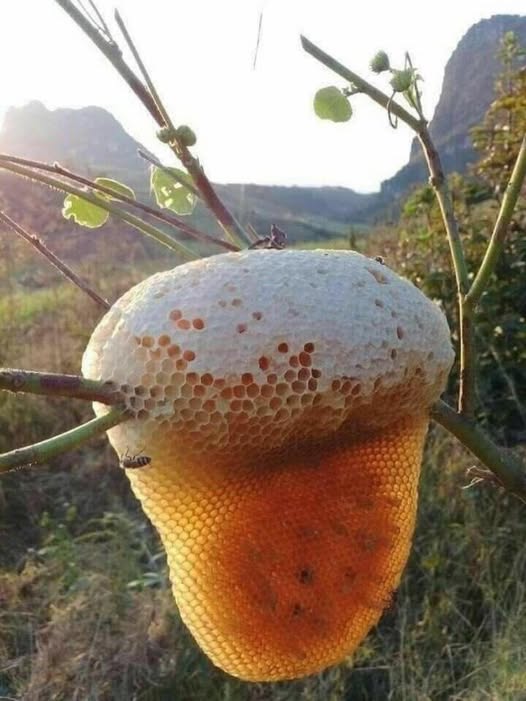
This Strange Object Hanging Between Tree Branches Is Completely Natural—And Bees Built Every Inch of It
What may look artificial at first glance is actually an exposed wild honeybee comb, created from beeswax with an extraordinary repeating hexagonal structure
At first glance, the unusual object hanging between the branches can be difficult to identify.
Its surface is covered with hundreds of perfectly arranged shapes.
The structure looks so precise that it could easily be mistaken for something manufactured by people.
But there is nothing artificial about it.
It is a wild honeybee comb.
The entire structure is made from beeswax
Honeybees build the comb themselves.
The surface is divided into the familiar repeating hexagonal cells associated with honeybee colonies.
Those cells are not merely decorative.
They form the working structure of the colony.
Bees use them for storing important resources and supporting the development of the next generation.
The cells can serve several purposes
Some cells are used to store honey.
Others may contain pollen.
Cells are also used for developing young bees.
That means a honeycomb is much more than a place where honey is kept.
It is an organized structure that supports many of the colony’s basic needs.
Different colors can reveal different areas of the comb
In this example, part of the comb has a darker golden appearance.
That section contains filled cells.
Near the upper portion, another area appears much lighter and almost whitish.
That pale section appears to contain capped comb.
The contrast makes the structure look even more unusual when viewed from a distance.
Capped cells have a noticeably different appearance
Instead of seeing the open hexagonal pattern clearly, capped areas have their openings covered.
This creates a smoother and lighter-looking surface.
Beside darker sections of exposed or filled cells, the difference can be striking.
Someone unfamiliar with natural honeycomb could easily assume that the sections were made from different materials.
Most people are more familiar with boxed beehives
When people imagine honeybees, they often picture wooden hive boxes maintained by beekeepers.
Inside those boxes, bees construct comb on frames or other protected surfaces.
That familiar image can make an exposed comb hanging outdoors seem particularly surprising.
Wild bees do not always live inside the type of hive people commonly recognize.
Wild honeybees can construct exposed comb
Depending on the location available to them, bees can build directly on natural or sheltered surfaces.
Branches can provide support.
Cliffs and other protected locations can also offer places for colonies to establish comb.
The result may hang openly rather than being enclosed inside a wooden hive.
That is what gives structures like this such a dramatic appearance.
The repeating pattern is created entirely by the bees
Perhaps the most remarkable feature is the geometry.
Each section is made from closely packed hexagonal cells.
The pattern repeats again and again across the surface.
No human measures the cells.
No machine stamps them into place.
The bees create the entire structure themselves.
The precision can make the comb look manufactured
Human-made objects with repeated geometric patterns usually require careful planning and tools.
Seeing the same degree of order hanging naturally from a branch can therefore be surprising.
The cells fit tightly against one another.
There are few wasted spaces between them.
The result is both practical and visually impressive.
The hexagonal shape helps make the structure efficient
The cells sit side by side in a highly organized arrangement.
The repeating form allows the bees to create a large number of compartments within one continuous sheet of comb.
Each compartment can then be used for the colony’s needs.
This efficient use of space is one reason honeycomb is often highlighted as an extraordinary example of natural construction.
A honeycomb is also a working storage system
The beauty of the pattern can make it easy to forget its practical purpose.
For bees, these cells are functional spaces.
Honey can be stored inside them.
Pollen can be placed inside them.
Young bees can develop inside them.
Every part of the structure contributes to the life of the colony.
The darker golden areas are especially recognizable
The deeper golden section gives the comb the familiar color many people associate with honey and beeswax.
Combined with the darker contents of filled cells, it creates a rich pattern across the structure.
Those tones contrast sharply with the lighter capped area near the top.
This natural variation makes the entire comb appear almost layered.
The pale portion can initially look like a different substance
When cells become capped, their appearance changes.
The light surface may look white or cream-colored compared with the surrounding golden comb.
From a distance, a viewer may wonder whether something unusual has been attached to the hive.
Instead, it is simply another part of the bees’ construction.
The location makes the sight even more surprising
A honeycomb inside a beekeeper’s hive is expected.
A large geometric structure hanging openly between branches feels very different.
There is no wooden box around it.
No manufactured frame is immediately visible.
The comb appears almost suspended in the landscape.
That can make it look mysterious until its identity becomes clear.
The bees need no architectural blueprint
Nothing about the structure requires human direction.
The colony collectively produces the wax and constructs the cells.
Slowly, the repeated pattern grows into a larger organized comb.
What eventually looks like one object is actually the result of countless individual building actions.
Every small cell becomes part of something much larger
One hexagonal compartment would not look especially dramatic on its own.
But hundreds of them placed tightly together create an impressive structure.
The effect is similar to looking at a mosaic.
Individual pieces combine into a single recognizable form.
For the bees, however, every one of those pieces also has a practical role.
Exposed combs reveal something people rarely get to see
Wooden hive boxes can hide much of the colony’s architecture from casual observers.
An exposed wild comb presents that architecture directly.
The geometry is visible from the outside.
The changing colors can be seen.
The scale of the construction becomes immediately apparent.
It is easy to understand why the image attracts attention
The first reaction may simply be confusion.
What is hanging from the tree?
Is it artificial?
Was it placed there by someone?
Then the repeating honeycomb pattern provides the clue.
The mysterious object is a natural structure built by insects.
Its appearance demonstrates how organized a bee colony can be
A colony contains many individual bees, yet their combined activity can produce a remarkably ordered result.
The comb is not random.
Cells follow the same basic shape over and over.
Different portions become dedicated to different needs.
Storage and development take place inside one continuous structure.
Beeswax becomes the foundation of the colony
The bees use wax to create the walls separating individual cells.
As more cells are added, the comb expands.
That means the material supporting honey, pollen and developing young originates from the bees themselves.
The colony effectively builds the structure it needs to survive.
The comb can change as the colony uses it
Not every section looks identical at every moment.
Some cells may be open.
Others may be filled.
Some may be capped.
These differences give different portions of the comb their distinctive colors and textures.
The structure is therefore both architecture and an active working environment.
What looks decorative is actually highly practical
The hexagonal pattern has become so visually familiar that honeycomb designs are often used decoratively.
But in nature, the original structure exists for practical reasons.
The repeating cells provide numerous small compartments within a compact area.
The result supports the colony while also creating one of nature’s most recognizable geometric patterns.
The branch itself becomes part of the support system
When bees construct exposed comb, they need a place from which the structure can hang or attach.
A strong branch can provide that support.
From there, the wax comb can extend downward.
The result may look delicate, but it has been deliberately constructed around the location available to the colony.
Wild bees make use of the environments they find
They are not limited to human-made hive boxes.
Natural landscapes offer other possibilities.
A sheltered branch may work.
A protected cliff surface may work.
Other locations capable of supporting and sheltering the colony can also become building sites.
The structure is a reminder that hives do not all look alike
The wooden boxes associated with beekeeping represent only one way humans commonly encounter honeybee colonies.
Wild colonies can look very different.
Sometimes their architecture is hidden.
Sometimes, as with an exposed comb, nearly the entire structure is visible.
The geometry remains the most captivating feature
Look closely and the apparent mystery disappears.
The surface is filled with repeating six-sided cells.
The consistency is extraordinary.
Each small compartment joins perfectly with those around it.
Together they create a pattern that looks almost engineered.
Yet the engineers are the bees themselves
There is no external construction crew.
No measuring equipment.
No mold shaping the entire structure at once.
The colony gradually creates the comb through its own activity.
The finished result is a natural example of remarkable organization.
The structure serves both present and future generations
Some cells hold resources the colony can use.
Others provide space where young bees develop.
In this way, the same architecture helps sustain both the existing colony and its future members.
The honeycomb is therefore closely connected to the continuing life of the group.
It is more than simply a container for honey
Honey is the feature people most often associate with combs.
But viewing the structure only as honey storage misses much of its importance.
Pollen can also be stored there.
Developing young occupy cells as well.
The comb functions as a multipurpose center of colony activity.
That makes the exposed structure even more extraordinary
What appears to be a strange golden object hanging between branches is effectively an essential part of an entire living community.
The cells contain resources.
They support development.
They demonstrate organized construction.
And every visible section was produced by the insects living around it.
Nature often hides extraordinary engineering in plain sight
A person could walk past the comb and see only an unusual shape.
Closer inspection reveals an intricate arrangement of wax cells.
The more closely the pattern is examined, the more remarkable it becomes.
Something that initially looks artificial turns out to be completely natural.
The perfect pattern requires no human intervention
This is what makes wild honeycomb so captivating.
The shapes are not decorative additions.
They are the actual building blocks of the hive.
Bees repeat the same basic design until a large, efficient structure emerges.
A strange object in a tree becomes a lesson in natural construction
At first glance, the hanging comb may raise more questions than answers.
Once identified, however, it becomes an extraordinary window into the way honeybees live.
The darker golden cells, the pale capped area and the repeating hexagons all have a place within the same structure.
The bees built every visible cell themselves
No artist carved the pattern.
No person assembled the sections.
No machine created the symmetry.
What looks almost impossibly precise is the result of ordinary honeybee behavior repeated across the colony.
That is what makes the sight so impressive
The object is not mysterious technology.
It is not an unusual piece of art.
It is not something someone hung from the branches.
It is a functioning wild honeybee comb.
And its beautifully repeating pattern is one of nature’s clearest examples of how something practical can also be extraordinarily elegant.