
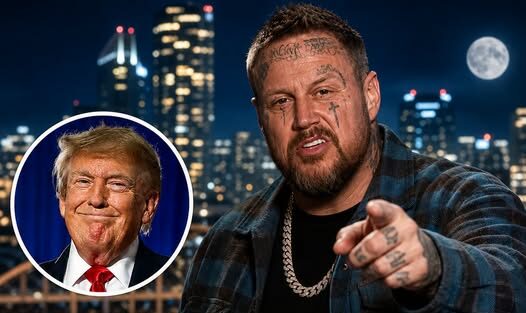
Jelly Roll’s Donald Trump Jokes Spark Backlash Before He Pivots to an Emotional Dolly Parton Tribute
A Late-Night Appearance Quickly Became More Than Entertainment
Jelly Roll’s guest-hosting appearance on Jimmy Kimmel Live! was never going to feel like an ordinary television monologue.
The country star is known for speaking openly and rarely presenting himself as someone interested in carefully polished opinions.
That approach became especially clear when he began directing jokes toward Donald Trump.
What started as a comedy segment quickly turned into a much larger argument about politics, celebrity, free expression, and how audiences respond when entertainers criticize public figures they support.
Some viewers celebrated the jokes.
Others reacted angrily.
Jelly Roll did not appear interested in retreating once the controversy began.
His Trump Jokes Immediately Divided the Audience
The monologue included several pointed references to Trump.
Among them were jokes about Trump’s weight, comments connected to his “own race” remark, and mockery of what was described as a “lap of honor” motorcade.
The humor was not designed to stay safely in the middle.
It was deliberately direct.
That ensured the segment would attract attention well beyond the television audience watching in real time.
Almost immediately, the performance became political content shared, discussed, defended, and criticized online.
The Reaction Was About More Than One Joke
The controversy quickly moved beyond whether a particular line was funny.
For supporters of Trump, some of the jokes were viewed as unnecessarily hostile.
For critics of Trump, the same material was treated as a comedian or entertainer doing what late-night hosts have traditionally done: making powerful political figures the subject of jokes.
Jelly Roll found himself at the center of that familiar cultural argument.
How much criticism should public figures be expected to absorb?
And how much political expression should fans expect from musicians they may have originally followed for reasons having nothing to do with politics?
Jelly Roll Did Not Try to Calm the Backlash
Some celebrities respond to controversy by clarifying their words or emphasizing that they never intended to offend anyone.
Jelly Roll took a different approach.
Rather than softening his position, he defended the idea that political leaders should be able to withstand jokes.
He did not present presidential status as protection from comedy.
His response suggested the opposite.
The more powerful the person, the more reasonable it is for that person to become a target of public humor.
He Told Offended Fans They Had a Choice
The strongest part of his response was directed not at Trump himself but at listeners who objected to hearing Jelly Roll express political opinions.
Instead of promising to keep politics separate from his public persona, he indicated that fans unhappy with his views were free to stop listening.
It was an unusually direct response for an artist whose audience may include people with dramatically different political beliefs.
There was little attempt to preserve universal approval.
That refusal to retreat became almost as controversial as the original jokes.
The Moment Raised Questions About Celebrity and Politics
Musicians often develop relationships with audiences that feel deeply personal.
Listeners connect songs with marriages, heartbreaks, family memories, long drives, difficult periods, and major life changes.
Because of that connection, political disagreements can feel more emotional when they come from an artist someone has followed for years.
A fan may love the music while strongly disagreeing with the performer’s political views.
Jelly Roll’s appearance placed that tension directly in front of his audience.
He Made It Clear He Was Not Seeking a Neutral Position
There was no effort to frame the jokes as completely detached from his own perspective.
Jelly Roll leaned into the material.
He mocked.
He criticized.
And when the response became heated, he did not suddenly pretend the segment had been misunderstood.
Whether viewers admired or disliked that approach, the position itself was clear.
The Debate Became a Test of How Much Humor Political Leaders Should Tolerate
The episode also raised a broader question that has followed political comedy for decades.
Should presidents and other powerful leaders be treated differently from ordinary people when they become the subject of jokes?
Jelly Roll’s response suggested that public office should create greater tolerance for criticism, not less.
To him, jokes were part of the territory.
His critics saw the situation differently, particularly when they believed the humor crossed into personal insult.
Trump’s Weight Became One of the Targets
Among the most attention-grabbing parts of the monologue were jokes aimed at Trump’s physical appearance.
That type of humor often generates its own debate regardless of the political figure involved.
Some audiences treat it as ordinary late-night comedy.
Others view jokes about weight as unnecessary or overly personal.
In this case, the existing political divide made reactions even stronger.
The “Own Race” Comment Also Became Material
Jelly Roll also referenced Trump’s “own race” remark.
Rather than ignoring the comment, he folded it into the monologue as another opportunity for ridicule.
The joke worked because viewers already understood the political context surrounding Trump’s public statements.
For supporters, however, the cumulative effect of multiple jokes made the segment feel more like an attack than a single comedic observation.
The Motorcade Joke Added Another Layer
The “lap of honor” motorcade also became part of Jelly Roll’s material.
Again, the goal appeared to be exaggeration and mockery rather than neutral commentary.
Late-night monologues often rely on that kind of framing.
Public events are compressed into short punch lines designed to generate immediate audience reaction.
Jelly Roll showed that he was willing to use the same approach even though he came from country music rather than traditional political comedy.
His Country Music Background Made the Moment More Surprising to Some Fans
Part of the controversy came from the audience associated with Jelly Roll’s career.
Country music includes listeners across a wide political spectrum, but the genre is often connected in public discussion with more conservative audiences.
For some fans, hearing Jelly Roll deliver sharp Trump jokes therefore felt unexpected.
The reaction demonstrated how easily people can assume that an artist’s political views match those of a particular audience.
Jelly Roll disrupted that assumption.
He Refused to Separate His Personality From His Public Platform
Some entertainers try to maintain a strict boundary between their artistic work and political opinions.
Jelly Roll did not appear interested in that kind of separation during the appearance.
He treated the guest-hosting role as an opportunity to speak in his own voice.
That included humor some longtime listeners may not have wanted to hear.
His response to the backlash suggested he accepted that consequence.
The Controversy Could Have Defined the Entire Night
After the political jokes and the reaction surrounding them, it would have been easy for the appearance to be remembered only as another celebrity political controversy.
But the tone of the program changed sharply.
Jelly Roll moved from mocking Trump to speaking emotionally about Dolly Parton.
The transition revealed a completely different side of him.
The same person who had been confrontational moments earlier became reflective and sentimental.
His Dolly Parton Tribute Changed the Mood
Jelly Roll spoke about Dolly Parton through personal memories rather than political commentary.
He remembered her music being part of his family life.
He described hearing her songs around the kitchen table.
The tribute was not about celebrity statistics or industry achievements.
It was about what her music had represented inside an ordinary home.
That gave the moment an intimacy completely different from the opening political material.
He Called Her “the last American that everyone liked.”
One line from the tribute captured the contrast particularly well.
Jelly Roll referred to Dolly Parton as “the last American that everyone liked.”
The remark carried humor, sadness, and a broader observation about division at the same time.
After spending part of the monologue participating directly in political conflict, he turned toward a figure he viewed as unusually capable of crossing those divisions.
Dolly Parton Represented Common Ground
In Jelly Roll’s telling, Parton represented something increasingly rare.
She was a cultural figure admired by people who might disagree about almost everything else.
Her songs could exist inside homes without requiring agreement about politics.
Her personality could appeal across generations and different parts of the country.
That was what made the tribute especially emotional after such a combative opening.
The Kitchen-Table Memory Made the Tribute Personal
Jelly Roll did not speak about Parton only as another famous musician.
He connected her to childhood and family memory.
Music heard at a kitchen table becomes attached to people, places, smells, conversations, and moments that may have happened decades earlier.
That kind of memory can make an artist feel less like a distant celebrity and more like part of a family’s history.
Jelly Roll’s tribute reflected that kind of connection.
One Monologue Revealed Two Different Sides of Him
The contrast was striking.
During one part of the show, Jelly Roll appeared combative, sarcastic, and completely willing to provoke a political audience.
During another, he was sentimental and openly affected by the memory of an artist whose music had been part of his upbringing.
Those two versions of his personality were not presented as contradictions.
They existed side by side.
He Was Unwilling to Apologize for Either Side
The connecting thread between the political jokes and the Dolly Parton tribute was authenticity.
Jelly Roll did not appear interested in becoming less opinionated to satisfy one audience.
He also did not hide the emotional part of himself to maintain a tougher public image.
He allowed both sides to appear in the same appearance.
That gave the night a broader emotional range than the controversy alone suggested.
The Trump Backlash Showed the Cost of Speaking Freely
When celebrities express strong political opinions, there is almost always a cost.
Some fans leave.
Others become more loyal.
Social media turns individual reactions into larger public battles.
Jelly Roll seemed prepared to accept that reality.
His message to critics was essentially that agreement was not required for anyone to listen to his music.
But neither was he required to hide his opinions simply to preserve their support.
His Response Was Almost More Provocative Than the Jokes
Political comedy can sometimes be dismissed as performance.
The response afterward revealed that Jelly Roll was not interested in creating that distance.
When people challenged him, he did not say the monologue was merely written material that did not reflect him.
He defended the right to make the jokes and challenged listeners who expected silence.
That made the controversy more personal.
The Appearance Became a Debate About Fan Expectations
How much of an artist are fans entitled to control?
Someone may buy albums, attend concerts, stream songs, and emotionally connect with an artist for years.
But that connection does not necessarily mean the performer will share the listener’s politics.
Jelly Roll’s blunt response forced that reality into the open.
The audience could accept the disagreement or walk away.
Late-Night Television Gave Him a Different Kind of Stage
A concert audience expects music.
A late-night monologue creates different expectations.
The format traditionally mixes entertainment, current events, personality, and political humor.
Jelly Roll used that freedom rather than trying to behave like a neutral guest.
For some viewers, that made the appearance entertaining.
For others, it made the show impossible to separate from partisan conflict.
The Country Star Showed He Was Comfortable With Risk
There was an obvious professional risk in criticizing a political figure with a large and devoted following.
Jelly Roll knew some listeners would be angry.
He also knew some might threaten to stop supporting his career.
Yet he continued.
The willingness to accept that reaction became part of the story.
The Dolly Parton Moment Offered a Completely Different Kind of Honesty
If the Trump jokes showed Jelly Roll’s willingness to confront, the Dolly tribute showed his willingness to be emotionally exposed.
Talking about family memories and the music heard around a kitchen table carried none of the aggressive energy of the political material.
It was quiet and personal.
That emotional shift prevented the appearance from becoming entirely defined by anger.
The Two Subjects Reflected a Divided Cultural Moment
Trump represented political division within the monologue.
Parton represented a longing for common ground.
That contrast gave the night a larger meaning.
Jelly Roll first demonstrated how quickly public figures can divide audiences.
Then he remembered someone he believed could still unite them.
His Tribute Suggested He Missed That Kind of Shared Culture
Calling Parton “the last American that everyone liked.” suggested more than admiration for one performer.
It implied nostalgia for a cultural figure capable of existing beyond constant political sorting.
For Jelly Roll, Parton seemed connected to a time when music could be shared at a family table without immediately becoming another political argument.
The Monologue Ultimately Became About More Than Trump
The jokes generated the headlines because political conflict attracts immediate attention.
But the full appearance showed something broader.
It showed Jelly Roll refusing to divide himself into different personalities for different audiences.
He could mock a president.
He could challenge his own fans.
And moments later, he could speak with tenderness about the music that shaped his childhood.
Jelly Roll Made It Clear That Approval Was Not His Priority
The strongest message of the night may have been his unwillingness to seek universal approval.
That applied to the political jokes.
It also applied to his refusal to apologize for them.
He appeared willing to lose listeners rather than reshape his public voice simply to avoid controversy.
The Backlash Only Made His Position Clearer
Instead of ending the argument, criticism seemed to sharpen it.
Jelly Roll emphasized that presidents should be able to withstand jokes.
He also made clear that fans uncomfortable with his opinions were not obligated to remain fans.
That bluntness ensured the debate continued long after the monologue ended.
The Night Showed Why Jelly Roll Remains Difficult to Categorize
His public image has always contained contrasts.
There is toughness and vulnerability.
Humor and grief.
Defiance and sentimentality.
The Jimmy Kimmel Live! appearance placed those contrasts together in a particularly visible way.
He did not smooth them out.
He allowed them to collide.
One Appearance Became Both Political Brawl and Personal Tribute
By the end of the night, Jelly Roll had managed to create two completely different conversations.
One involved Trump, political humor, offended supporters, and the boundaries of celebrity commentary.
The other involved Dolly Parton, family memories, country music, and the rare ability of one artist to feel beloved across divisions.
The contrast made the appearance more memorable than either subject might have been on its own.
Jelly Roll Refused to Choose Between Defiance and Emotion
The political jokes showed someone willing to provoke.
The Dolly Parton tribute showed someone willing to grieve.
Neither side canceled out the other.
Together, they offered a picture of an artist who appeared unwilling to make himself simpler for public consumption.
Fans could agree with him or disagree.
They could laugh or become angry.
But Jelly Roll made one thing clear.
He was not interested in becoming less himself simply because the reaction became uncomfortable.