
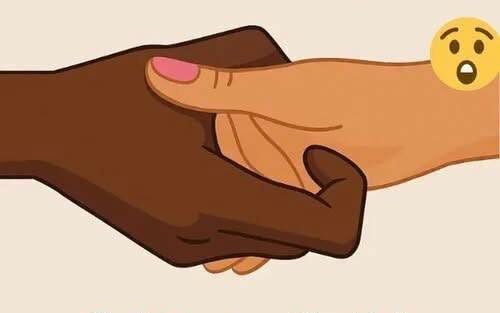
When a Man Scratches a Woman’s Palm During a Handshake, Here’s What It Could Really Mean
A Small Movement of the Fingers During a Handshake Can Leave Someone Wondering Whether It Was Flirting, a Secret Signal, or Simply an Accident
A handshake is one of the most familiar forms of human interaction.
People shake hands when meeting someone for the first time, greeting a friend, celebrating an achievement, or showing professional respect.
Most of the time, the gesture passes without attracting much attention.
But sometimes, something unexpected happens.
A man reaches for a woman’s hand, and during the handshake, one of his fingers moves lightly across the center of her palm.
It may feel like a gentle scratch or a deliberate stroke.
The movement lasts only a second, but it can leave the woman wondering what just happened.
Was he trying to flirt?
Was it some kind of secret romantic signal?
Or was it simply an accidental movement that meant nothing at all?
In some social settings, scratching or lightly stroking another person’s palm during a handshake is associated with romantic or sexual interest.
However, the gesture has no universal meaning, and it cannot reliably reveal someone’s intentions.
Understanding the difference between a possible signal and a confirmed intention is important, especially when physical boundaries and personal comfort are involved.
Why This Unusual Handshake Attracts So Much Attention
Most handshakes follow a familiar pattern.
Two people briefly clasp hands, exchange a greeting, and release their grip.
Because the movement is so ordinary, even a small variation can become noticeable.
When a finger moves across someone’s palm in an unexpected way, the gesture may feel more personal than a conventional handshake.
The palm is a sensitive part of the hand, so light contact may be particularly noticeable.
That unexpected sensation can cause someone to pause and reconsider the interaction.
If the movement occurs during an otherwise friendly exchange, it might be interpreted as flirtatious.
But if the people barely know each other, the same movement could seem confusing or uncomfortable.
The context surrounding the handshake often matters more than the movement itself.
What Does Scratching the Palm During a Handshake Mean?
One commonly suggested interpretation is that a person scratching another person’s palm may be expressing romantic or sexual interest.
In some communities and informal social traditions, the gesture has been described as a discreet way to flirt.
Instead of openly expressing attraction, someone might use a subtle movement of the fingers to suggest a more personal interest.
However, there is no established universal code that gives this gesture the same meaning everywhere.
Not everyone recognizes it as flirting.
Some people may have heard of the interpretation without ever using the gesture themselves.
Others may perform a similar movement unintentionally.
Therefore, a palm scratch during a handshake should never be considered definite evidence of attraction.
Could It Be a Secret Sign of Romantic Interest?
In certain social settings, subtle physical gestures are used to communicate attraction without direct conversation.
A person may linger during a handshake, maintain eye contact, or smile in a way that appears especially personal.
A light stroke across the palm might become part of that interaction.
When such gestures occur together, someone may reasonably wonder whether the other person is flirting.
But wondering is not the same as knowing.
Human behavior is influenced by personality, social expectations, nervousness, and individual habits.
One person may view a particular touch as romantic, while another may not attach any meaning to it.
That is why interpreting a single movement as a secret confession can lead to misunderstandings.
Why Some People Associate the Gesture With Flirting
Flirting does not always involve obvious compliments or direct statements.
Sometimes people attempt to communicate interest through small gestures.
These may include changes in tone of voice, prolonged eye contact, playful conversation, or brief physical contact.
A movement across the palm may be interpreted within that broader category of subtle behavior.
The interpretation becomes more plausible when both people already have a flirtatious relationship.
For example, if two adults have been exchanging romantic signals and one introduces an unusual touch during a handshake, the gesture may be understood differently than it would be between strangers.
Even then, it remains an interpretation rather than proof.
The only reliable way to establish the person’s intentions is through clear communication.
It Might Be Completely Accidental
Not every unusual movement during a handshake is deliberate.
People do not always position their hands perfectly when greeting one another.
A finger may shift as someone adjusts their grip.
Long fingernails, jewelry, or the angle of the hands can also create unexpected sensations.
Someone may move their fingers without realizing that the motion feels like a scratch.
There may be no romantic intention behind it at all.
This possibility is especially important when the gesture occurs only once and the surrounding interaction offers no other indication of personal interest.
Assuming that every unusual touch carries a hidden message can create confusion where none is necessary.
The Difference Between a Scratch and a Gentle Stroke
People sometimes use the words scratching and stroking interchangeably when discussing this gesture.
But the sensations can be different.
A scratch may involve a fingernail moving across the skin.
A stroke may involve the soft part of a finger moving gently against the palm.
The distinction can influence how the interaction feels to the person receiving it.
However, neither sensation automatically reveals what the other person intended.
A deliberate movement can be unwelcome even when it is gentle.
And an accidental movement can feel uncomfortable without the person causing it realizing what happened.
What matters is recognizing both the uncertainty of the gesture and the right of the recipient to respond according to their comfort.
Does the Meaning Change Depending on the Relationship?
Yes, the relationship between the people involved can strongly influence how a gesture is understood.
Consider two people who are already dating.
A light touch during a handshake might be received as affectionate or playful because there is an established romantic connection.
Now consider two people meeting for the first time at a professional event.
The same movement might feel inappropriate or simply confusing.
Between close friends, it might be interpreted as a joke or an unfamiliar habit.
Different relationships create different expectations about physical contact.
That is why context is essential when deciding how to interpret an unusual handshake.
What If the Man Maintains Eye Contact While Doing It?
Eye contact can influence how people interpret social interactions.
If a man lightly moves his finger across a woman’s palm while maintaining prolonged eye contact, she may wonder whether the gesture was intentional.
A smile or playful expression might strengthen that impression.
However, eye contact itself is not a reliable indicator of romantic attraction.
Some people naturally maintain eye contact as a sign of politeness and attentiveness.
Others may smile during nearly every social interaction.
Combining several ambiguous behaviors does not automatically produce a certain conclusion.
The surrounding conversation and the relationship between the individuals remain important.
A Lingering Handshake Can Feel More Personal
Another detail that sometimes attracts attention is the length of the handshake.
Most greetings involve relatively brief contact.
If someone holds another person’s hand longer than expected, the interaction may feel more intimate.
Adding a light palm movement can make the gesture even more noticeable.
Some people may interpret the combination as an attempt to flirt.
Others may experience it as an unwelcome invasion of personal space.
There is no fixed amount of time that determines whether a handshake is romantic.
What matters is whether both people are comfortable with the interaction and whether any personal interest is communicated respectfully.
Cultural Expectations Can Change the Interpretation
Physical greetings vary considerably across cultures and communities.
In some places, handshakes are common in both professional and social settings.
Elsewhere, greetings may involve bows, verbal acknowledgments, or different forms of physical contact.
Expectations about touch can also differ based on age, relationships, and social circumstances.
As a result, the same handshake may be interpreted differently by people from different backgrounds.
Some individuals may have heard that scratching a palm carries a flirtatious meaning.
Others may never have encountered that interpretation.
There is no reliable basis for assuming that everyone shares the same understanding of the gesture.
Why Body Language Is Often Misunderstood
Many people enjoy trying to decode body language.
They look for hidden meanings in eye contact, posture, facial expressions, and physical contact.
Although nonverbal communication can provide useful information, individual gestures are rarely as precise as people imagine.
A smile does not always mean attraction.
Crossed arms do not always mean defensiveness.
And a palm scratch does not always mean someone is making a romantic advance.
Body language is influenced by numerous factors, including personality, emotions, environment, and cultural expectations.
Interpreting it accurately usually requires more than observing one isolated action.
Why Assuming Attraction Can Create Confusion
If a woman assumes a palm scratch is a declaration of romantic interest, she may respond based on an intention that was never present.
That misunderstanding can produce awkwardness or disappointment.
Similarly, someone who deliberately uses the gesture to flirt may assume that the other person understands its supposed meaning.
But the recipient may interpret it differently or fail to notice it altogether.
These situations show the limits of indirect communication.
Subtle gestures may create curiosity, but they do not provide the clarity necessary for understanding another person’s feelings.
A respectful conversation is generally more useful than relying on a supposed secret signal.
What If the Gesture Happens in a Workplace?
A palm scratch during a professional handshake deserves particular attention to context and boundaries.
Workplace greetings are generally expected to remain professional.
An unexpected intimate gesture may make someone uncomfortable, especially when the individuals do not have a personal relationship.
This concern can become more significant when there is a difference in authority or professional influence.
A manager, supervisor, or senior colleague should not assume that a friendly interaction welcomes flirtatious physical contact.
Likewise, employees should not feel required to tolerate unwanted touching to maintain professional relationships.
If the behavior is unwelcome, the recipient can communicate a boundary or seek appropriate support if the conduct continues.
Being Friendly Does Not Mean Welcoming Intimate Touch
People often greet each other warmly without intending anything romantic.
A woman may smile, make conversation, or shake hands simply because she is being polite.
None of those actions automatically invites additional physical contact.
Friendliness should not be confused with consent to intimate gestures.
Even people who have known each other for years may have different comfort levels when it comes to touching.
Someone’s preferences can also change depending on the setting.
Respectful interaction requires attention to those boundaries rather than assumptions based on familiarity.
What If the Woman Feels Uncomfortable?
The most important consideration is not whether the gesture has a hidden romantic meaning.
It is whether the person receiving the touch feels comfortable.
If a handshake becomes unpleasant, a woman can release her hand and step away.
She does not need to provide a detailed explanation to justify ending the contact.
If she wants clarification, she can ask what the person intended.
She can also state that she prefers an ordinary handshake or does not want to be touched that way.
Those responses are reasonable ways to establish personal boundaries.
Physical contact should never depend on one person feeling obligated to accept something that makes them uncomfortable.
Does an Unusual Handshake Automatically Mean Harassment?
Not necessarily.
A single ambiguous movement may be accidental or misunderstood.
It would be inappropriate to assume harmful intent without considering the circumstances.
However, unwanted touching can become a serious concern, particularly if it continues after someone has expressed discomfort.
The context, repetition, nature of the contact, and applicable workplace or legal standards can all matter.
In professional settings, individuals may have access to human resources procedures or other reporting channels.
The important distinction is between an uncertain gesture and conduct that disregards another person’s boundaries.
Both deserve thoughtful responses rather than automatic assumptions.
How Can a Woman Respond Without Making the Situation Awkward?
There is no single response that works for everyone.
Some women may simply withdraw their hands and continue the conversation.
Others may prefer to ask directly what the gesture meant.
If the touch feels unwelcome, a clear statement of preference can be appropriate.
For example, someone might explain that they prefer a normal handshake and would rather avoid additional touching.
It is not necessary to turn every ambiguous interaction into a confrontation.
But avoiding discomfort should not require remaining silent when a boundary has been crossed.
The individual receiving the touch can decide which response is safest and most comfortable for the situation.
What If She Is Interested in the Man?
If the woman already feels attracted to the man, an unusual handshake may seem exciting or encouraging.
She might interpret the movement as a possible sign that he shares her interest.
But the same uncertainty remains.
The gesture alone does not confirm what he feels.
If both people are interested in developing a connection, conversation offers a clearer path.
They can get to know each other, discuss their interests, and communicate attraction in ways that allow both people to respond freely.
Mutual interest is best established through reciprocal communication rather than through a single ambiguous touch.
Why Clear Communication Is Better Than Secret Signals
Subtle flirting can feel playful, but it also has limitations.
Two people may interpret the same gesture differently.
One may think it expresses attraction, while the other views it as accidental.
That uncertainty can create confusion and unnecessary assumptions.
Clear communication makes intentions easier to understand.
Someone interested in another person can express that interest respectfully without relying on physical gestures that may be unwelcome.
The other person then has the opportunity to respond honestly.
This approach supports mutual understanding and reduces the risk of misunderstanding.
Consent Matters Even With Small Gestures
Consent is important whenever physical contact becomes personal or intimate.
Although ordinary handshakes are common in many settings, someone agreeing to shake hands is not necessarily agreeing to additional touching.
A light movement across the palm may seem minor to the person initiating it.
But the recipient may experience it differently.
Consent should not be assumed because two people are familiar with each other or because one person believes a gesture is harmless.
Respecting another person’s comfort is part of considerate social behavior.
If interest is mutual, there are many opportunities for both people to communicate that clearly.
Can the Same Gesture Mean Different Things to Different People?
Absolutely.
One woman may interpret a light palm scratch as playful flirting.
Another may view it as an accidental movement.
A third may find it intrusive, regardless of the intention behind it.
The man initiating the gesture may also have a different understanding of what happened.
These variations demonstrate why assigning one fixed meaning to the movement is unreliable.
Social interactions depend on the experiences and expectations of both participants.
Understanding another person’s reaction requires recognizing that their interpretation may differ from your own.
What Experts Say About Interpreting Nonverbal Behavior
Research into nonverbal communication generally emphasizes the importance of context.
Gestures do not operate like words in a dictionary, where every movement has one precise definition.
Facial expressions, body movements, and touch may carry different meanings depending on the people and circumstances involved.
A person’s behavior also needs to be interpreted alongside verbal communication and established patterns of interaction.
Therefore, there is no scientific basis for claiming that scratching someone’s palm during a handshake always proves attraction.
It may be perceived that way in some settings, but perception and intention are not necessarily identical.
Responsible interpretation requires acknowledging that uncertainty.
When Is It Better to Ask Directly?
If the gesture continues bothering someone or affects how they understand a relationship, asking directly may help.
A simple question can clarify whether the movement was intentional.
The conversation does not need to be dramatic.
Someone might ask whether the other person meant to move their finger across the palm during the handshake.
If the answer indicates romantic interest, both individuals can decide whether they want to discuss that possibility.
If it was accidental, the uncertainty can be resolved without further speculation.
If the person receiving the touch is uncomfortable, they can communicate that regardless of the explanation.
How to Recognize Respectful Flirting
Respectful flirting generally allows both people to participate willingly.
It involves paying attention to how the other person responds rather than assuming interest.
Friendly conversation, appropriate compliments, and invitations that can be declined without pressure are often clearer than ambiguous physical gestures.
Someone who respects boundaries should be willing to stop or adjust their behavior when another person expresses discomfort.
Attraction does not give anyone permission to disregard another person’s preferences.
A positive connection depends on mutual interest and respect.
Those qualities matter much more than whether someone recognizes a supposed secret handshake signal.
Why Social Media Sometimes Exaggerates the Meaning
Online discussions frequently present unusual gestures as though they are hidden codes everyone should understand.
A short video or dramatic headline may claim that a particular movement always indicates attraction.
Such explanations can be entertaining, but they often overlook differences in culture and individual behavior.
They may also encourage people to interpret ordinary interactions as evidence of secret intentions.
The palm-scratch handshake is a good example.
Although it has been associated with flirting in some settings, that interpretation is not universal.
Readers should be cautious about treating simplified online claims as reliable guides to another person’s feelings.
The Most Important Signal Is Respect
When people discuss romantic body language, they often focus on decoding small movements.
But there is another question that matters more.
Does the person respect the other individual’s boundaries?
A genuinely considerate person should be attentive to whether physical contact is welcome.
If someone appears uncomfortable, the respectful response is to stop rather than pressure them to accept the gesture.
If there is mutual attraction, it can develop through conversation and freely chosen interaction.
No hidden signal should outweigh another person’s expressed preferences.
What a Palm Scratch During a Handshake Really Tells You
Ultimately, scratching or stroking someone’s palm during a handshake tells you only that an unusual movement occurred.
It may have been deliberate flirting.
It may have been a nervous or absent-minded gesture.
It may have resulted from the position of the hands or an accidental movement.
Without additional information, none of these explanations can be confirmed.
The surrounding relationship and conversation may provide clues, but clues should not be mistaken for certainty.
Someone who wants to understand another person’s intentions can ask rather than relying entirely on interpretation.
And someone who dislikes the contact has every right to establish a boundary.
The Real Meaning Behind a Man Scratching a Woman’s Palm
A small scratch across the palm during a handshake can create a surprisingly large question.
In some social environments, the gesture is associated with romantic or sexual interest.
A lingering touch, playful smile, or unusually personal interaction may cause someone to interpret it as flirting.
But the movement has no universally accepted meaning.
It can also be accidental, habitual, or misunderstood.
The relationship between the individuals, their cultural expectations, and the circumstances surrounding the handshake all influence how it may be perceived.
For that reason, no one should treat a palm scratch as automatic proof that another person is attracted to them.
More importantly, the person receiving the gesture does not have to ignore discomfort while trying to decode its meaning.
She can withdraw her hand, ask what was intended, or explain that she does not welcome that kind of touch.
When attraction is mutual, respectful conversation is more valuable than guessing at hidden messages.
Sometimes a small touch may be an attempt to communicate interest.
Other times, it may mean nothing at all.
What truly matters is not the secret someone imagines behind a handshake, but whether both people feel comfortable, respected, and free to express their intentions openly.