
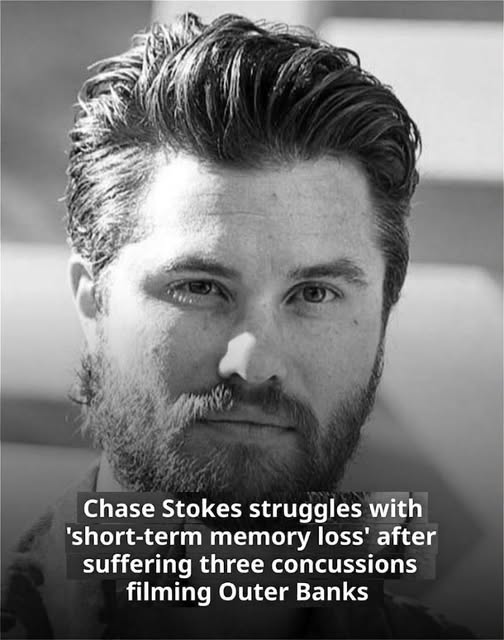
Chase Stokes Opens Up About Memory Problems After Three Concussions While Filming Outer Banks
The Physical Demands Behind One of Netflix’s Biggest Adventure Shows
For viewers, Outer Banks became known for treasure hunts, dramatic escapes, water sequences, chases, and physically demanding action.
For Chase Stokes, who played John B. throughout the series, bringing those scenes to life also came with a significant physical cost.
The actor has now spoken openly about several injuries he experienced during the years he spent working on the Netflix series.
Among the most serious were three concussions.
Stokes said those head injuries were followed by memory-retention problems that became increasingly noticeable over time.
His experience eventually changed the way he approached stunt work and made him place greater emphasis on protecting his health.
Stokes Says He Sustained Three Concussions
In a recent interview, Stokes described the physical toll of filming a show that frequently required demanding action sequences.
He said he experienced three concussions during the production.
Those were not the only injuries.
He also recalled dislocating a finger, injuring his shoulder, and requiring stitches at different points.
For an actor playing a character constantly involved in adventures and physical danger, some demanding scenes became part of the job.
But repeated injuries eventually made Stokes reconsider how much he should personally attempt.
The Memory Issues Became More Noticeable
Stokes said the most concerning long-term effect involved his memory.
During the last couple of years, he began noticing that retaining information had become more difficult.
Sometimes he would study dialogue the evening before filming and feel confident that he knew the material.
By the following morning, parts of it could feel unfamiliar.
At other times, he would hear information and then realize shortly afterward that he had already forgotten it.
He described the experience as similar to short-term memory loss.
For an actor whose work depends heavily on memorizing scripts, those changes were understandably concerning.
Learning Lines Became a Different Challenge
Actors regularly receive large amounts of dialogue that must be learned quickly.
Production schedules can also change, meaning scenes sometimes need to be prepared with little notice.
For Stokes, memory retention had previously been something he could manage through preparation and repetition.
After the concussions, that process became less predictable.
A scene he understood perfectly one evening might require additional work the following day.
That did not prevent him from continuing to perform.
It did, however, make him more aware that his brain needed the same attention and recovery as any other injured part of the body.
He Began Taking Brain Health More Seriously
Stokes said the experience encouraged him to learn more about concussion recovery and neurological health.
He became interested in neuroplasticity, the brain’s ability to reorganize and adapt.
Rather than simply accepting the memory difficulties, he began exploring treatment options and strategies that might support recovery.
One of those treatments was transcranial magnetic stimulation, commonly known as TMS.
What Is TMS?
Transcranial magnetic stimulation is a noninvasive medical treatment that uses magnetic pulses directed toward specific areas of the brain.
It is used clinically for certain neurological and mental-health conditions.
Stokes described his own experience with TMS as part of an effort to support the way his brain processes and retains information.
He said the treatment had helped him considerably.
His comments reflected his personal experience rather than a universal recommendation for anyone dealing with concussion-related symptoms.
People experiencing ongoing symptoms after a head injury should seek guidance from qualified medical professionals.
The Injuries Changed His Approach to Stunts
For years, Stokes was heavily involved in the physical side of playing John B.
That approach helped make the character’s adventures feel authentic.
But after multiple injuries, he began recognizing that there was a point where enthusiasm could become unnecessary risk.
He has since become more willing to allow trained stunt professionals to perform demanding sequences.
That is not unusual in film and television production.
Stunt doubles are specialists whose job is to perform scenes requiring advanced physical skills while reducing unnecessary risk to actors.
Knowing When to Step Back Became Important
Stokes spoke about learning that doing every stunt personally was not necessary to prove his commitment to a role.
After years of physically demanding work, protecting his long-term health became the more responsible choice.
He has worked with stunt double Levi Gilbert and has increasingly trusted the specialist to take on sequences that carry greater risk.
The adjustment represents a change in perspective.
Early in a career, performers may feel pressure to demonstrate that they are willing to do almost anything for a role.
Experience can teach a different lesson.
Sometimes professionalism means knowing when someone else is better equipped to perform a particular task.
Outer Banks Required Years of Physical Work
Outer Banks premiered in 2020 and quickly became one of Netflix’s most recognizable young-adult adventure series.
Stokes played John B., the central member of a group of friends known as the Pogues.
The series regularly placed its characters in demanding environments.
There were boats.
Water sequences.
Chases.
Falls.
Fights.
Travel.
And numerous action scenes that required extensive preparation.
Over five seasons, that physical workload accumulated.
Stokes Still Looks Back on the Series With Gratitude
Despite the injuries, Stokes has made clear that he does not regret the experience of playing John B.
The role changed his career.
It introduced him to a global audience and gave him years of experience working on a major television production.
He has described the series as an important period of personal and professional growth.
The physical challenges are part of that history, but they do not erase what the role meant to him.
The Series Became a Major Turning Point
Before Outer Banks, Stokes had appeared in smaller television roles.
John B. changed that almost immediately.
The show’s success turned its young cast into recognizable stars and attracted a large international fan base.
Stokes spent years growing alongside the character.
That meant learning how to lead a major television production while also adjusting to sudden public attention.
The experience was professionally valuable, but it also demanded significant physical and emotional energy.
The Final Season Marked the End of an Era
After five seasons, Outer Banks reached the end of its run.
For Stokes, saying goodbye to John B. meant closing a chapter that had occupied much of his adult life.
There was nostalgia.
There was also relief.
The demanding production schedule and action-heavy nature of the series had taken a toll.
Finishing the show created space for him to focus more carefully on his health and decide what he wanted from the next stage of his career.
He Has Been More Open About Recovery
Stokes has increasingly discussed what happened after filming ended.
Rather than immediately jumping into another demanding project, he spent time addressing health concerns.
That included neurological treatment, medical monitoring, and a broader effort to understand what his body needed after years of intense production.
For someone accustomed to moving from one project to another, slowing down became an important adjustment.
Memory Is Especially Important for an Actor
Short-term memory difficulties can present a unique challenge in acting.
Performers need to remember dialogue, physical marks, timing, blocking, and changes made by directors.
They also need enough mental freedom to perform naturally rather than simply concentrating on remembering words.
Stokes has previously discussed using different techniques to help retain material.
One approach involves connecting dialogue with specific physical locations or movements.
That kind of structured memory strategy can help reduce some of the pressure associated with dialogue-heavy scenes.
He Is Adjusting Rather Than Walking Away
Stokes has not suggested that his memory issues mean the end of his acting career.
Instead, he appears to be adapting.
That includes treatment.
Different preparation methods.
More careful decisions around physical work.
And greater reliance on stunt professionals.
Those adjustments allow him to continue working while acknowledging that his health requires more attention than it once did.
A New Chapter After John B.
With Outer Banks behind him, Stokes is moving toward projects that allow audiences to see him differently.
One of his upcoming roles is in AMC’s Thunder Road.
The project places him in another physically demanding environment, this time connected to NASCAR.
But his approach to that work has changed.
He can still train intensely and commit fully to a character without assuming every physical risk himself.
Experience Changed His Definition of Commitment
Stokes once associated commitment with pushing through difficult conditions.
Years of injuries taught him that commitment can also mean protecting the ability to continue working in the future.
A successful career can last decades.
One television scene lasts only moments.
That difference matters when deciding whether an unnecessary physical risk is worth taking.
His Comments Highlight the Reality Behind Action Television
Television audiences generally see only the finished sequence.
A chase lasts a few minutes.
A fall happens in seconds.
A fight scene may appear effortless.
Behind those moments can be days of choreography, rehearsals, safety planning, repeated takes, and physical strain.
Stokes’ experience provides a reminder that action-oriented entertainment involves real physical demands even when extensive precautions are in place.
Why Concussions Deserve Careful Attention
Concussions are brain injuries and can affect people differently.
Symptoms can include headaches, difficulty concentrating, memory changes, sleep disruption, dizziness, and other problems.
Recovery times also vary.
Repeated head injuries can make careful medical evaluation especially important.
Stokes’ decision to speak publicly about his experience may encourage others to take persistent symptoms seriously rather than simply trying to work through them.
He Is Focusing on Longevity
Stokes is still relatively early in his career.
Outer Banks may always remain one of the roles most closely associated with his name, but it does not have to define everything that comes afterward.
Protecting his health now gives him a better opportunity to continue acting and exploring different kinds of characters for years to come.
That means making different decisions than he might have made during the first season of Outer Banks.
Looking Back Without Regret
The injuries are real.
The memory problems have been unsettling.
And the recovery process has required changes.
Even so, Stokes continues to speak about Outer Banks with appreciation.
He gave years of his life to John B. and helped turn the character into one of Netflix’s most recognizable adventure heroes.
Now the series is finished, and Stokes is taking the lessons from that experience with him.
One of the biggest may be surprisingly simple.
Giving everything to a project does not have to mean risking everything for it.