
Found This Strange Wooden Tool in an Old Dresser? Here’s What It Was Used For
An Old Household Object That Leaves Many People Guessing
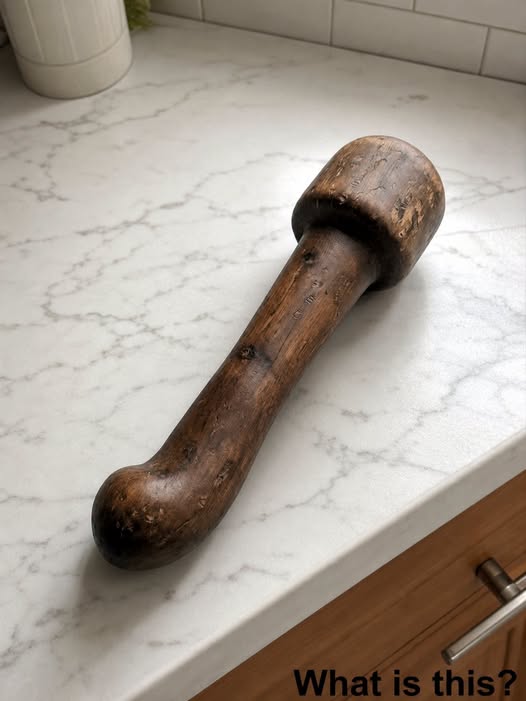
Imagine opening an old dresser drawer while sorting through a relative’s belongings and finding an unfamiliar wooden object tucked among sewing supplies, clothing, and keepsakes.
It has a long handle.
One end is rounded.
The other has a larger smooth wooden head.
At first glance, it may be difficult to determine whether it belonged in a kitchen, workshop, sewing box, or somewhere else entirely.
For people who grew up before disposable clothing became common, however, the object would have been instantly recognizable.
It is a traditional darning tool, often called a darning mushroom, sock darner, or darning egg depending on its exact shape.
It Was Designed for Repairing Socks
The purpose of the tool was remarkably simple.
When a sock developed a hole in the heel or toe, the rounded wooden section was inserted inside the sock.
The damaged fabric was then stretched gently over the smooth curved surface.
This provided a firm backing while someone repaired the hole using a needle and thread.
Without that support, the soft fabric could bunch together while sewing.
The rounded tool helped the person performing the repair maintain the natural shape of the sock.
Why Was It Called Darning?
Darning is a traditional method of repairing fabric by weaving new thread across a worn or damaged area.
Instead of simply closing a hole by pulling its edges together, the person creates a small woven patch using thread.
Threads are first stitched across the damaged area in one direction.
Additional threads are then woven across them in the opposite direction.
The result can reinforce fabric that would otherwise continue tearing.
For generations, this was an ordinary household skill.
The Rounded Shape Had a Practical Purpose
The mushroom-like head was not decorative.
Socks and stockings are curved around the heel and toes.
Trying to repair them while lying flat on a table can distort their shape.
A smooth rounded piece of wood gives the fabric something similar to the shape of a foot to rest against.
The person sewing could hold the handle with one hand while guiding the needle with the other.
That made the repair easier and helped prevent accidental needle pricks.
Darning Tools Came in Many Shapes
Not every old sock darner looks exactly like this one.
Some were shaped almost like eggs.
Others resembled mushrooms.
Some had long handles, while others were simply smooth rounded pieces of wood, glass, ceramic, or stone.
There were even decorative versions with painted handles or compartments for storing needles.
The basic purpose remained the same.
They provided a firm curved surface underneath fabric while repairs were being made.
Wood Was an Ideal Material
Wood was commonly used because it was inexpensive, durable, lightweight, and easy to shape.
A skilled woodworker could turn one on a lathe relatively quickly.
Once polished smooth, the surface would not easily catch delicate threads.
Wood also felt comfortable to hold during longer sewing sessions.
Many surviving examples show scratches, small needle marks, and worn areas from decades of use.
Those marks are often part of what makes old household tools interesting today.
Why Did Nearly Every Household Need One?
Modern clothing has changed the way many people think about repairs.
If an inexpensive pair of socks develops a hole today, it may simply be replaced.
That was not always practical.
Clothing represented a larger portion of household expenses in earlier generations.
Families expected garments to last.
A small hole in a sock was therefore not necessarily a reason to throw it away.
It was a reason to bring out the sewing basket.
Socks Wore Out Quickly
Socks were particularly good candidates for repeated repair.
The heel and toe experience constant friction.
Before modern synthetic fibers and inexpensive mass production, worn areas could appear relatively quickly.
A careful repair could extend the life of a pair considerably.
Some socks might be darned several times before finally being discarded.
For families watching every household expense, that effort mattered.
Darning Was Once an Everyday Skill
Basic sewing skills were once much more common than they are today.
Children might learn simple mending techniques from parents or grandparents.
Buttons were replaced.
Seams were repaired.
Tears were patched.
And socks were darned.
The tools associated with those tasks were ordinary objects rather than antiques.
Many lived permanently inside sewing boxes or dresser drawers.
The Tool Could Also Be Used on Other Garments
Although commonly associated with socks, a rounded darner could help repair other knitted items as well.
Mittens.
Gloves.
Sweater elbows.
Stockings.
Any curved section of fabric that needed support while being stitched could potentially benefit from the tool.
The user simply positioned the damaged area over the rounded surface before beginning the repair.
Some Darners Had Hidden Compartments
Certain antique darning tools were surprisingly clever.
Some handles could be opened to reveal a small compartment for sewing needles.
That allowed the repair tool and needles to be stored together.
Museum collections include examples combining a darning surface with built-in needle storage.
Not every darner had this feature, but it shows how much thought went into seemingly simple household objects.
Why Does This One Look So Worn?
The darkened wood and surface marks visible on many old darners can come from years of handling and use.
Natural oils from hands gradually change unfinished or lightly finished wood.
Needles may leave tiny marks.
Repeated contact with fabric can polish certain areas.
Storage in a drawer for decades can also affect the finish.
Rather than being damage, that appearance may simply show that the object served its intended purpose for many years.
These Tools Became Less Common After Clothing Became Cheaper
During the twentieth century, mass-produced clothing became progressively more affordable.
Synthetic materials improved durability.
Replacement socks became inexpensive and widely available.
As a result, fewer people spent evenings repairing worn pairs by hand.
Darning gradually changed from an everyday necessity into a specialized sewing skill.
The tools disappeared from many modern homes.
That Is Why Younger Generations Often Do Not Recognize Them
An object can become mysterious surprisingly quickly once people stop performing the task it was designed for.
A person who has never seen anyone darn a sock has little reason to recognize a darning mushroom.
The wooden shape does not immediately reveal its purpose.
It has no blade.
No moving parts.
No electrical components.
Without context, almost any explanation can seem possible.
Some People Mistake Them for Kitchen Tools
The shape can resemble a pestle or small food-preparation tool.
That leads some people to assume it was used for crushing spices or ingredients.
Others think it may have been used for woodworking or massage.
The large rounded sewing surface is usually the clue.
A darning tool needs to be smooth enough to sit directly underneath delicate fabric without damaging it.
Others Think They Are Children’s Toys
Simple wooden household objects can also resemble old toys.
But darning mushrooms were functional adult tools.
The unusual proportions make much more sense once a sock is stretched over the rounded end.
Suddenly the object that appeared mysterious becomes perfectly practical.
Could an Antique Darner Be Valuable?
Most ordinary wooden darning tools are more interesting historically than financially valuable.
Their value can depend on age, maker, material, decoration, condition, and rarity.
Elaborately carved examples or unusual designs can attract collectors.
Simple household versions are still widely found in antique shops and online marketplaces.
For a family, however, sentimental value may be far greater than resale value.
It Can Reveal Something About the Person Who Owned It
A worn darning tool tells a small story about everyday life.
Someone valued clothing enough to repair it.
Someone knew how to use a needle and thread.
The object may have been held hundreds of times over many years.
It could have helped repair socks worn by children, spouses, or grandchildren.
Those ordinary domestic tasks rarely appear in family photographs or written histories.
Objects can sometimes preserve them instead.
Darning Is Becoming Popular Again
Interestingly, mending has attracted renewed interest in recent years.
Some people want to reduce textile waste.
Others enjoy repairing favorite clothing instead of replacing it.
Visible mending has even become a creative craft, with colorful threads intentionally used to make repairs noticeable.
Traditional darning mushrooms are once again sold by craft suppliers alongside modern versions.
You Can Still Use an Old One Today
If an antique wooden darner is structurally sound and smooth, its basic design still works exactly as intended.
A sock can be placed over the rounded end.
The damaged section can be positioned on top.
Then thread can be woven across the hole.
The technique has changed very little because there was little about the original tool that needed improving.
Simple Objects Can Outlast Entire Technologies
There is something interesting about a tool with no complicated mechanism surviving for generations.
No battery can fail.
No software becomes outdated.
No replacement part is required.
A shaped piece of smooth wood can remain useful for a century.
That simplicity explains why so many old darners survive today.
The Mystery Has a Surprisingly Ordinary Answer
The strange wooden object found in an old dresser is not a medical device, unusual kitchen utensil, or mysterious family artifact.
It is most likely a darning mushroom or handled sock darner.
Its purpose was to make repairing worn socks easier.
What seems like an odd antique today was once an ordinary tool that could be found in countless homes.
And the reason many of us no longer recognize it says almost as much about how everyday life has changed as the object itself.
A Small Reminder of an Era When Things Were Repaired
Older generations often lived with a simple principle: if something could still be repaired, it did not need to be replaced.
This small wooden tool represents that mindset perfectly.
It existed because a hole in a sock was considered a problem worth fixing.
Decades later, the tool may remain long after the socks it repaired have disappeared.
And when it turns up unexpectedly in a drawer, it gives another generation a small glimpse into the routines of the people who used it before them.