
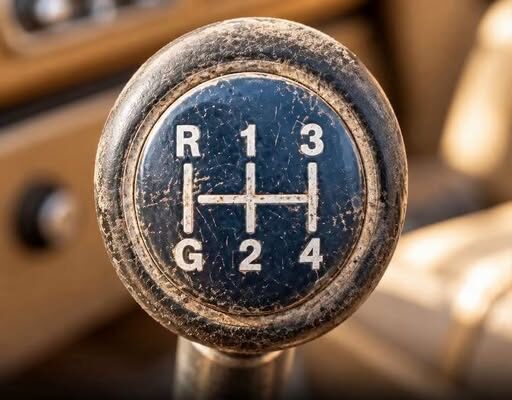
What Does the Mysterious ‘G’ on a Manual Gear Shift Mean? Most Drivers Have Never Needed to Use It
Most Drivers Recognize the Numbers on a Manual Gear Stick. But Some Unusual Vehicles Feature an Extra Letter That Looks Completely Out of Place. The Meaning Behind That Single ‘G’ Reveals a Clever Piece of Automotive Engineering Designed for Situations Where Driving Faster Is the Last Thing You Want.
If you’ve ever driven a car with a manual transmission, you’re probably familiar with the markings on the gear stick.
First gear.
Second gear.
Third gear.
And perhaps fourth, fifth, or sixth.
There’s usually an R for reverse.
And depending on the vehicle, the shift pattern might look slightly different.
But imagine climbing into an older performance car or specialized off-road vehicle and discovering something unexpected.
A single letter G.
Not a number.
Not reverse.
And not a marking most drivers encounter during everyday commuting.
At first glance, it might seem like a strange design choice.
Does G stand for gear?
Is it a special driving mode?
Could it somehow make the vehicle faster?
The answer is more interesting than many people expect.
On certain manual transmissions, G stands for the German word Gelände, meaning terrain.
The marking identifies an extremely low gear intended for situations where a vehicle needs to travel very slowly while maintaining strong pulling force at the wheels.
In other words, it is not there to help the car win a race.
It is there to help the vehicle keep moving when the terrain becomes difficult.
And one of the most famous cars to feature this unusual gear was actually a legendary supercar.
What Does the Letter G Actually Stand For?
The letter G comes from the German word Gelände.
In English, the word translates to terrain or ground.
Within automotive terminology, it is closely associated with driving beyond ordinary paved roads.
That connection explains why certain vehicles use G to identify a low-speed terrain gear.
Rather than serving as another ordinary forward ratio, the gear is designed for specialized conditions.
Its purpose is to multiply engine torque through a very low transmission ratio.
That allows the wheels to turn slowly while the engine operates within a useful range.
For a driver facing a steep incline or difficult ground, that combination can be extremely valuable.
The Secret Is Not More Speed—It’s More Control
Most drivers associate changing gears with acceleration.
As a car gains speed, the driver moves from first gear to second.
Then to third.
And eventually into the higher gears when road conditions allow.
But off-road driving often requires the opposite approach.
When a vehicle is climbing a rocky slope, moving through deep ruts, or navigating an obstacle, excessive speed can make the situation more difficult and dangerous.
The driver may need to move at walking pace.
Sometimes even more slowly.
That is where an especially low crawler gear becomes useful.
It lets the vehicle advance in a deliberate, controlled manner rather than relying on momentum.
Why an Ordinary First Gear Isn’t Always Enough
First gear is normally the lowest forward gear in a conventional manual car.
It provides strong torque multiplication for moving away from a standstill.
But in certain vehicles, first gear is still relatively tall for extreme off-road conditions.
That means the vehicle may travel faster than the driver wants when the clutch is fully engaged.
Trying to maintain a very low speed could require frequent clutch slipping.
Prolonged clutch slipping creates heat and can accelerate wear.
A dedicated crawler gear offers a different solution.
Because the ratio is lower, the engine can continue operating while the vehicle moves more slowly.
That reduces the need to control every movement through clutch slip.
It also gives the driver finer control in demanding situations.
What Exactly Is a Crawler Gear?
A crawler gear is an unusually low transmission ratio intended for very slow vehicle movement.
The idea is simple.
The engine turns relatively quickly compared with the wheels.
That difference provides increased torque multiplication.
The vehicle can then move with greater controlled pulling force at low speed.
Crawler gearing is particularly useful when a vehicle encounters substantial resistance.
Examples include steep rocky climbs, uneven tracks, and carefully controlled movement over obstacles.
However, gearing cannot create unlimited traction.
If the tires cannot grip the surface, additional wheel torque may simply cause wheelspin.
Successful off-road driving depends on suitable tires, ground conditions, vehicle design, and the driver’s judgment as well as gearing.
The Porsche 959 Made the G Gear Famous
One of the best-known vehicles equipped with a G-marked gear was the Porsche 959.
Introduced during the 1980s, the 959 became one of the most technologically advanced performance cars of its era.
It featured a sophisticated all-wheel-drive system.
Its engineering drew from Porsche’s motorsport ambitions.
And its design helped demonstrate what was possible when advanced performance technology was brought to a road car.
But beneath the familiar-looking manual shift pattern was an unusual detail.
The Porsche 959 included a very low G gear.
This provided a specialized ratio below the car’s ordinary first gear.
The presence of that gear reflected the model’s development history and its connection to rally-oriented engineering.
Why Would a Supercar Need an Off-Road Gear?
At first, the idea seems contradictory.
Supercars are famous for high speeds.
They are designed around acceleration, handling, and performance.
Why would a vehicle like the Porsche 959 need a gear intended for difficult terrain?
The answer lies in the car’s origins.
The 959 project was influenced by Porsche’s ambitions in Group B competition and advanced all-wheel-drive development.
That engineering background helped shape some unusual features.
The G gear was one of them.
Although most owners would never take their valuable 959s onto demanding off-road trails, the unusual transmission reflected the car’s development philosophy.
It was a remarkable reminder that engineering ideas developed for demanding environments can appear in unexpected vehicles.
The G Gear Was Not Designed for Highway Driving
Despite its presence in a powerful car, G was not intended as an ordinary cruising gear.
It was significantly lower than the conventional first gear.
That meant using it at normal road speeds would be inappropriate.
Extremely low gears are intended for specific operating conditions.
They allow controlled low-speed movement but are unsuitable for sustained high-speed travel.
Drivers need to follow the procedures established by the vehicle manufacturer.
Using specialized gearing incorrectly can create mechanical stress and potentially damage components.
The Connection to Mercedes-Benz Is Easy to Recognize
The German word Gelände also appears in another famous automotive name.
Geländewagen.
That term roughly translates to all-terrain vehicle.
It is the origin of the name associated with the Mercedes-Benz G-Class, commonly called the G-Wagon.
The G-Class became famous for its rugged construction and off-road capabilities.
Its development emphasized the ability to handle difficult ground rather than simply perform well on paved highways.
That is why the German word Gelände appears so frequently in discussions of specialized off-road engineering.
However, the G in the G-Class name should not be confused with a guarantee that every G-Class transmission includes a G-marked shift position.
Modern G-Class models use their own transmission and low-range systems.
Not Every Off-Road Vehicle Has a Gear Marked G
This is an important distinction.
The letter G is not a universal standard across the automotive industry.
Many off-road vehicles provide very low gearing without displaying a G on their gear sticks.
Some use a transfer case with a low-range setting.
Others offer specialized transmission modes.
Some modern vehicles use electronic assistance to maintain controlled low speeds.
And certain older manual transmissions use a particularly low first gear without assigning it a special letter.
Different manufacturers have adopted different solutions.
The meaning and operation of any unfamiliar marking should always be confirmed in the specific vehicle’s owner’s manual.
What Is the Difference Between G and Low Range?
A G-marked crawler gear and a four-wheel-drive low-range transfer case may serve similar driving needs.
But they are not necessarily the same mechanism.
A G gear is a specific transmission ratio.
A low-range transfer case introduces additional gear reduction within the drivetrain.
That reduction affects the available ratios used by the transmission.
Both approaches can help a vehicle move slowly while delivering substantial wheel torque.
However, the exact operating characteristics depend on the vehicle.
Some machines combine low transmission ratios with transfer-case reduction.
Others rely on only one of these systems.
Why Low Gearing Helps When Climbing Hills
Imagine driving a vehicle up a steep, uneven slope.
The engine must provide enough force to overcome gravity and the resistance of the terrain.
At the same time, the driver needs to maintain control.
A high gear would not generally be suitable for that task.
The engine could struggle at low speed.
And the driver might need to slip the clutch to avoid stalling.
A much lower ratio allows the engine to turn at a useful speed while the wheels advance slowly.
That can make progress more manageable.
However, it does not remove the need to assess the slope, traction, obstacles, and vehicle limitations.
Going Downhill Can Be Just as Important
Low gearing is not useful only for climbing.
On certain vehicles, an appropriately selected low ratio can also provide more engine braking during a descent.
Engine braking helps resist vehicle acceleration without relying exclusively on continuous friction braking.
This may be useful when traveling slowly downhill.
But the effect depends on the drivetrain and the vehicle’s equipment.
It should not be assumed that every G-marked gear behaves identically.
Drivers must follow manufacturer guidance, particularly on loose or slippery surfaces.
The Difference Between Torque and Horsepower
Drivers often hear discussions about engine horsepower and torque.
The two are related, but they describe different concepts.
Torque is a measure of rotational force.
Horsepower describes the rate at which work is done.
A transmission does not create additional engine power.
Instead, different gear ratios trade rotational speed for torque at the output, subject to mechanical losses.
A very low ratio allows greater wheel torque for a given engine torque.
That is valuable for slow, demanding movement.
But the wheels rotate more slowly as a result.
It is a mechanical trade-off.
One that becomes especially useful when the goal is control rather than speed.
Why a Lower Gear Ratio Can Feel Stronger
Imagine turning a stubborn bolt with a short wrench.
It may require considerable effort.
Using a longer wrench increases the leverage available.
That makes it easier to produce the necessary turning force.
A vehicle’s gearing works on a related principle, although the mechanical design is different.
Low gearing multiplies torque while reducing output speed.
Drivers experience that multiplication as increased pulling ability at low speed.
The trade-off is that the vehicle cannot travel as quickly in that gear.
Could You Use G in Everyday Traffic?
In most cases, there is little reason to use a dedicated terrain gear for normal commuting.
Typical roads do not require the extreme reduction it provides.
Ordinary first gear is generally designed for pulling away smoothly.
Higher gears are used as road speed increases.
A crawler gear is intended for specific conditions where unusually low speed and controlled torque delivery are desirable.
On a vehicle equipped with such a gear, the correct use depends on its transmission design and the manufacturer’s instructions.
It is not a shortcut to stronger acceleration during ordinary driving.
Can Using the Wrong Gear Damage a Vehicle?
Incorrect gear selection can place unnecessary stress on components.
For example, selecting a very low ratio when the vehicle is traveling too quickly may result in excessive engine speed or driveline shock, depending on the design and circumstances.
Some modern systems include protective features.
Older manual vehicles may provide fewer electronic safeguards.
That makes understanding the transmission important.
The driver should never assume that an unusual gear can be selected at any speed.
And forcing a gear lever into an unfamiliar position is never a sensible way to experiment.
Consulting the owner’s manual is the correct starting point.
Why the G Marking Is So Rare
Most ordinary passenger cars are built for paved roads.
Their transmissions are optimized for acceleration, fuel efficiency, and comfortable everyday driving.
An extra crawler ratio adds mechanical complexity and may provide little benefit to the average motorist.
For that reason, G-marked positions are uncommon.
Specialized vehicles are more likely to incorporate unusually low ratios or dedicated low-range systems.
Even among those vehicles, the actual marking may be different.
Drivers may encounter labels such as L, LOW, or 4L, depending on the particular transmission or drivetrain.
They should not assume these labels all describe exactly the same mechanism.
Automotive Engineers Design Gears for Different Priorities
Every gear ratio represents a compromise.
Some are intended to help a vehicle accelerate.
Others allow efficient cruising.
And a few specialized ratios prioritize very low-speed operation.
Engineers choose those ratios based on how a vehicle is expected to be used.
A lightweight city car has very different requirements from a heavy-duty utility vehicle.
A sports car has different priorities from an agricultural machine.
And a vehicle intended to cross difficult terrain may need unusually precise low-speed control.
The G marking is one small example of how a transmission can reveal the purpose behind a vehicle’s design.
Technology Has Changed How Vehicles Handle Rough Terrain
Modern off-road vehicles may use electronic systems that were unavailable when many older manual transmissions were designed.
Some have selectable driving modes.
Others feature electronic traction aids and automated low-speed control.
Certain systems help maintain a slow, steady pace over difficult ground.
These technologies can reduce driver workload under appropriate conditions.
But they do not change the fundamental importance of torque multiplication and suitable gearing.
The mechanical principles remain relevant even when computers assist with their application.
The Mercedes-Benz G-Class Still Uses Low-Speed Off-Road Technology
Mercedes-Benz continues developing systems intended for demanding terrain.
Its G-Class vehicles are known for their off-road capabilities.
Depending on the model and drivetrain, their equipment can include low-range gearing and specialized electronic functions.
For example, Mercedes-Benz documentation for the electric G-Class describes an intelligent off-road crawler function used with low-range operation.
That system helps control the vehicle at very low speeds in appropriate conditions.
It is an example of how the same general engineering goal can be pursued through newer technology.
But it should not be confused with the particular G gear found on some older manual shifters.
Why Slow Driving Can Be More Difficult Than Fast Driving
It might seem that driving slowly should always be easier.
But when the ground is steep, uneven, or slippery, maintaining controlled movement can require considerable skill.
The driver must consider wheel placement.
Vehicle clearance.
Available traction.
Steering inputs.
And the consequences of sudden acceleration or braking.
A good crawler ratio helps make speed easier to manage.
But it does not replace careful judgment.
In difficult terrain, patience can be as important as engine performance.
The Gear Helps With Torque, but Traction Still Matters
One common misconception is that more torque automatically produces better traction.
It does not.
Traction depends on the relationship between the tires and the ground.
Loose gravel, mud, ice, and wet rock can all reduce available grip.
A very low gear may deliver more torque than the surface can support.
If that happens, a wheel may spin.
That is why experienced off-road drivers pay attention to controlled throttle application and vehicle setup.
The goal is to use the available traction efficiently.
Not simply to apply the greatest possible force.
Why Some Vehicles Can Crawl Almost at Walking Pace
In an appropriately equipped vehicle, very low gearing lets the wheels rotate slowly even when the engine is operating smoothly.
That can produce movement at or near walking speed.
In challenging terrain, this provides time to assess the route and respond carefully.
The exact speed depends on the total drivetrain ratio, engine speed, and tire size.
It also depends on how the vehicle is designed.
Not every crawler system provides the same reduction.
And not every vehicle is suitable for the same terrain.
The Small Letter That Reveals a Vehicle’s History
The unusual G marking is interesting for more than its function.
It also connects automotive engineering with language and history.
German manufacturers have a long history of building specialized performance and utility vehicles.
The words used to describe their engineering sometimes remain visible decades later.
Gelände is one example.
It appears in the name Geländewagen.
And it explains the special low gear found in certain manual transmissions.
A single letter on a gear knob can therefore point toward an entire philosophy of vehicle design.
One that values controlled movement through demanding terrain.
How to Recognize Whether Your Vehicle Has a Special Low Gear
If you own an older manual vehicle and notice an unfamiliar marking on the shift pattern, start by identifying the exact model and transmission.
Check the owner’s manual.
Look for the manufacturer’s explanation of the shift positions.
And follow any restrictions concerning vehicle speed or operating conditions.
Some vehicles have unusual shift layouts unrelated to off-road driving.
Others may use a low first gear without marking it G.
A shift pattern alone does not provide enough information to assume how a vehicle should be driven.
Could Modern Drivers Benefit From a G Gear?
For most people, a dedicated crawler ratio would rarely be necessary.
Ordinary city and highway driving does not typically involve the conditions it was designed to handle.
However, drivers who operate specialized utility or off-road vehicles may benefit from very low gearing.
It can be useful when carefully navigating steep tracks or obstacles.
In those situations, slow controlled movement may be more valuable than high speed.
That is why the basic idea remains relevant even when modern vehicles use different labels or systems.
Why This Tiny Letter Surprises So Many Drivers
Most people learn to associate manual gearboxes with numbers.
The higher the number, the faster the vehicle can generally travel at a given engine speed.
That simple pattern is familiar to millions of drivers.
But a G position interrupts the expected sequence.
It looks unfamiliar because it represents a special purpose.
It is not another ordinary commuting gear.
It is a dedicated ratio for conditions where precision and torque multiplication matter more than speed.
Once drivers learn that explanation, the unusual marking becomes much easier to understand.
The Difference Between a Performance Feature and a Practical Feature
Car manufacturers often advertise features associated with impressive numbers.
Horsepower.
Top speed.
Acceleration times.
And maximum torque.
But not every important engineering feature makes a car faster.
Some features are intended to make a vehicle more controllable.
Others improve its ability to operate in specialized conditions.
The G gear belongs in that second category.
Its purpose is practical.
It helps the drivetrain provide appropriate wheel torque at unusually low speed.
That may sound less dramatic than high-speed performance.
But for a driver facing difficult terrain, it can be far more useful.
The Real Meaning Behind the Mysterious G
The next time you see a manual gear knob with an unfamiliar G marking, remember that it usually has a specific purpose.
In the relevant German automotive context, G stands for Gelände.
That means terrain.
And the gear is intended for circumstances where slow, controlled movement is essential.
It provides an unusually low ratio.
It increases torque multiplication at the wheels.
And it helps a suitably equipped vehicle move through difficult ground with more control.
The Porsche 959 remains one of the best-known examples.
Its unusual G gear reflects the model’s rally-influenced engineering heritage.
Meanwhile, the same German word appears in Geländewagen, the name associated with the Mercedes-Benz G-Class.
But that linguistic connection should not be confused with identical gearbox designs.
Not every G-Class has a G-marked manual gear.
And not every off-road vehicle uses the same transmission layout.
The owner’s manual remains the definitive guide to any particular vehicle.
Sometimes the Most Important Gear Is the Slowest One
For ordinary drivers, the idea of a special ultra-low gear may seem unnecessary.
Most journeys involve paved roads.
Normal traffic.
And speeds that conventional transmissions handle easily.
But automotive engineering isn’t only about everyday conditions.
Some vehicles are designed to operate where the road becomes steep, rough, or unpredictable.
In those environments, going faster may make the problem worse.
The vehicle needs to move carefully.
Its driver needs time to react.
And the drivetrain must deliver usable force without demanding excessive speed.
That is the role of specialized crawler gearing.
It does not make the vehicle more powerful in the sense of creating additional engine power.
It changes how that power and torque are delivered to the wheels.
And that mechanical difference can make demanding movement easier to control.
Perhaps that is what makes the little G so fascinating.
It looks like an insignificant marking beside the familiar numbers on a gear stick.
But its meaning reaches far beyond the letter itself.
It represents a different approach to driving.
One where carefully controlled movement matters more than speed.
One where precision can be more useful than acceleration.
And one where the right gear can help a vehicle tackle challenges that an ordinary road car was never intended to face.
So if you ever encounter a manual gearbox with a mysterious G, you won’t have to wonder whether it stands for something related to racing.
The answer is much simpler.
It stands for terrain.
And it is a reminder that sometimes the best way forward is to slow down.
Editor’s note: The meaning and function described here apply to certain transmissions with a G-marked crawler gear. This marking is not universal. Drivers should consult the owner’s manual for the correct operation and limitations of their specific vehicle.