
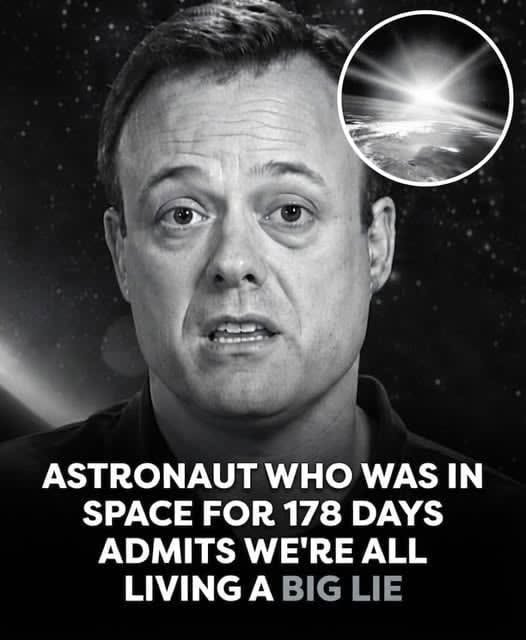
Astronaut Ron Garan Spent 178 Days in Space—Here’s the “Big Lie” He Says Earth Revealed
Seeing Earth From Space Changed His Perspective
Former NASA astronaut Ron Garan has seen Earth from a viewpoint only a small number of people will ever experience.
Across his space missions, Garan spent a total of 178 days away from Earth and completed 2,842 orbits around the planet.
He traveled more than 71 million miles and completed four spacewalks.
But the experience he talks about most is not a technical achievement.
It is what happened when he looked back at Earth.
The Atmosphere Looked Shockingly Thin
From the International Space Station, Garan could see storms flashing across the planet and auroras stretching above Earth.
What affected him most was the atmosphere.
From orbit, the layer surrounding Earth appeared remarkably thin.
Garan said the sight produced a powerful realization: that narrow layer supports every person, animal, plant, and ecosystem on the planet.
Against the darkness of space, Earth looked both beautiful and unusually fragile.
Astronauts Call This the “Overview Effect”
Garan’s experience is often described as the overview effect.
The term refers to a change in perspective reported by some astronauts after seeing Earth from space.
From orbit, political borders are invisible.
The planet appears as one interconnected system rather than a collection of separate countries.
For Garan, that view made many disagreements that dominate everyday life seem much smaller when compared with the shared environment on which everyone depends.
What Did He Mean by the “Big Lie”?
Garan has used deliberately strong language when explaining what he concluded from the experience.
He said that from space he could see forests, oceans, weather systems, cities, and a thin atmosphere supporting life.
What he could not see was the economy.
His point was not that economic systems are imaginary or unnecessary.
Instead, he argued that humanity often behaves as though the natural world exists primarily to support the economy.
From his perspective, that relationship should be reversed.
His Argument Is About Priorities
Garan believes the planet’s natural systems should come first because society and economic activity ultimately depend on them.
He has described the conventional order as economy, society, planet.
He argues that it should instead be understood as planet, society, economy.
Without a functioning environment, he says, neither society nor economic systems can continue successfully.
He Connected Environmental Problems Together
Garan also came to see problems such as climate change, deforestation, and biodiversity loss as connected rather than completely separate issues.
In his view, they reflect a broader failure to recognize humanity as one planetary species living within the same interconnected system.
That idea became central to the work he pursued after his NASA career.
There Are No Borders From Orbit
One of the most frequently mentioned aspects of seeing Earth from space is the absence of visible national boundaries.
Maps divide the planet into countries using lines and colors.
Earth itself does not.
From orbit, rivers cross borders.
Storm systems move between countries.
Smoke, air pollution, and changing weather patterns do not stop at political boundaries.
For Garan, the view reinforced how interconnected human problems really are.
He Did Not Return to Earth Rejecting Progress
Garan’s message is sometimes presented online in a more dramatic way than he intended.
He is not arguing that money, businesses, technology, or economies should disappear.
His argument is about perspective.
Economic activity should operate within the limits of the systems that make human life possible, rather than treating those systems as unlimited resources.
His Spaceflight Experience Shaped His Later Work
After his astronaut career, Garan became involved in humanitarian and social-enterprise projects.
He worked on initiatives designed to help organizations cooperate more effectively and supported projects involving clean water and sustainable development.
He also wrote about what he calls the “orbital perspective,” which takes the awareness created by the overview effect and asks how it can influence decisions on Earth.
The View Left Him With a Simple Question
Why do people spend so much time treating global problems as though they belong only to individual countries when everyone depends on the same planetary system?
That question became one of the central ideas behind Garan’s public speaking and writing.
He argues that cooperation does not require people to abandon their countries, cultures, or communities.
It requires recognizing that those identities exist within something larger.
Other Astronauts Have Described Similar Feelings
Garan is not the first astronaut to describe a psychological shift after looking at Earth from space.
For decades, astronauts have spoken about feeling greater appreciation for Earth’s fragility and a stronger sense of connection with people living on it.
That recurring experience is precisely why the term “overview effect” was created.
Individual astronauts describe it differently, but themes of unity, vulnerability, and environmental responsibility appear repeatedly.
The “Lie” Was Really an Assumption
The viral phrase can sound mysterious when removed from its context.
But Garan was not revealing hidden information about space.
He was challenging an assumption about life on Earth.
His argument is that humanity often behaves as though economic systems are the foundation supporting everything else.
From space, he came away believing the opposite.
The planet comes first because everything humans build exists inside it.
178 Days Changed How He Saw Home
Most people experience Earth from ground level, surrounded by cities, roads, borders, buildings, and institutions.
Garan experienced it from hundreds of miles above.
From there, the planet looked like one small, interconnected place surrounded by darkness.
That view did not give him secret knowledge.
It gave him a different scale for thinking about the problems people face.
And years after returning home, he continues trying to communicate the same lesson.
Humanity may live in different nations, but everyone is relying on the same extraordinarily thin layer of atmosphere and the same planet beneath it.