
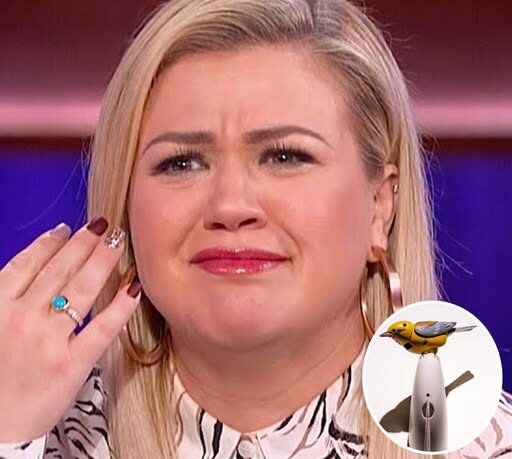
Kelly Clarkson Fires Back at Brooklyn Store After Disputed $15,000 Shopping Encounter Sparks Heated Debate
Kelly Clarkson Fires Back at Brooklyn Store After Disputed $15,000 Shopping Encounter Sparks Heated Debate
What began as an ordinary shopping trip in Brooklyn turned into an unexpected public disagreement involving Kelly Clarkson and a small specialty store. The singer described an encounter that left her feeling judged and unwelcome, while the business offered a different explanation of what happened.
At the center of the dispute was an unusual mechanical singing bird, a possible $15,000 purchase, and a conversation that Clarkson and the store appeared to remember very differently.
After Clarkson shared her frustration publicly on October 10, the store responded with a statement defending its approach to customers. But that explanation did not settle the matter.
Clarkson challenged the business’s version of events and presented photographs that she believed supported her account. A second statement from the store introduced further details about the mechanical bird, prompting another round of questions from people following the disagreement.
The exchange quickly developed into a broader discussion about customer service, celebrity influence, and the difficulties a small business can face when a disagreement becomes public.
A Shopping Trip That Kelly Clarkson Expected to Enjoy
Clarkson had traveled to Brooklyn intending to visit Art of Play, a specialty shop offering unusual gifts, puzzles, games, toys, and interactive experiences.
The store had attracted her interest because of its distinctive merchandise. She explained that she had already identified several items she wanted to explore purchasing.
Her visit was therefore not simply an unplanned stop. She had made the journey specifically because the shop appeared to offer products that appealed to her.
However, Clarkson later described feeling disappointed by her interaction with an employee.
In her account, she believed the employee made assumptions about her ability to afford an item before giving her an appropriate opportunity to consider the purchase.
The singer expressed particular frustration with the suggestion that she might prefer a comparable alternative.
For Clarkson, the problem was not merely whether she could purchase the product. She felt the way the conversation unfolded was dismissive and condescending.
Clarkson Shares Her Frustration Publicly
On October 10, Clarkson described the encounter in a post on X, explaining that she had traveled to the store because she admired its products and wanted to purchase several things.
She claimed that instead of receiving a welcoming shopping experience, she was treated as though the merchandise was beyond her financial means.
Her message communicated disappointment that a store she had been excited to visit had left her feeling uncomfortable.
Clarkson also suggested that the business had missed an opportunity to make a substantial sale.
She then compared her experience to a recognizable shopping scene from the film Pretty Woman, in which Julia Roberts’ character encounters dismissive treatment at a luxury boutique.
The comparison made Clarkson’s complaint particularly memorable because it emphasized the feeling of being evaluated on appearance rather than treated as a potential customer.
Her comments quickly attracted responses from people who viewed the incident as an example of why businesses should avoid making assumptions about shoppers.
Fans Question Whether Customers Are Treated Equally
Following Clarkson’s post, some social media users expressed disbelief that a recognizable celebrity could have experienced the interaction she described.
Others argued that her fame should not be the focus of the disagreement.
Instead, they emphasized that all customers deserve respectful treatment regardless of whether employees recognize them or believe they can afford an expensive product.
One response suggested that the employee’s possible unfamiliarity with Clarkson was irrelevant because considerate customer service should not depend on celebrity status.
This perspective became an important part of the discussion.
For Clarkson’s supporters, the alleged problem was not that a famous customer had failed to receive special treatment. It was that any shopper could potentially feel embarrassed by an assumption about their finances.
However, the public conversation soon changed when Art of Play presented its own explanation.
Art of Play Responds to the Accusations
The Brooklyn business issued a statement explaining that Clarkson had expressed interest in a mechanical bird called Molly.
The store described Molly as a distinctive singing and dancing automaton used during its magical performances.
It explained that the bird was permanently attached to a wall and was not available for purchase.
According to the business, the employee’s response concerned the availability of this particular item rather than any judgment about Clarkson’s financial circumstances.
The store also acknowledged that feeling judged while shopping could be upsetting, regardless of the circumstances.
It emphasized that visitors were welcome whether they intended to buy something or simply spend time exploring the merchandise.
Art of Play described its environment as one where customers were encouraged to interact with products, experiment with puzzles, and enjoy the unusual selection of games and toys.
Rather than requiring visitors to make purchases, the store said it welcomed people who wanted to browse.
The Business Describes the Impact of Sudden Public Attention
Beyond explaining the bird’s availability, Art of Play addressed the consequences of Clarkson’s public complaint.
The store expressed surprise at becoming the subject of widespread criticism following the singer’s post.
As a small local business, it described the experience of receiving attention from a massive online audience as overwhelming.
The company’s statement suggested that many people criticizing the shop had never visited it or experienced its customer service themselves.
It thanked supporters who had offered encouragement while also welcoming people who had discovered the business because of the controversy.
The store expressed hope that it might eventually resolve the disagreement directly with Clarkson.
Its response also included a lighthearted reference to one of the singer’s well-known songs about becoming stronger after difficult experiences.
However, the statement did not end the disagreement. Instead, it prompted a new debate about the responsibilities of celebrities when criticizing smaller businesses publicly.
Some Critics Accuse Clarkson of Using Her Influence Unfairly
After Art of Play responded, the discussion began shifting beyond the original shopping experience.
Some observers questioned whether Clarkson should have publicly named a small business following a disagreement with one employee.
They argued that a celebrity with a large audience could expose a local store to substantial criticism, even when the details of a customer interaction remained disputed.
One critic characterized Clarkson’s decision as an excessive response to a personally disappointing encounter.
Others suggested that the store should have been given an opportunity to explain privately before the complaint reached such a wide audience.
These reactions contrasted sharply with the earlier responses defending Clarkson’s right to speak about what she considered disrespectful treatment.
The disagreement was no longer only about the sale of an expensive mechanical bird.
It had also become a question of how public figures and small businesses should handle conflicts when social media allows both sides to reach large audiences.
Kelly Clarkson Challenges the Store’s Explanation
Clarkson did not accept the business’s initial statement that the mechanical bird was unavailable for purchase.
She responded publicly, describing a conversation that differed significantly from the store’s account.
According to Clarkson, she had pointed toward a displayed price tag identifying a singing bird and asked whether the item was for sale.
She claimed an employee confirmed that it was available but emphasized its $15,000 price.
Clarkson described the employee’s manner as condescending and said she was offered the possibility of finding a comparable alternative.
In her view, that response demonstrated the very assumption she had criticized in her original complaint.
She also challenged the suggestion that the item had never been offered for sale, questioning why pricing information had been displayed.
Her response made clear that she considered the dispute to be about honesty and respect, not simply about disappointment over an unavailable product.
Photographs of a Price Tag Add Another Question
To support her account, Clarkson included photographs that appeared to show the mechanical bird displayed near pricing information.
The images became an important part of the public exchange because they seemed to raise questions about the store’s initial explanation.
Clarkson maintained that the employee had indicated the bird was available for $15,000.
The business, meanwhile, had described its own Molly automaton as permanently attached to the wall and unavailable for purchase.
Without additional context, the photographs alone could not establish exactly which item the displayed pricing concerned or what was said during the conversation.
Nevertheless, they gave people following the disagreement another detail to examine.
The discussion increasingly focused on whether the store’s statements were consistent and whether the apparent price tag related to Molly or another mechanical bird.
Clarkson Defends Her Support for Small Businesses
Clarkson also addressed criticism that she had unfairly targeted an independent shop.
She emphasized that her decision to visit Art of Play reflected genuine interest in supporting a small business.
Her argument was that customers should not be expected to overlook disrespectful treatment simply because a company is independently owned.
She maintained that kindness and professionalism were reasonable expectations for any retail interaction.
Clarkson also distinguished between her appreciation for the shop’s merchandise and her disappointment with the way she believed she had been treated.
She continued to describe the store itself as appealing, while criticizing the individual interaction that prompted her complaint.
For her, the principle remained straightforward: a business can offer interesting products and still leave a customer feeling unwelcome if an interaction is handled poorly.
But Art of Play soon released another statement that added substantial new details to the story.
Art of Play Issues a Second Explanation
In its follow-up response, the store described Clarkson’s visit in greater detail and characterized the disagreement as a misunderstanding.
It stated that the singer had spent approximately five minutes inside the shop.
During that time, she had asked about Molly, the mechanical bird displayed on the wall.
The business repeated that its own bird was a permanent installation and served as an unofficial mascot for the store.
However, the statement introduced another important piece of information.
Art of Play explained that the artist responsible for creating the mechanical birds possessed another similar automaton that could potentially be purchased.
The creator, Bliss Kolb, was identified as an artist living in Seattle.
The store said Kolb had indicated a willingness to sell the other bird for $15,000.
This explanation offered a possible reason for the price Clarkson said had been discussed during her visit.
The $15,000 Bird and the $2,000 Alternative
According to Art of Play’s second statement, the mechanical bird displayed in Brooklyn was not itself available for purchase.
Instead, the $15,000 figure concerned a nearly identical automaton owned by its creator.
The store said this distinction had been explained to Clarkson during their conversation.
It also revealed that an additional singing bird automaton was available as another option.
That alternative had been produced by a traditional clockmaking workshop in Germany and was priced at approximately $2,000.
Unlike the wall-mounted Molly, the business said the less expensive bird could have been purchased and taken home immediately.
The store maintained that Clarkson left before having an opportunity to examine that particular product.
In this version of events, the employee’s offer to find something comparable was intended as assistance rather than an assumption that Clarkson could not afford the original item.
However, Clarkson had already described that same offer as the part of the interaction that made her feel judged.
Why the Second Statement Sparked More Confusion
Rather than completely settling the disagreement, the additional explanation generated further discussion online.
Some observers questioned the difference between the store’s initial description of Molly as a unique, unavailable item and its later statement about another nearly identical bird.
Others focused on the wording used to describe the automaton, suggesting that a bird characterized as one of a kind should not also have a twin.
The store’s explanation distinguished between the permanent bird displayed in Brooklyn and a separate creation owned by the artist.
Yet several people remained skeptical about why that distinction had not been made clearer in the initial response.
At the heart of the confusion was whether Clarkson and the employee had been discussing the displayed bird, the artist’s other automaton, or the additional German-made alternative.
Those differences became central to understanding how the encounter might have developed into a disagreement.

Two Accounts of the Same Shopping Experience
The public statements reveal two contrasting interpretations of the interaction.
Clarkson maintains that the employee’s tone and comments made her feel as though her ability to afford an expensive item had been questioned.
Art of Play maintains that its employee was explaining the availability and pricing of different mechanical birds.
These accounts are not necessarily disagreements about every detail. Both involve Clarkson’s interest in a singing bird and a discussion of an item valued at $15,000.
The central conflict concerns how the conversation was conducted and what the employee intended by offering an alternative.
Clarkson interpreted the interaction as condescending. The store described its response as an effort to explain the available purchasing options.
The statements alone do not conclusively establish the employee’s tone or the complete sequence of the conversation.
That uncertainty helps explain why the disagreement continued even after both sides offered detailed explanations.
The Larger Debate About Customer Service and Celebrity Influence
The controversy has raised questions extending beyond Clarkson and Art of Play.
One concerns the importance of making customers feel comfortable when discussing expensive merchandise.
Another involves how businesses can clearly communicate when a displayed product is not actually available for purchase.
The situation also highlights the effects of public complaints when the customer involved has a substantial audience.
A negative experience shared by an ordinary shopper may receive limited attention, while a similar complaint from a celebrity can quickly become a widely discussed story.
That visibility gives public figures a powerful platform for describing their experiences, but it also increases the potential impact on the businesses involved.
At the same time, independent businesses must be able to respond when they believe an accusation does not accurately represent what occurred.
The exchange between Clarkson and Art of Play illustrates the difficulty of resolving a personal interaction once conflicting interpretations become part of a larger online discussion.
Will Kelly Clarkson and Art of Play Resolve Their Disagreement?
In its second statement, Art of Play said it had contacted Clarkson directly in an effort to resolve the dispute.
The business expressed a desire to clear up the misunderstanding and suggested that it hoped the situation might eventually become something both sides could look back on with humor.
Its message was notably conciliatory compared with the frustration expressed during the earlier public exchange.
Clarkson, meanwhile, had made clear that she stood by her description of the encounter and objected to the store’s initial explanation.
The supplied account does not establish whether the parties ultimately reached an agreement or had a further private conversation.
For now, their public statements remain the clearest record of how each side interpreted the incident.
A Shopping Dispute That Became an Unexpected Public Controversy
Kelly Clarkson’s visit to Art of Play began with genuine enthusiasm for a Brooklyn store known for its imaginative products.
Instead, the experience resulted in a public disagreement over a mechanical bird, its availability, and the manner in which its price was discussed.
Clarkson believed she had been unfairly judged, while the business maintained that it was attempting to explain the differences between several unusual items.
The store’s subsequent clarification identified a $15,000 automaton owned by an artist in Seattle and a separate German-made alternative priced at approximately $2,000.
Those details helped explain the possible source of the confusion but did not resolve the conflicting interpretations of the employee’s conduct.
What might otherwise have remained a brief disagreement inside a specialty shop became a widely discussed controversy about fairness, respect, and the influence of public criticism.
Ultimately, the experience serves as a reminder that customer service depends not only on the information communicated but also on how people understand the interaction.
Whether Clarkson and Art of Play eventually reconcile their accounts remains unresolved in the available material. What is clear is that a five-minute visit and a conversation about an unusual singing bird developed into a much larger debate than either side likely expected.