
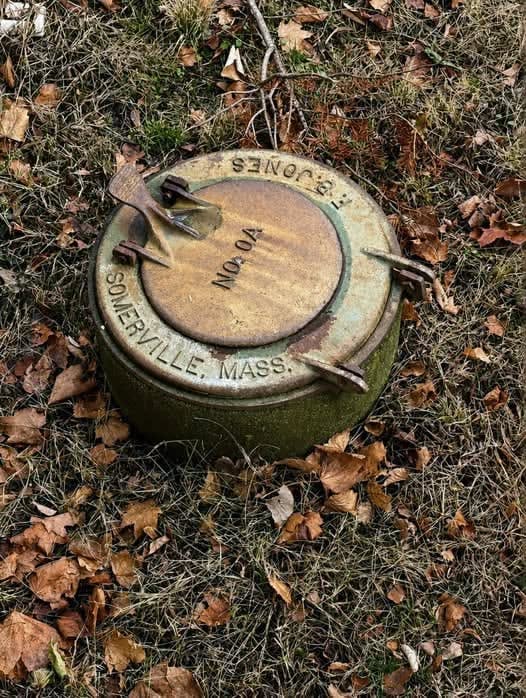
Man Finds a Rusted Metal Hatch Hidden in His Backyard — Then Learns What It Was Really Used For
A Strange Discovery Beneath Autumn Leaves Leads to an Unexpected Piece of Neighborhood History
When Mike called a friend and said he had discovered something unusual in his backyard, the description immediately sounded mysterious.
Beneath a thick layer of autumn leaves was a heavy, rusted metal hatch embedded in the ground.
The lid was old, weathered, and stamped with the words “Somerville, Mass.”
At first glance, it looked like the entrance to something much larger hidden beneath the yard.
Was it an old water tank?
A forgotten utility vault?
Could it even be some kind of underground shelter left behind by a previous owner?
The possibilities made the discovery far more interesting than an ordinary piece of buried metal.
But after looking into what the hatch actually was, the explanation turned out to be much more practical.
And in its own way, much more fascinating.
The Mysterious Hatch Was Part of an Underground Garbage System
The rusted lid was connected to an old underground garbage container.
Systems like these were once used in parts of New England as a way to store household waste below ground rather than leaving garbage cans exposed beside a house.
Today, the idea may seem unusual.
Most people are accustomed to large plastic bins, wheeled carts, and regular curbside garbage collection.
But household waste disposal did not always work that way.
Before modern sanitation systems became standardized, homeowners often had to deal with heavy metal garbage cans that could create a long list of problems.
Underground garbage containers were one attempt to make that daily task cleaner, more organized, and easier to manage.
Household Garbage Was Once a Much Bigger Problem
Older garbage cans were usually made from metal.
They were heavy, prone to rust, and difficult to move when full.
During hot weather, exposed garbage could quickly develop strong odors.
Animals could knock lids aside or tip containers over while searching for food.
Strong winds could also move empty cans across yards and streets.
Rain created additional problems, particularly when water collected inside metal containers or around outdoor storage areas.
For homeowners trying to keep their property clean, garbage storage could become an unpleasant and constant challenge.
Placing the container underground provided an alternative.
How Underground Garbage Containers Worked
The basic design was surprisingly simple.
A container or well was installed below the surface of the yard.
Only a sturdy metal lid or hatch remained visible at ground level.
Household garbage could be placed inside the underground container and kept there until collection day.
The surrounding soil helped shield the waste from direct sunlight.
That natural insulation could help reduce some of the heat associated with garbage sitting outdoors during warm weather.
The heavy metal lid also made it more difficult for animals to reach the contents.
Wind was less of a problem because most of the container was protected underground.
Instead of a loose garbage can sitting beside the house, much of the system remained hidden beneath the lawn.
Sanitation Workers Had to Remove the Inner Container
On collection days, sanitation workers would open the metal hatch.
Inside was typically a removable container that held the household waste.
The worker could lift the container from the underground well, empty it, and then return it to its place beneath the ground.
It required more physical effort than modern automated trash collection, but at the time it offered homeowners a relatively neat way to store garbage between pickups.
The system also kept unsightly waste containers partially out of view.
For neighborhoods where these systems were common, the small metal lids may once have been an ordinary feature of backyards and side yards.
Today, many people would have no idea what they were looking at.
The “Somerville, Mass.” Marking Added to the Mystery
The lettering on Mike’s hatch made the discovery especially interesting.
Seeing a town name stamped into an old metal object buried in the yard naturally suggested that it might once have served some official or municipal purpose.
That could explain why someone might initially suspect a utility connection or other underground infrastructure.
But markings like these could also point to where the container was manufactured or associated with local sanitation systems.
Instead of revealing a hidden bunker or forgotten tunnel, the words helped connect the object to a period when household waste was managed very differently.
Why These Systems Eventually Disappeared
Underground garbage containers solved certain problems, but they created others.
As municipal sanitation systems changed, the design became less practical.
Standardized curbside collection made it easier for workers to gather trash from the street rather than repeatedly lifting containers from underground wells.
Lightweight plastic garbage cans also began replacing heavy metal containers.
Later, wheeled carts made moving household waste even easier.
These newer containers could hold more garbage while requiring less physical effort from both homeowners and sanitation workers.
Eventually, underground systems no longer fit the way modern collection routes were organized.
Rust Became a Serious Problem
Metal buried in or near damp soil naturally deteriorates over time.
Rust became one of the most obvious weaknesses of underground garbage systems.
Lids could corrode.
Inner containers could weaken.
Hinges and handles could become difficult to operate.
Once the metal began breaking down, maintaining the system could become more trouble than replacing it with a conventional garbage can.
For a homeowner, repeatedly repairing an old underground unit made less sense as easier alternatives became available.
Drainage Could Turn the Underground Well Into a Problem
Water was another challenge.
An underground opening could collect rainwater if drainage was poor.
Moisture could accelerate rust and deterioration.
Standing water could also make the container unpleasant to use and difficult to clean.
If the surrounding soil shifted or drainage channels became blocked, the problem could become worse over time.
What had once been a clever storage solution could eventually become a rusty hole holding water and debris.
Harsh Winters Created Additional Difficulties
In New England, freezing temperatures added another complication.
Water around the lid or inside the underground structure could freeze.
That could make the hatch difficult to open during winter.
Frozen soil could also place additional pressure on the surrounding structure.
Repeated freezing and thawing could contribute to cracking, shifting, and gradual damage.
As modern garbage collection became easier, there was less reason to keep dealing with those problems.
Many Homeowners Eventually Abandoned the Old Containers
Once underground garbage systems were no longer useful, homeowners dealt with them in different ways.
Some removed the containers entirely.
Others filled the underground wells with soil.
Some covered the openings with paving stones or landscaping.
In many cases, the structures were simply forgotten.
Grass gradually grew over the edges.
Leaves collected on top.
Plants spread across areas that had once been opened regularly on garbage day.
After decades passed, a feature that had once been completely ordinary became almost invisible.
That Is Why Discoveries Like Mike’s Can Feel So Mysterious
When a modern homeowner uncovers one of these lids today, there may be no obvious clue explaining what it is.
The people who installed it may be long gone.
Previous owners may never have used it.
The neighborhood’s garbage collection system may have changed several times since the hatch was last opened.
Without context, an old metal door in the ground naturally invites speculation.
Its weight and construction can make it look more significant than an ordinary household object.
That is part of what makes the discovery so interesting.
Ordinary Household Objects Can Become Historical Artifacts
History is often associated with major events, famous buildings, or objects displayed in museums.
But everyday household technology can reveal just as much about how people once lived.
An underground garbage container tells a story about sanitation, neighborhood design, manual labor, and changing expectations about cleanliness.
It shows how people solved common problems before modern systems existed.
At one time, opening a metal hatch in the backyard to deposit garbage may have seemed completely normal.
Today, the same hatch can look like the entrance to something secret.
Modern Trash Collection Made the Old Design Obsolete
The rise of wheeled plastic carts changed household garbage collection dramatically.
They were lighter than old metal cans.
They could be rolled directly to the curb.
Their lids were designed to close securely.
Many could also be lifted mechanically by collection vehicles.
That reduced the need for sanitation workers to repeatedly lift heavy containers by hand.
As cities and towns adopted these systems, underground garbage wells lost most of their practical advantage.
The old design quietly disappeared from everyday use.
Many Younger Homeowners Have Never Seen One
Because these systems vanished gradually, there was no single moment when they became historical objects.
One generation remembered using them.
Another remembered seeing abandoned lids in older yards.
Later homeowners sometimes had no idea what the metal circles or hatches were.
That gap in memory is what allows a simple backyard discovery to become a mystery.
An object can remain in place long after knowledge of its original purpose has disappeared.
Old Underground Containers Can Sometimes Be Reused
Some homeowners choose not to remove these structures after discovering them.
If an old container is safe and structurally sound, it may be possible to give it a new purpose.
People have transformed old underground spaces into planters or storage areas.
Others simply preserve the lid as an unusual piece of the property’s history.
The important consideration is the condition of the structure.
Decades of corrosion and exposure can weaken metal, so an abandoned underground container should not automatically be assumed to be safe.
The Discovery Offers a Glimpse Into Everyday Life From Another Era
What makes Mike’s find interesting is not that it led to a dramatic hidden chamber.
It is interesting because the explanation is so ordinary.
Someone once used that hatch regularly.
A family may have opened it every day to dispose of household waste.
Sanitation workers may have visited it repeatedly during collection routes.
Then the system became outdated.
It was abandoned, covered, and forgotten.
Years later, another homeowner discovered it and had to investigate what it had once been.
A Rusted Lid Became a Reminder of How Quickly Daily Life Changes
Household routines can seem permanent while people are living through them.
Garbage goes into a bin.
The bin goes to the curb.
A truck arrives and empties it.
That system feels completely normal today.
But previous generations developed different solutions based on the technology and services available at the time.
Underground garbage containers were one of those solutions.
They addressed real problems involving animals, weather, odors, and storage.
Eventually, newer technology replaced them.
Sometimes History Really Is Hidden in the Backyard
Mike’s discovery began with a simple question about a rusted piece of metal beneath some leaves.
For a moment, it seemed possible that the hatch might lead to something unusual underground.
The truth was far less dramatic but still revealing.
It was the remains of an old household garbage system, a design once practical enough to be used in neighborhoods across parts of New England.
Today, only scattered examples remain beneath lawns, gardens, and patios.
They are easy to overlook until a homeowner happens to uncover one.
Then an ordinary backyard can suddenly reveal how people lived decades earlier.
The rusted hatch was not hiding treasure or a secret shelter.
It was hiding something more familiar: a forgotten solution to one of everyday life’s oldest problems.
And sometimes those ordinary discoveries provide the clearest reminder that history does not always sit behind museum glass.
Sometimes it is buried only a few inches beneath the grass.