
Part 2 of 2
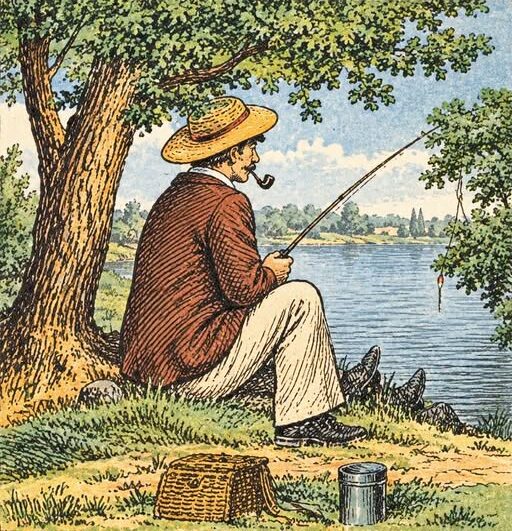
The secret is not another small person standing somewhere beside the fisherman.
The second man is much larger than that.
His face is hidden inside the landscape.
The trees, shadows, rocks and natural contours work together to create the impression of a giant human face.
At first, those elements simply look like part of the scenery.
But once your brain connects them, everything rearranges itself.
The darker areas begin to resemble eyes.
The curves of the terrain suggest a nose and cheek.
Branches and foliage begin to look like hair.
And suddenly the background no longer feels like background at all.
It feels like someone has been watching the fisherman the entire time.
That sudden shift is a classic example of how perception can change without the image itself changing.
Nothing new has appeared.
The hidden face was always there.
Your brain simply had not categorized those shapes as a face yet.
Human beings are remarkably good at detecting faces.
We can sometimes recognize them in clouds, rocks, buildings and even random shadows.
That tendency is one reason hidden-image puzzles can be so effective.
The artist gives your brain enough visual information to create two different interpretations.
The first is obvious.
A fisherman beside a peaceful body of water.
The second only appears after you stop focusing on individual objects and begin seeing the larger pattern.
That is also why people often have such different reactions to the same illusion.
One person may notice the hidden face immediately.
Another may need a hint.
Someone else may not see it until the exact location is pointed out.
None of those reactions mean anything is wrong with your eyesight.
They simply show how strongly attention influences perception.
Your brain does not process every visible detail with equal importance.
It selects.
It filters.
And it constantly makes predictions about what you are looking at.
In this picture, your first prediction is probably correct.
There really is a fisherman.
There really is water.
There really is a quiet landscape.
But that first interpretation is incomplete.
There is another image hiding inside it.
That is what gives the illustration its strange atmosphere.
Before spotting the second man, the scene feels peaceful.
After spotting him, it can feel almost unsettling.
The same trees suddenly seem intentional.
The same shadows feel like features.
The entire landscape seems to be looking back at you.
And once that happens, it is difficult to see the image the old way again.
That is the real appeal of this puzzle.
It is not only about finding a hidden face.
It is about experiencing the exact moment when your perception changes.
One second, you are looking at an ordinary fishing scene.
The next, you are wondering how you ever failed to notice the enormous figure hidden inside it.
So if you spotted the second man quickly, congratulations. If you needed a little longer, look again at the larger shapes instead of the small details — because the answer has been staring back at you the whole time.