
Giraffe With Bark-Like Skin Stuns Photographer in Kruger National Park
An Unusual Sight in the South African Bush
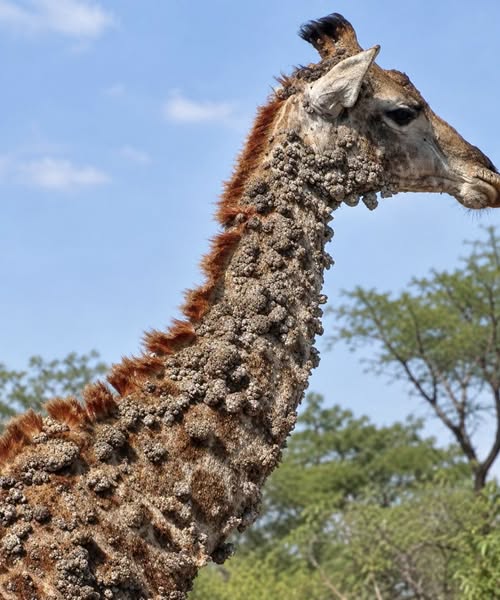
A wildlife photographer visiting South Africa’s Kruger National Park encountered a giraffe whose appearance was so unusual that, at first, she believed part of the animal was hidden behind vegetation.
Photographer Helen Olive, from Oxfordshire, England, initially thought the strange texture covering the giraffe’s neck came from surrounding bushes.
Only after looking more closely did she realize that the rough, bark-like surface was actually part of the giraffe’s skin.
The animal’s neck was covered with thick, crusty growths that made its natural pattern difficult to recognize in places.
For someone accustomed to seeing giraffes with smooth, patterned coats, the sight was immediately striking.
The Bark-Like Texture Was Part of the Animal’s Skin
What appeared at first to be camouflage or vegetation was actually a series of skin lesions.
The growths had developed across portions of the giraffe’s neck, giving the skin an unusually rough and uneven appearance.
The texture resembled tree bark because the affected areas had become thickened and crusted.
The photographs captured an animal that looked dramatically different from the healthy giraffe most visitors expect to see in a protected reserve.
Despite the unsettling appearance, the condition did not necessarily mean the giraffe was facing an immediate life-threatening problem.
Papillomavirus Was Linked to the Lesions
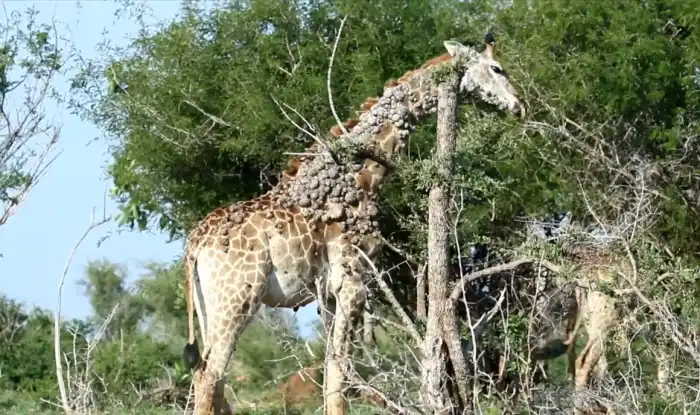
The unusual growths were attributed to papillomavirus.
This type of infection can cause thick, raised, and crusty changes to the skin.
The resulting lesions may look severe, especially when they cover a large visible area of an animal’s body.
In the giraffe photographed by Olive, the changes were particularly noticeable because they affected the long neck, one of the animal’s most recognizable features.
The condition transformed an otherwise ordinary wildlife sighting into something far more memorable.
The Appearance Can Be More Alarming Than the Immediate Risk
Although the lesions looked dramatic, they are generally not considered life-threatening by themselves.
The giraffe’s unusual appearance therefore did not automatically mean the animal was dying.
Without additional complications, survival remains possible.
The greater concern comes from what the lesions can cause indirectly.
Skin that becomes irritated may encourage repeated scratching.
That scratching can damage the surface and create open wounds.
Scratching Can Create a Secondary Problem
When irritated skin is repeatedly rubbed or scratched, the protective surface can break.
Once the skin is damaged, wounds can become vulnerable to secondary infections.
This creates a different risk from the original papillomavirus infection itself.
The growths may not be immediately dangerous, but the injuries caused by persistent irritation can create additional health problems.
For a wild giraffe, avoiding that irritation completely may be difficult.
The animal continues moving through natural vegetation, interacting with other wildlife, and living without the type of direct medical care available to domestic animals.
The Condition Highlights the Challenges Wild Animals Face
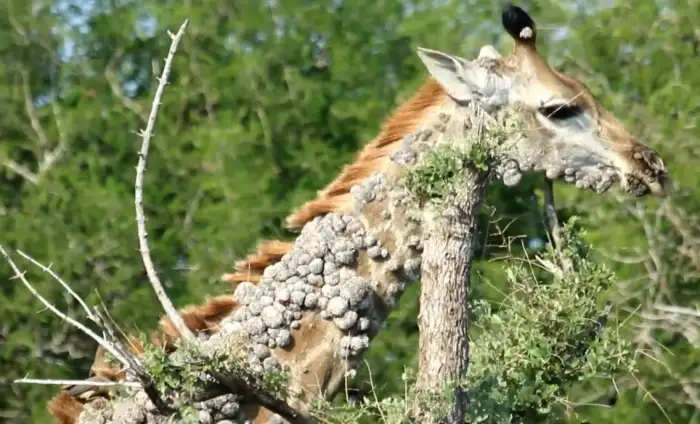
Seeing an animal inside a protected national park can create the impression that it is protected from every possible danger.
In reality, protected status does not remove disease, infection, injury, or other natural health challenges.
The giraffe’s condition is a reminder that wildlife can experience serious physical problems even in environments designed to preserve habitats and animal populations.
Conservation areas can protect animals from many human-related threats, but they cannot eliminate every biological challenge.
Disease remains part of life in the wild.
Oxpeckers May Play a Role in Spreading the Infection
Another part of the giraffe’s situation involves oxpeckers.
These birds are commonly seen on large mammals and are known for removing ticks from their skin.
However, their feeding behavior may also contribute to the spread of infection when they peck at affected areas.
If an oxpecker comes into contact with damaged or infected skin and then moves to another area, it may help spread the condition.
This creates an unexpected complication in a relationship that is often associated with tick removal.
Helpful Behavior Can Have Unintended Effects
Oxpeckers are familiar sights on large African mammals.
Their presence is often linked with feeding on ticks and other material found on the skin.
But pecking at irritated or infected tissue can potentially have consequences beyond ordinary feeding.
In the case of papillomavirus lesions, contact with affected areas may contribute to transmission.
This illustrates how interactions between species can have both helpful and harmful effects depending on the circumstances.
The Virus Is Typically Adapted to Particular Hosts
Papillomaviruses are generally adapted to specific host species.
That means the condition affecting this giraffe is not considered a threat to visitors in the national park.
The unusual appearance of the animal may be alarming, but it does not indicate that people nearby face the same infection risk.
This distinction is important because dramatic-looking wildlife conditions can sometimes create unnecessary fear.
The giraffe’s condition is primarily an animal health issue rather than a public health concern for tourists.
The Photographs Captured More Than a Rare Appearance
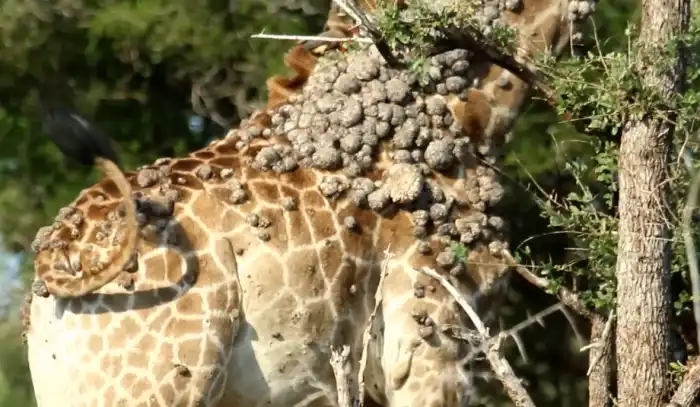
Olive’s photographs are remarkable because of how dramatically the lesions changed the giraffe’s appearance.
But the images also reveal something less obvious about wildlife.
Animals living in the wild may continue moving, feeding, and surviving while dealing with physical problems that are rarely visible to visitors.
A short safari encounter can therefore reveal only a small part of an animal’s daily reality.
The giraffe’s bark-like skin made that hidden struggle unusually visible.
Its Condition Did Not Automatically Mean the Worst
One of the most important details surrounding the sighting is that the giraffe’s appearance alone does not establish that it is close to death.
The lesions may look severe, but without secondary complications, the animal can continue surviving.
The main concern is whether irritation leads to repeated scratching, broken skin, and infection.
That makes the condition something to monitor rather than a reason to assume an immediate fatal outcome.
Wild animals can sometimes tolerate visible abnormalities better than their appearance might suggest.
Protected Parks Still Contain Natural Health Risks
Kruger National Park provides protected habitat for a wide variety of wildlife.
But protection from hunting or habitat destruction does not mean individual animals are free from illness.
Viruses, parasites, injuries, and infections remain part of the ecosystem.
The giraffe photographed by Olive shows how conservation and natural health challenges can exist at the same time.
A national park can offer space, food, and protection while animals still face biological risks beyond human control.
The Lesions Created a Powerful Visual Illusion
Part of what made the sighting so memorable was the way the affected skin blended visually with the surrounding landscape.
The rough texture looked enough like tree bark that Olive initially believed vegetation was obscuring part of the giraffe.
Only after watching more carefully did she realize that the texture was attached to the animal itself.
That moment of recognition transformed the sighting from ordinary wildlife observation into something unexpected.
The photographs captured the contrast between the giraffe’s familiar shape and the unfamiliar condition affecting its skin.
The Giraffe Became a Reminder of Wildlife Resilience
The animal’s condition also revealed the resilience required for survival in the wild.
Despite carrying extensive visible lesions, the giraffe remained part of the landscape of Kruger National Park.
Its appearance reflected a physical challenge, but not necessarily an immediate end to its life.
Wildlife often continues functioning while dealing with injuries, infections, and other difficulties that humans may never notice.
This giraffe happened to make that struggle visible in a particularly dramatic way.
Secondary Infection Remains the Greater Concern
The papillomavirus-related growths themselves are generally not the most serious danger described in the giraffe’s condition.
The more significant concern comes if the lesions become irritated enough to cause repeated scratching.
Broken skin can expose tissue to additional infection.
That process can turn an otherwise manageable condition into something more serious.
For that reason, the giraffe’s future depends partly on whether complications develop.
The Encounter Offered a Different View of Life in the Wild
Wildlife photography often focuses on dramatic hunts, newborn animals, striking landscapes, or rare behavior.
Olive’s encounter showed another side of nature.
The giraffe was not involved in a chase or a spectacular display.
Instead, the photographs documented an animal living with a visible health condition.
That made the encounter unusual in a different way.
It offered a glimpse into the quiet physical struggles that can unfold throughout a natural ecosystem.
Visitors Were Not Considered at Risk
Although the giraffe’s appearance might concern people seeing the photographs, papillomaviruses are generally host-specific.
The condition affecting the giraffe is therefore not considered a danger to visitors simply because they are near the animal.
This helps separate the dramatic visual impact of the lesions from the actual risk they represent to humans.
The animal itself faces the challenge, particularly if damaged skin becomes infected.
For park visitors, the sighting remains an unusual wildlife observation rather than a known health threat.
An Extraordinary Photograph With a Sobering Message
What began as a normal wildlife sighting became something Helen Olive would remember for a very different reason.
The giraffe’s neck appeared covered in rough, bark-like tissue, creating an image that was both fascinating and unsettling.
The explanation was not camouflage or vegetation but skin lesions associated with papillomavirus.
Although those growths are generally not fatal on their own, irritation and secondary infection can create additional risks.
Oxpeckers may also contribute to spreading infection when they peck at affected areas.
The giraffe’s condition is not considered a threat to park visitors, and its appearance alone does not mean it is dying.
Instead, the photographs provide a rare look at the health challenges wild animals can carry while continuing to live inside a protected environment.
In a place as vast and celebrated as Kruger National Park, even a familiar animal such as a giraffe can reveal an unexpected story about survival, disease, and the realities of life in the wild.