
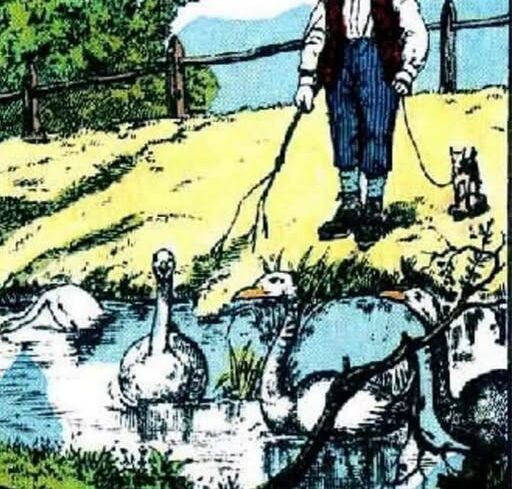
Can You Spot the Fifth Goose in This Picture? This Tricky Hidden-Object Puzzle Is Harder Than It Looks
A Simple Countryside Picture With a Surprising Hidden Challenge
At first glance, the illustration appears to show an ordinary countryside scene. A farmer stands beside a peaceful pond, holding a slender stick while several geese float nearby.
Nothing about the picture initially seems unusual. The setting is calm, the animals are easy to recognize, and the drawing has the familiar appearance of a vintage illustration.
But there is a challenge concealed within the scene.
Although four geese are relatively easy to identify, the puzzle asks viewers to locate a fifth bird that is not immediately obvious.
The hidden goose is what makes this visual challenge interesting. Instead of appearing in the same straightforward way as the other birds, it is incorporated into the illustration in a manner that encourages closer inspection.
The challenge is simple: can you find all five geese without receiving any additional clues?
Give yourself ten seconds to examine the picture before continuing.
Look carefully, because the missing bird may not be where you expect it.
Why the Fifth Goose Is So Difficult to Notice
Hidden-object puzzles often take advantage of the way people naturally interpret pictures.
When looking at an illustration, viewers usually identify the most recognizable elements first.
In this case, attention naturally moves toward the pond, where the visible geese provide an obvious starting point.
Once those birds have been counted, the brain may continue searching the same area because it expects the remaining goose to look similar.
That expectation can make the challenge more difficult.
The missing bird may be concealed within parts of the illustration that initially appear to serve another purpose.
A curved outline might be interpreted as part of the landscape, while an unusual space between objects may go unnoticed.
Instead of treating every line as an independent visual clue, the viewer tends to organize the picture into familiar objects.
This ordinary process of interpretation helps people recognize scenes quickly, but it can also make cleverly concealed shapes harder to identify.
Start by Examining the Four Visible Geese
The first step is to identify the birds that are already easy to see.
Focus on the pond and locate the four recognizable geese.
Once you have counted them, avoid repeatedly examining only those same animals.
The puzzle becomes more interesting when you begin exploring other parts of the drawing.
Consider how each visible goose is represented.
Look at the curved necks, the general shape of their bodies, and the outlines that distinguish them from the surrounding water.
These visual characteristics may help you recognize another goose-shaped form elsewhere in the illustration.
The important point is not to assume that every bird must appear as a complete, clearly separated figure.
A hidden-object challenge may rely on shapes that initially resemble something else.
Look Beyond the Water for Unexpected Shapes
If you have already counted four geese in the pond, move your attention away from the water.
The surrounding countryside contains other details worth examining.
Begin with the farmer standing beside the pond.
Study the outline of his clothing, the position of his body, and the slender stick he is holding.
Then examine the vegetation nearby.
Leaves, branches, and irregular lines can create shapes that are easy to overlook when they are treated as ordinary background scenery.
Next, pay attention to the empty spaces between objects.
Sometimes the most important part of a visual puzzle is not a clearly drawn figure, but the shape formed by the surrounding lines.
A familiar outline can become recognizable only after the viewer stops focusing exclusively on the objects that first attracted attention.
This approach may help you notice details that did not seem important during your initial inspection.
Why Your First Impression Can Be Misleading
When people encounter a familiar scene, they quickly form an understanding of what they are seeing.
A farmer beside a pond suggests a rural setting. Geese in the water reinforce that interpretation.
Once the overall scene is understood, smaller details may receive less attention.
That does not mean the viewer is careless or has poor eyesight.
It simply reflects the way visual attention is often directed toward recognizable objects and meaningful parts of a picture.
Hidden-object puzzles use this tendency to create a challenge.
The viewer knows that something additional is present, but the expected arrangement of the scene can make it harder to identify.
For this reason, finding the fifth goose may require changing how you examine the illustration rather than simply looking harder at the same location.
A Ten-Second Challenge That Encourages Closer Observation
The puzzle invites viewers to search for the missing goose within ten seconds.
That time limit creates a playful sense of urgency.
Some people may recognize an unusual shape immediately, while others may need considerably longer to inspect the scene.
There is no need to feel discouraged if the answer does not become obvious within the suggested time.
The ten-second limit is part of the entertainment rather than a formal measure of visual ability.
Different people may notice different parts of the picture first.
Someone might immediately focus on the farmer, while another person may spend the entire interval examining the birds in the pond.
Those differences can affect how quickly the hidden object is discovered.
The important goal is to enjoy the search and challenge your initial interpretation of the illustration.
Try Looking at the Picture From a Different Perspective
If the fifth goose remains hidden, changing your viewing approach may help.
One useful technique is to examine the illustration from a slightly greater distance.
Stepping back can make larger outlines easier to recognize without becoming distracted by small decorative details.
Another possibility is to zoom in on different sections of the drawing.
Looking more closely may reveal unusual curves or connections that were not obvious at the original size.
You can also pause briefly before returning to the picture.
After concentrating on one area for too long, it is easy to continue seeing the same arrangement of shapes.
A short break may encourage a different interpretation when you look again.
There is no single method that guarantees an immediate discovery.
However, exploring the image in several ways can make the process more engaging.
Pay Attention to the Farmer’s Outline
The farmer is one of the most prominent features of the illustration.
Because he is presented as an ordinary part of the countryside scene, viewers may not initially consider him relevant to the hidden-object challenge.
But his outline deserves closer attention.
Examine the boundaries formed by his clothing and the objects surrounding him.
Look for shapes that might resemble the curved neck or body of a goose.
The slender stick he carries may also influence how nearby lines are interpreted.
The purpose of examining these details is not to assume that the hidden bird must be part of the farmer.
Instead, it is to broaden the search beyond the most obvious area.
When a puzzle directs attention toward one group of objects, looking elsewhere can reveal details that were initially overlooked.
The Surrounding Vegetation May Offer Useful Clues
Plants and other natural features often contain irregular outlines.
In a vintage-style illustration, these shapes may be represented through a collection of curved lines and shaded areas.
Such details can create patterns that resemble recognizable objects when viewed differently.
As you examine the vegetation around the pond, consider whether any part of it appears unusually shaped.
Look for curves that seem distinct from the surrounding lines.
Also examine where vegetation meets the farmer’s outline or the edge of the water.
These boundaries may create shapes that do not immediately stand out when the picture is viewed as a complete countryside scene.
The key is to inspect without deciding too quickly what each line represents.
Sometimes an ordinary-looking background detail becomes more interesting when examined independently.
Understanding Hidden Shapes and Negative Space
One useful concept when approaching visual puzzles is negative space.
Negative space refers to the areas surrounding or separating the main objects in an illustration.
Viewers usually concentrate on the recognizable figures rather than the empty areas between them.
But those spaces can sometimes form meaningful outlines of their own.
For example, the gap between two objects may create a curved shape that becomes recognizable when attention shifts away from the objects themselves.
This can make hidden-object puzzles particularly satisfying.
The concealed figure may seem invisible until the viewer recognizes a different arrangement of the same lines.
After that discovery, the shape may become much easier to notice.
In the goose puzzle, examining the spaces between the farmer, vegetation, and other features is a useful part of the search.
It encourages viewers to consider the entire illustration instead of treating the visible geese as the only relevant elements.
Does Finding the Goose Reveal Your Brain’s Age?
Some versions of visual challenges use playful claims about intelligence, mental sharpness, or the age of a person’s brain.
Those claims should not be interpreted as medical or scientific conclusions.
Finding a hidden goose in an illustration does not establish someone’s cognitive age.
It also cannot determine whether a person has a particular level of intelligence or cognitive health.
The time required to solve a visual puzzle can be influenced by several ordinary factors, including attention, familiarity with similar challenges, image quality, and the size of the picture being viewed.
A person who recognizes the hidden bird quickly has successfully completed an entertaining observation task.
Someone who needs more time has not failed a medical or psychological assessment.
The illustration is best understood as a recreational challenge rather than a diagnostic test.
Its purpose is to encourage careful looking and provide a satisfying moment when the concealed shape becomes recognizable.
Why These Puzzles Are Popular With Families and Friends
Hidden-object challenges are easy to share because they require very little preparation.
People can examine the same illustration and compare what they notice.
One person may immediately identify a possible answer, while another may see only the obvious objects.
This difference can lead to enjoyable conversations about how each person approached the puzzle.
The experience is particularly entertaining when someone discovers a shape that other viewers have overlooked.
Once the hidden object has been identified, explaining its location can help others recognize it too.
Unlike a complicated game requiring special equipment, a picture puzzle can be enjoyed simply by looking closely.
Its appeal comes from the combination of curiosity, observation, and the possibility of discovering something unexpected.
What to Do if You Still Cannot Find the Fifth Goose
If you have spent several minutes searching without success, avoid becoming frustrated.
Return to the beginning and count the four obvious geese once more.
Then deliberately stop looking at them.
Shift your attention to the farmer, the stick, the surrounding plants, and the areas between the main objects.
Follow the outlines slowly instead of trying to identify everything at once.
Look for a shape resembling a goose’s curved neck or body, even if it does not initially appear to be a separate animal.
Consider whether a line you interpreted as part of the landscape might belong to another figure.
If the hidden bird remains difficult to identify, try viewing the illustration at a different size.
There is no penalty for taking longer than ten seconds.
The challenge remains enjoyable whether the discovery happens immediately or after repeated attempts.
The Real Appeal of the Fifth Goose Challenge
The countryside illustration succeeds as a visual puzzle because it begins with such a familiar scene.
A farmer beside a pond and several geese floating nearby do not immediately suggest anything mysterious.
But the instruction to find a fifth bird transforms that ordinary image into a search for hidden details.
The viewer begins examining shapes that would otherwise receive little attention.
Lines, curves, and spaces become possible clues.
That change in perspective is what makes the puzzle entertaining.
It encourages a second look at something that initially seemed easy to understand.
And when the concealed form finally becomes apparent, the discovery can feel surprisingly satisfying.
Can You Find All Five Geese?
The challenge remains simple: four geese are easy to recognize, while a fifth is concealed somewhere within the countryside illustration.
The exact location of the hidden bird should be established by examining the original picture rather than guessing from the written description alone.
If you have not found it yet, revisit the farmer’s outline, inspect the vegetation, and pay attention to the spaces formed by nearby objects.
Do not assume that the missing goose must look exactly like the four birds floating on the pond.
Remember that the ten-second limit is only a playful part of the puzzle, not a measure of intelligence or brain health.
Whether you identify the hidden shape immediately or need several attempts, the important part is enjoying the challenge.
Once you believe you have spotted the fifth goose, compare your observation with someone else’s interpretation.
You may discover that the most interesting part of the puzzle is not how quickly the answer appears, but how differently people can interpret the very same picture.
So take one more careful look. Somewhere in that peaceful countryside scene, an unexpected shape may be waiting to catch your eye.