
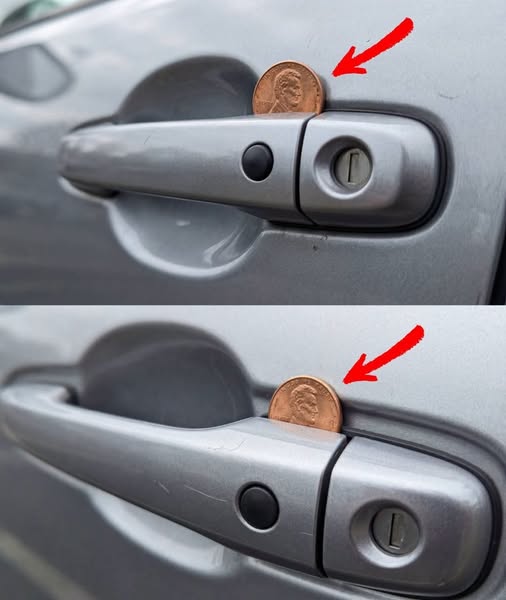
If You Find a Coin in Your Car Door Handle, Here’s What You Should Know About the Viral Theft Warning
A Widely Shared Warning Claims Thieves Use Pennies and Nickels to Interfere With Car Locks, but the Alleged Trick Requires a Closer Look
Imagine returning to your parked car after shopping, finishing work, or running an ordinary errand. You reach for the door handle, expecting to unlock the vehicle and continue your day.
But something feels wrong.
The key does not turn smoothly, the door seems unusually difficult to open, or the locking mechanism behaves differently from what you expect.
Then you notice something small near the handle: a coin.
For anyone who has encountered a viral warning about pennies and nickels being used in car theft attempts, that discovery might immediately raise concerns.
According to a story circulating online, thieves supposedly place coins inside passenger-side door handles to interfere with vehicle locking systems. The warning suggests that this simple trick could leave a car vulnerable to theft.
It sounds alarming because it turns an ordinary object into a potential sign of danger.
However, there is an important detail missing from many versions of the story: the claim has not been established as a reliable, widely documented vehicle theft method.
A coin near a car handle does not automatically mean someone has attempted to steal the vehicle.
Understanding the difference between a suspicious observation and confirmed tampering can help drivers respond appropriately without unnecessary panic.
The Strange Coin-in-the-Door-Handle Warning
The warning generally begins with a simple scenario.
A driver discovers a penny or nickel wedged near a passenger-side car door handle.
According to the circulating claim, someone may have deliberately placed the coin there to interfere with the vehicle’s locking mechanism.
The story suggests that thieves use this supposed trick to prevent a door from locking correctly, potentially allowing them to return later and access the vehicle.
Some versions describe the coin as a way of creating an opportunity while the driver believes the car is secure.
Other versions focus on the fear a person might experience when discovering an unexpected object near the door.
Although the details vary, the central message remains similar: drivers should treat a coin near the handle as a possible warning sign.
But the popularity of a warning does not establish that the described technique actually works.
How the Alleged Penny Trick Is Supposed to Work
In the viral narrative, a thief supposedly wedges a small coin into the gap around an exterior door handle.
The claim is that the coin may interfere with the locking process when the vehicle owner attempts to secure the car.
If the driver fails to notice that a door remains unlocked, someone could theoretically gain access later.
However, this description should not be mistaken for a demonstrated method of defeating automotive security systems.
Vehicle locking mechanisms differ considerably between makes, models, and production years.
A door handle’s shape does not necessarily correspond to the internal components responsible for locking the door.
Simply placing a coin near an exterior handle does not establish that the locking system has been compromised.
The supplied warning provides no verified technical demonstration or documented theft incident proving that this approach is an established method.
Why the Passenger-Side Door Is Mentioned
Many versions of the story specifically refer to the passenger-side door rather than the driver’s door.
The suggestion is that a driver might be less likely to inspect the opposite side of the vehicle before leaving it parked.
That possibility makes the warning sound plausible.
People often focus on the driver’s door because it is the entrance they use most frequently.
However, a plausible explanation is not the same as evidence that criminals commonly use a particular technique.
The account does not identify confirmed incidents involving coins placed in passenger-side handles.
Nor does it establish that a penny or nickel could reliably prevent a vehicle’s doors from locking.
The passenger-side detail is therefore part of the circulating claim rather than proof of a recognized security vulnerability.
Does Finding a Coin Mean Someone Is Targeting Your Car?
No reliable conclusion about criminal intent can be drawn from a coin alone.
Small objects may become lodged near a vehicle for ordinary reasons.
A coin could have been accidentally dropped, moved by someone handling another object, or placed near the car without any connection to theft.
Of course, unexplained objects or visible changes around a door should not automatically be dismissed.
Evidence of tampering deserves attention, particularly when accompanied by scratches, damaged components, or a malfunctioning lock.
But the presence of one coin does not establish who placed it there or why.
The safest response is to assess the circumstances rather than assume a particular explanation.
That distinction helps avoid turning a suspicious detail into an unsupported accusation.
Why a Car Door Might Suddenly Refuse to Open
When a car door behaves unusually, there are several possible explanations unrelated to criminal activity.
The locking mechanism may be worn, damaged, or temporarily jammed.
A physical obstruction near the handle can also interfere with normal movement.
In some situations, dirt, debris, or corrosion can affect mechanical components.
Weather conditions may contribute to problems with certain door seals, handles, or locks.
Electronic locking systems can also experience difficulties associated with batteries, sensors, or other components.
Without inspecting the vehicle, it is impossible to determine the precise cause of a particular malfunction.
That is why a stubborn door should not immediately be interpreted as evidence of a theft attempt.
It may be a maintenance issue that requires professional attention.
The Difference Between a Suspicious Object and Actual Tampering
One of the most important lessons from the viral warning is the need to distinguish observation from interpretation.
Finding a coin is an observation.
Concluding that a thief placed it there is an interpretation.
The second claim requires additional evidence.
Possible signs of vehicle tampering may include visible damage around locks, displaced components, or indications that someone has tried to interfere with access points.
Even then, determining exactly what happened can require further examination.
A driver who notices an unusual object should consider the overall circumstances.
Is the handle damaged? Does the door function normally? Are there other changes to the vehicle?
These questions are more useful than assuming the object proves a particular crime.
What to Do if You Find a Coin Near Your Door Handle
If you discover a coin or another unfamiliar object near your car’s door handle, begin by assessing whether the surroundings feel safe.
You do not need to approach or inspect the object if someone nearby is behaving threateningly or the location feels unsafe.
Move toward a populated, well-lit area and seek assistance if necessary.
If there is no immediate concern, visually examine the handle for an obvious obstruction or visible damage.
Avoid forcing the key, pulling aggressively on the handle, or attempting to dismantle the lock.
Applying excessive force can damage components and make an existing problem worse.
If the object can be safely observed without disturbing anything, note its location and the condition of the surrounding area.
When there are signs suggesting deliberate interference, contacting local authorities may be appropriate.
Check Whether Every Door Actually Locks
One practical precaution is to verify that your vehicle is properly secured.
Many drivers rely on the sound of a remote locking system or the flash of exterior lights as confirmation that the car is locked.
However, if something appears unusual, it is reasonable to confirm that the doors have secured correctly.
When the surroundings are safe, checking each door can help identify a malfunction that might otherwise go unnoticed.
This is useful whether or not a coin is present.
A poorly functioning latch, damaged actuator, or other locking problem can create a genuine security concern.
Ensuring that the vehicle is locked addresses the practical risk without relying on an unverified internet claim.
If one door does not lock, arrange for appropriate repairs rather than assuming the situation will resolve itself.
Why You Should Not Force a Jammed Lock
When a key refuses to turn or a handle becomes difficult to operate, frustration can make it tempting to use greater force.
But forcing a mechanism can create additional damage.
A key may bend or break, and components inside the lock can become more difficult to repair.
If something is visibly obstructing the handle, avoid pushing it farther into a gap or using tools without understanding the mechanism.
Modern vehicles contain different mechanical and electronic systems, making improvised repairs unreliable.
Persistent locking problems are best assessed by a qualified locksmith, mechanic, or roadside assistance provider.
The important goal is to restore normal operation without making the problem more serious.
When to Contact the Police
Not every unusual object near a parked vehicle requires a police report.
However, certain circumstances may justify contacting law enforcement.
Visible evidence of forced entry, damaged locks, missing belongings, or other indications of attempted theft should be taken seriously.
If someone is actively threatening you or attempting to enter your vehicle unlawfully, seek immediate assistance through the appropriate emergency services.
When there is no immediate danger but you suspect tampering, a nonemergency police contact may be appropriate.
Explain what you observed rather than presenting assumptions as established facts.
For example, reporting an unfamiliar object near a damaged handle is more accurate than stating that a specific theft method was definitely attempted.
Clear observations can help authorities evaluate the circumstances.
Why Viral Safety Warnings Spread So Quickly
Stories involving unexpected dangers often attract attention because they transform familiar situations into possible threats.
A small coin is an ordinary object that most people encounter without concern.
Suggesting that it might be part of a theft technique changes how readers interpret it.
The warning becomes memorable because it creates a connection between something harmless-looking and an alarming outcome.
Social media can amplify these messages rapidly, especially when they encourage readers to warn friends and family.
However, frequent sharing does not guarantee factual accuracy.
A claim can become widely recognized through repetition even when supporting evidence remains limited or absent.
The coin-in-the-door-handle story illustrates why it is important to examine the evidence behind a dramatic safety warning.
Fear Can Make an Ordinary Problem Feel More Threatening
Imagine noticing that a car door is difficult to unlock after reading a warning about coins and thieves.
The earlier story may immediately influence how the situation feels.
Instead of considering ordinary mechanical problems, the driver might assume someone deliberately interfered with the vehicle.
That reaction is understandable, especially when personal safety is involved.
Nevertheless, it may lead to unnecessary anxiety if there is no evidence of criminal activity.
A measured response can help separate immediate safety concerns from uncertain explanations.
The driver can move to a safe location, observe the condition of the vehicle, and seek professional help when needed.
Those actions are useful regardless of whether the online warning is accurate.
Not Every Car Security Threat Looks Dramatic
While the coin story is unverified, vehicle theft and property crime are real concerns.
Drivers can reduce some risks by following ordinary security precautions.
Keeping doors locked, closing windows, and avoiding the visible storage of valuables are familiar examples.
Parking in well-lit areas when possible may also help drivers feel more secure and improve visibility around their vehicles.
Security measures should be appropriate to the vehicle and the surrounding environment.
It is generally more useful to focus on recognized vulnerabilities than on dramatic techniques that lack reliable documentation.
The presence of a suspicious object may deserve examination, but it should be considered alongside the wider situation.
Understanding Modern Vehicle Locking Systems
Car door mechanisms have changed significantly across different vehicle generations.
Some vehicles use traditional mechanical locks, while others rely heavily on electronic controls.
Remote locking, central locking, and keyless entry systems involve components that are not necessarily accessible through an exterior door-handle gap.
As a result, claims about one simple trick affecting every vehicle should be treated cautiously.
A method that supposedly interferes with an older design would not automatically apply to newer systems.
The viral coin warning does not provide sufficient technical evidence demonstrating effectiveness across specific vehicle models.
Without such information, it is misleading to present the technique as a universal threat.
Vehicle owners experiencing locking problems should seek advice relevant to their particular make and model.
Could an Obstruction Affect a Door Handle?
A physical obstruction can sometimes prevent a mechanical part from moving normally.
For example, debris lodged near an exterior handle might interfere with its movement on certain designs.
However, restricting the movement of a handle is not the same as defeating the entire locking mechanism.
The two functions may operate through different components.
The effect of an obstruction depends on the vehicle’s design and the location of the material.
Therefore, the possibility of a handle becoming obstructed does not prove the viral claim that a coin can reliably leave a passenger door unlocked.
It simply provides another reason to investigate an unusual mechanical problem rather than ignore it.
What Makes a Safety Warning Reliable?
A credible safety warning should provide more than an alarming description.
Useful evidence may include documented incidents, statements from relevant authorities, or a clear technical explanation supported by independent examination.
Details such as the location, circumstances, and affected vehicle models can help readers understand whether a claim is applicable.
In the coin warning, those details are missing from the supplied account.
No verified case is presented establishing that the alleged method is commonly used.
Nor is there a demonstrated mechanism explaining how it consistently defeats vehicle security.
Those gaps do not mean drivers should ignore unusual activity around their cars.
They mean the specific claim should not be repeated as established fact.
How to Respond When Something Feels Wrong in a Parking Area
Personal safety should take priority over investigating a vehicle problem.
If a driver returns to a car and notices unusual activity, unfamiliar people nearby, or anything that creates a reasonable concern, moving toward a safer location may be the best immediate choice.
Busy, well-lit places generally provide more opportunities to seek help.
If there is an immediate threat, contact emergency services.
When there is no immediate danger, take time to assess the vehicle calmly.
Avoid confronting someone based solely on an assumption that they placed an object near the door.
The purpose of being cautious is to reduce risk, not to create a confrontation over uncertain circumstances.
Why Routine Security Checks Are More Dependable
One of the strongest conclusions from the story is that ordinary precautions offer practical value even when a viral warning remains unverified.
Checking that the doors are locked protects against a genuine problem: leaving a vehicle unsecured.
Inspecting visible damage can help identify maintenance needs or possible tampering.
Seeking professional assistance for persistent lock problems reduces the risk of further mechanical damage.
Reporting credible signs of attempted theft allows authorities to assess an incident using actual observations.
These actions address realistic concerns without depending on an unproven coin technique.
They also help drivers respond consistently when something unusual happens, regardless of where they first heard a safety warning.
A Coin Alone Cannot Tell You Someone’s Intentions
The presence of an unfamiliar object can be unsettling, particularly when its location seems unusual.
But an object does not reveal the intentions of the person who may have placed it there.
Without additional evidence, there is no reliable way to determine whether a coin near a car handle was accidental, harmless, or deliberately placed.
Assuming criminal intent from that detail alone may lead to conclusions that are not supported.
At the same time, dismissing obvious damage or signs of interference would be unwise.
A balanced response recognizes both possibilities.
Drivers can remain alert while avoiding exaggerated interpretations of ordinary observations.
That approach is more reliable than treating every unusual object as confirmation of a viral story.
The Real Lesson Behind the Viral Car Door Warning
The coin-in-the-door-handle warning has attracted interest because it presents a frightening possibility involving an everyday situation.
It suggests that a penny or nickel might be used to interfere with a passenger-side door lock and create an opportunity for theft.
However, the supplied account does not establish that this is a verified or widely used criminal technique.
There are also several ordinary reasons a car door or lock might behave unusually.
A coin near a handle does not prove that a thief has targeted the vehicle.
The most useful response is to examine the circumstances carefully, prioritize personal safety, and seek help when necessary.
Visible damage or credible evidence of tampering may justify contacting authorities.
Mechanical problems should be addressed by qualified professionals.
And drivers should verify that their doors are properly secured before leaving their vehicles.
Stay Alert, but Don’t Let an Unverified Warning Create Unnecessary Fear
Returning to a vehicle and discovering that the door will not open normally can be frustrating and unsettling.
Finding a coin near the handle may make the experience feel even more suspicious, particularly for someone familiar with the viral theft warning.
But the presence of a coin is not evidence that a theft attempt has occurred.
The circulating claim about pennies and nickels interfering with passenger-side locks remains unsupported by verified examples in the available account.
Rather than assuming the worst, drivers should focus on what they can observe and confirm.
Check for visible obstructions when safe, avoid forcing malfunctioning mechanisms, and make sure every door locks correctly.
If the surroundings feel threatening, move to a safer place and seek assistance.
When genuine signs of tampering appear, contact the appropriate authorities.
For persistent mechanical trouble, a locksmith or roadside assistance provider can help identify the cause.
The lesson is not to fear every coin found near a parked car.
It is to remain attentive, distinguish evidence from speculation, and take sensible precautions that protect both personal safety and property.
A suspicious detail deserves consideration. It does not automatically prove that danger is present.