
A Mother Lost One of Her Twin Daughters Just Three Hours After Birth — Then a Stranger’s Innocent Remark Inspired the Purple Butterfly That Changed Everything
Millie Smith Was Caring for Her Surviving Daughter When Four Simple Words Reopened an Unimaginable Heartache. Her Response Would Become a Powerful Symbol of Love, Loss, and Remembrance in Neonatal Units.
For most parents, the birth of a baby is a moment filled with joy, hope, and the promise of a new beginning.
But for Millie Smith, the arrival of her twin daughters brought two emotions that seemed almost impossible to experience at the same time.
Extraordinary love.
And heartbreaking loss.
One of her daughters survived. The other lived for just three hours.
Weeks later, while Millie was caring for her surviving daughter in a neonatal intensive care unit, another mother made an innocent remark.
She had no idea what Millie had experienced.
She didn’t know that the baby beside her had once shared the womb with a twin sister.
And she couldn’t have known how deeply her words would hurt.
That brief encounter would eventually inspire a small purple butterfly, a symbol designed to communicate something grieving parents should never have to explain repeatedly.
A baby was missing.
And that baby would always matter.
The Pregnancy That Began With Two Little Heartbeats
Millie Smith and her partner, Lewis Cann, were preparing to welcome twins into their family.
Expecting two babies brought the anticipation of a future filled with shared milestones, family memories, and the special bond often associated with twins.
Like other expectant parents, they had hopes for the lives their children would lead.
But during the pregnancy, medical examinations revealed devastating news.
One of their daughters had anencephaly, a severe congenital condition affecting the development of the brain and skull.
Doctors explained that their baby was not expected to survive for long after birth.
Suddenly, a pregnancy that had begun with excitement was overshadowed by the knowledge that one of their daughters would likely have only a very short life.
For Millie and Lewis, the diagnosis meant preparing to welcome two babies while knowing they would probably have to say goodbye to one.
Understanding the Diagnosis That Changed Everything
Anencephaly is a serious neural tube defect that develops very early in pregnancy.
It occurs when the upper portion of the neural tube does not close properly, preventing major parts of the brain and skull from developing as expected.
The condition is not compatible with long-term survival.
Many affected pregnancies end in stillbirth, while babies born alive generally survive only a short time.
There is no treatment that can reverse the underlying condition.
For families receiving this diagnosis, medical care often involves sensitive discussions about pregnancy management, delivery, comfort care, and emotional support.
Every family’s circumstances and decisions are deeply personal.
For Millie, the diagnosis did not change the fact that she was carrying two daughters.
Both were loved.
Both were part of her family.
And both deserved to be remembered.
Millie Chose to Cherish Every Moment With Both Babies
After learning about her daughter’s condition, Millie decided to continue the pregnancy.
She wanted the opportunity to meet both girls and cherish whatever time she could have with them.
It was a decision shaped by love and the painful understanding that their time together might be brief.
For parents facing a life-limiting prenatal diagnosis, preparing for birth can involve emotions that are difficult to describe.
There may be excitement about meeting a baby, alongside anticipatory grief for the future that may never unfold.
Ordinary preparations can take on extraordinary meaning.
Choosing a name becomes more than a routine milestone.
It becomes part of how a child will be known, loved, and remembered.
For Millie and Lewis, one name carried especially powerful significance.
Why They Named Their Daughter Skye
Millie and Lewis chose the name Skye for the daughter they knew they might lose.
The name held a beautiful meaning for them.
They wanted to have somewhere they could look and remember her.
The sky would always be there.
Whether they were at home, walking outdoors, or simply looking upward, it could provide a quiet connection to the daughter they loved.
Her name was not defined by the medical diagnosis.
It reflected her place in their family.
She was Skye.
A daughter.
A sister.
And someone whose life, however brief, would leave a lasting mark on the people who loved her.
Then Labor Began Earlier Than Expected
At 30 weeks of pregnancy, Millie went into premature labor.
The early delivery added another layer of uncertainty to an already emotionally difficult situation.
Babies born at 30 weeks are considered very preterm and commonly require specialized neonatal care.
For Millie and Lewis, there were now concerns surrounding both daughters.
They knew Skye’s condition was life-limiting.
They also knew her twin sister, Callie, would be arriving well before her expected due date.
When the girls were born, something deeply meaningful happened.
Both babies cried.
For Millie, hearing both daughters after their birth became part of the precious time she was able to share with them.
There were two babies.
Two daughters.
And for a short while, both were alive.
Three Hours That Would Last a Lifetime
Skye lived for approximately three hours after birth.
During that brief time, Millie was able to hold her daughter and be with her.
Then Skye died in her mother’s arms.
No amount of preparation could make that goodbye easy.
Although Millie had known during pregnancy that Skye’s life would likely be short, the reality of losing her daughter was profoundly painful.
Three hours might seem like a small amount of time when measured against an entire lifetime.
But a child’s importance cannot be measured by the number of days or years they live.
For Millie and Lewis, those hours were part of their daughter’s entire life.
They had met her.
They had loved her.
And now they would have to learn how to live without her.
One Daughter Was Gone, While the Other Still Needed Care
While the family grieved Skye, her twin sister Callie remained in neonatal care.
Being born prematurely meant that Callie needed specialized medical attention and monitoring.
For Millie, this created an extraordinarily difficult emotional experience.
She was mourning one daughter while remaining focused on the needs of another.
She couldn’t simply withdraw from the hospital environment to process her loss privately.
Her surviving baby still needed her.
The neonatal unit became a place where hope and grief existed side by side.
Every day brought the responsibility of caring for Callie, alongside the knowledge that Skye should have been part of their family’s future too.
And because only one baby was visible, other people did not necessarily know that Millie had given birth to twins.
The Painful Reality of Invisible Grief
When a family loses one baby from a multiple pregnancy, their experience can be difficult for others to recognize.
People may see a parent caring for one surviving baby and assume that was the only child born.
They may offer congratulations or make casual comments without realizing that the family is also grieving.
These interactions are rarely intended to cause harm.
But they can reopen painful emotions.
A parent may feel compelled to explain that another baby existed.
They may have to repeat the story of their loss to strangers, hospital visitors, or other families.
Even when people respond with kindness, telling that story again and again can be emotionally exhausting.
Millie would experience exactly this kind of misunderstanding.
And it would inspire an idea that extended far beyond her own family.
The Innocent Remark That Broke Her Heart Again
During Callie’s stay in neonatal care, another mother made a casual comment to Millie.
The woman believed Millie had only one baby.
Unaware that Callie had been born a twin, she told Millie she was lucky not to have twins.
The words were not meant to be cruel.
The other mother simply did not know what had happened.
But for Millie, the remark touched the deepest part of her grief.
She had given birth to twins.
She was the mother of two daughters.
And one of those daughters had died.
The comment made her realize how easily Skye’s existence could become invisible to people around her.
It also revealed a difficult problem faced by other families who lose one baby from a multiple birth.
How could hospital staff and visitors recognize that loss without requiring grieving parents to explain it every time?
A Simple Idea Began to Take Shape
Millie began thinking about a quiet way to communicate that a baby in neonatal care had lost a sibling from a multiple birth.
It needed to be something small.
Something respectful.
And something that could be understood without drawing unwanted attention to a grieving family.
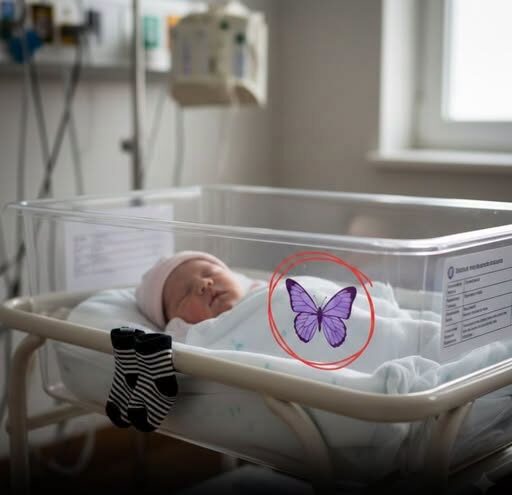
The idea was a purple butterfly.
A small butterfly symbol placed on or near an incubator could let people know that the baby had a sibling who had died.
Instead of requiring parents to repeatedly explain their loss, the symbol could communicate that important information gently.
It would not erase the grief.
It would not replace compassionate conversation.
But it could help prevent painful misunderstandings.
Why a Purple Butterfly?
The butterfly became the symbol associated with Millie’s initiative.
Its delicate appearance offered a gentle way to acknowledge a profoundly sensitive experience.
Purple butterflies placed in neonatal units came to represent the loss of a baby from a multiple pregnancy or birth.
The meaning is specific and deeply personal.
When someone sees the symbol in a participating hospital, it can indicate that the surviving baby had a sibling who is no longer alive.
It is a reminder to approach the family with sensitivity.
It also recognizes that the surviving baby is still part of a multiple birth, even though their sibling is absent.
For parents, that acknowledgment can matter enormously.
The butterfly says something that words sometimes struggle to express.
This family is celebrating a life while grieving another.
The Purple Butterfly Initiative Begins
What started as a response to one painful encounter developed into a wider effort to support families experiencing the loss of a baby from a multiple birth.
The purple butterfly initiative encouraged neonatal units to recognize these families and communicate their circumstances more sensitively.
The symbol could be displayed near the surviving baby’s incubator, helping alert staff and others to the family’s experience.
Its purpose was not to discourage conversation.
Rather, it was to reduce the chance that someone would unintentionally make a remark that caused additional distress.
For families already coping with grief, even a small improvement in communication can make a difference.
As awareness of the idea grew, purple butterflies began appearing in additional hospitals.
A simple symbol had become a practical expression of compassion.
How the Skye High Foundation Continued the Mission
Millie’s work also became connected to the Skye High Foundation, named in memory of her daughter.
The foundation has supported awareness and understanding of families who experience the loss of a baby from a multiple pregnancy.
Its work has helped bring attention to an aspect of neonatal care that can otherwise receive little public discussion.
Families experiencing this kind of loss may face a complicated combination of emotions.
They may feel immense love and gratitude for a surviving baby while grieving the child who died.
They may struggle with how others speak about their family.
And they may want their deceased child to be acknowledged without having to share painful details repeatedly.
The purple butterfly initiative addresses one small but meaningful part of that experience.
It encourages awareness, understanding, and respectful communication.
Why Words Matter So Much in a Neonatal Unit
Neonatal intensive care units bring together families facing very different circumstances.
Some babies are receiving support after premature birth.
Others need specialized care for medical conditions or complications.
Parents may be hopeful, frightened, exhausted, or grieving.
Often, several emotions exist at once.
Because every family’s situation is different, assumptions can be particularly painful.
A casual question about whether someone wants more children might be difficult for a parent who has experienced loss.
A remark about the challenges of raising twins may hurt someone whose surviving baby was born alongside a sibling who died.
Most people do not intend to cause distress.
They simply lack information.
The purple butterfly offers a way to communicate that information without requiring a grieving parent to explain it repeatedly.
Supporting Parents Who Are Experiencing Both Joy and Grief
The loss of one baby from a multiple pregnancy creates an emotional situation that can be difficult for others to understand.
A surviving child may bring tremendous happiness and hope.
At the same time, the absence of their sibling can be deeply painful.
These feelings do not cancel each other out.
A parent can be grateful for one child’s survival while mourning another child.
They can celebrate milestones and still feel sadness about the experiences their deceased baby will never have.
There is no single correct way to process these emotions.
Some families find comfort in speaking openly about the baby they lost.
Others prefer privacy or need time before sharing their experiences.
Respecting those individual preferences is an important part of compassionate care.
Why Remembering a Baby’s Name Can Be Meaningful
For Millie and Lewis, Skye’s name was an important part of her identity.
They chose it so they would always have a way to look upward and remember her.
That choice reflects something many bereaved parents express: a desire for their child to be remembered as a person, not simply as a loss.
A baby’s life may be brief, but their place in the family can remain permanent.
Remembering a name, acknowledging a birthday, or recognizing a child’s existence can provide comfort when welcomed by the family.
It is important not to assume that every parent wants the same kind of remembrance.
But when parents choose to speak about their child, listening without minimizing their grief can be a meaningful act of support.
Skye’s name became more than a private family memory.
Through the foundation and the purple butterfly initiative, it became associated with helping other families feel seen.
A Small Symbol With a Powerful Purpose
The purple butterfly is visually simple.
It does not require a long explanation to be noticed.
But its meaning carries enormous emotional weight.
It recognizes that a baby receiving care may have a twin or another sibling from a multiple birth who has died.
It asks people to be thoughtful about their words.
And it helps ensure that a family’s experience is not unintentionally overlooked.
Importantly, the butterfly does not mean that the surviving baby is necessarily in immediate danger.
Its purpose is to acknowledge the family’s loss, not to describe the surviving baby’s medical condition.
That distinction helps explain why the symbol can be valuable in neonatal environments.
It communicates a sensitive family circumstance in a quiet, respectful way.
What Families and Visitors Can Learn From Millie’s Experience
Millie’s story offers a reminder that we rarely know everything another person is experiencing.
Someone caring for a newborn may also be grieving.
A parent celebrating one child’s progress may be remembering a sibling who is absent.
And a family that appears to be welcoming one baby may have begun its journey expecting more.
Compassionate communication does not require knowing every detail.
It begins with avoiding assumptions and allowing people to share their experiences at their own pace.
Sometimes a simple expression of support is more helpful than a question.
Sometimes listening is enough.
And sometimes recognizing a symbol, such as a purple butterfly, can prevent an unintentionally painful remark.
Skye’s Three Hours Became Part of Something Much Larger
Skye’s life lasted only three hours, but her story did not end there.
Through her mother’s determination to help other families, her memory became connected to a movement of compassion within neonatal care.
The purple butterfly initiative was born from a deeply personal experience.
Millie knew how painful it could be when others failed to recognize that she had given birth to twins.
Rather than allowing that experience to remain only a private hurt, she created a way to help others facing similar circumstances.
The result was not an elaborate invention or complicated medical procedure.
It was a small, recognizable symbol.
One that could quietly acknowledge a family’s grief.
One that could help staff and visitors communicate with greater sensitivity.
And one that could remind parents that their baby had not been forgotten.
The Meaning Behind Every Purple Butterfly
For families who have experienced the loss of a baby from a multiple birth, the purple butterfly can represent something deeply important.
Recognition.
Understanding.
And the knowledge that their child’s existence still matters.
Millie Smith’s experience demonstrates how an ordinary comment, made without harmful intentions, can reveal a need that others may never have considered.
Her response transformed that painful moment into an initiative intended to make hospital environments more compassionate.
Skye was loved before she was born.
She was held and cherished during her brief life.
And through the work inspired by her memory, her story continues to help other families.
The next time someone sees a purple butterfly near a baby’s incubator, they may understand that it carries a meaning far beyond its appearance.
It is a quiet acknowledgment of a sibling who is missing.
A reminder to speak with kindness.
And a symbol of a love that does not disappear when a life ends.
For Millie, Lewis, and families like theirs, that recognition can mean more than words.
Because behind every purple butterfly is a story of a child who mattered, a family that remembers, and a love that continues.