
Macaulay Culkin Faces Backlash Over Halloween Costume — But Many Fans Say Critics Missed the Meaning
The Home Alone Star’s Military-Inspired Costume Sparked a Debate Over Face Paint, Historical Context, and a Famous World War II Image
Macaulay Culkin has found himself at the center of an unexpected social media controversy after sharing a photograph of his Halloween costume. The actor, best known for his childhood role in Home Alone, dressed as a soldier inspired by a famous World War II painting, but some viewers interpreted the appearance very differently.
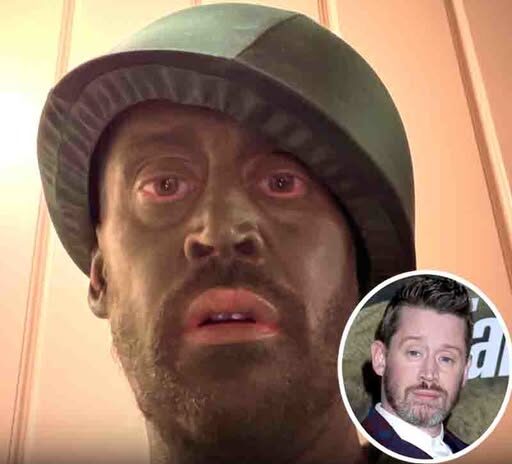
The photograph showed the 46-year-old actor wearing military-style clothing and a hat, with dark green paint covering portions of his face. While many fans immediately recognized the reference, others questioned whether the makeup was appropriate.
Some social media users suggested the appearance resembled blackface, a historically offensive form of racial caricature. Others strongly disagreed, explaining that Culkin appeared to be recreating a well-known image of an exhausted American soldier.
The disagreement quickly spread across social media, with commenters debating the costume’s meaning, the importance of historical context, and whether the criticism was justified.
At the center of the discussion was an artwork created more than eight decades ago, during one of the most difficult periods of World War II.
The Halloween Photograph That Started the Discussion
The controversy began after Culkin shared a photograph of himself wearing a military-inspired Halloween costume on Instagram.
His outfit included a military-style uniform and hat, while green face paint created a weathered appearance. His facial expression was particularly important to the costume, with the actor adopting a distant, exhausted stare.
For viewers familiar with military history or internet memes, the reference was recognizable.
However, not everyone understood what the actor was attempting to portray.
Some viewers focused on the face paint rather than the historical inspiration, questioning whether the costume could be considered insensitive.
Others argued that the appearance was being misunderstood because the makeup was intended to represent the visual characteristics of a wartime image rather than imitate a person’s race.
As screenshots and comments circulated, the photograph became the subject of a broader debate about Halloween costumes and how easily images can be interpreted differently when separated from their original context.
The Costume Was Inspired by a Famous World War II Painting
The historical reference behind Culkin’s costume was a painting titled That 2,000 Yard Stare, created in 1944 by American war artist Tom Lea.
The painting depicts a United States Marine during the Battle of Peleliu, a brutal military campaign fought in the Pacific Theater during World War II.
Rather than presenting the soldier as a triumphant figure, Lea portrayed a man whose expression suggested extreme exhaustion and psychological strain.
His eyes appear distant and unfocused, while his face reflects the physical and emotional consequences of prolonged combat.
The artwork became one of the most recognizable visual representations of the human cost of war.
Its title also contributed to the widespread recognition of the expression commonly known as the thousand-yard stare.
Over time, the painting’s distinctive appearance became familiar to audiences far beyond those who study military history.
What Does the Thousand-Yard Stare Actually Mean?
The phrase thousand-yard stare is commonly used to describe a distant, seemingly vacant expression sometimes associated with people experiencing extreme stress, exhaustion, or psychological trauma.
It has often been linked to soldiers who have endured prolonged combat or other deeply distressing experiences.
However, the expression itself is not a medical diagnosis and does not establish that someone has a particular mental health condition.
In the context of Tom Lea’s painting, the soldier’s appearance communicates the emotional toll of warfare without requiring words.
The image became powerful precisely because it focused on the individual experience of a soldier rather than the larger military campaign.
In more recent years, the painting has also circulated widely online as a meme.
Internet users have adapted its recognizable expression to represent moments of disbelief, exhaustion, or overwhelming experiences, often in humorous situations.
This modern internet familiarity helps explain why some viewers immediately recognized Culkin’s Halloween costume.
Why Some Social Media Users Criticized the Outfit
Despite the historical reference, the photograph prompted criticism from some social media users.
A portion of the discussion centered on the face paint, with certain viewers initially questioning whether Culkin was attempting to portray blackface.
Blackface has a long and deeply offensive history connected to racist theatrical traditions, making allegations involving the practice particularly sensitive.
However, the historical image cited as the costume’s inspiration depicts a soldier, and the makeup was described as green rather than an attempt to imitate a racial identity.
Other critics focused less on the makeup and more on the decision to use a war-related image as a Halloween costume.
One commenter, quoted in coverage of the controversy, suggested that the outfit was inappropriate given the number of armed conflicts taking place around the world.
Another criticized the timing and choice of costume more broadly.
These reactions reflected concerns about whether imagery associated with wartime suffering should be used for entertainment, even when the intended reference is recognizable.
Other Fans Strongly Defended Macaulay Culkin
Not everyone agreed with the criticism.
Many commenters defended Culkin, arguing that the costume was a recognizable recreation of the thousand-yard stare image rather than an attempt to offend anyone.
Some praised the actor for accurately capturing the facial expression associated with the painting and its popular internet adaptations.
One social media user described the costume as a particularly successful interpretation of the famous soldier meme.
Another expressed frustration that viewers were interpreting the makeup without considering the source material.
For these supporters, the controversy demonstrated how quickly a photograph can become misunderstood when its background is not immediately apparent.
They argued that understanding the original painting was essential before drawing conclusions about Culkin’s intentions.
The disagreement illustrated how differently audiences can respond to the same image depending on their familiarity with historical artwork and internet culture.
An Online Context Note Addressed the Confusion
As the discussion expanded, a community note appeared on X attempting to explain the context of Culkin’s costume.
According to reports about the controversy, the note identified the green face paint and the reference to the wartime image, distinguishing the costume from blackface.
The explanation was intended to help viewers understand the source material behind the photograph.
However, contextual explanations do not necessarily settle every disagreement about whether a costume is appropriate.
Some people may understand the historical reference and still feel uncomfortable with the use of wartime imagery in a Halloween setting.
Others may consider the costume a harmless recreation of a recognizable painting or internet meme.
The distinction between identifying a costume’s intended subject and evaluating its appropriateness became an important part of the debate.
Tom Lea’s Painting Captured the Human Cost of War
To understand why the image became so famous, it helps to consider the circumstances surrounding its creation.
Tom Lea was an American artist and war correspondent whose work documented military experiences during World War II.
His painting That 2,000 Yard Stare emerged from his observations of American Marines during the Battle of Peleliu in 1944.
The battle was marked by fierce fighting and severe casualties, leaving a lasting impression on those who experienced it.
Rather than emphasizing weapons, military equipment, or battlefield victories, Lea concentrated on the expression of an individual soldier.
The result was an image that communicated exhaustion and psychological strain with unusual intensity.
That emotional power helped the painting endure long after the war ended.
Its influence can still be seen in discussions about military experiences, combat stress, and the ways artists depict the consequences of conflict.
How a Wartime Image Became an Internet Meme
The thousand-yard stare has experienced a second life through internet culture.
Images inspired by Tom Lea’s painting have circulated across social media platforms, often accompanied by humorous captions about everyday situations.
These adaptations generally rely on the contrast between the soldier’s intensely exhausted expression and relatively ordinary modern experiences.
For example, users may apply the expression to describe a stressful workday, an unexpected problem, or a moment of disbelief.
The meme’s popularity has introduced the visual reference to younger audiences who may not know the painting’s original historical background.
At the same time, the transformation of serious wartime imagery into humor can create disagreements about taste and sensitivity.
Some viewers see these adaptations as harmless internet humor, while others believe they risk diminishing the seriousness of the experiences represented by the original artwork.
Culkin’s Halloween costume brought those differing perspectives into the same conversation.
Why Halloween Costumes Can Lead to Unexpected Controversies
Halloween costumes frequently draw inspiration from films, historical figures, popular culture, and internet trends.
When the reference is widely recognized, the intended meaning is usually easy to understand.
However, more obscure references can create confusion, especially when photographs circulate without explanations.
A viewer unfamiliar with the source material may interpret an outfit based on its appearance alone.
Meanwhile, someone who immediately recognizes the reference may view the same costume as a creative recreation.
These differences become particularly significant when makeup, military imagery, or culturally sensitive subjects are involved.
Social media can amplify the disagreement because individual photographs often reach audiences who have very different experiences and expectations.
The discussion surrounding Culkin’s costume reflects this broader challenge of communicating visual references to large and diverse online audiences.
Macaulay Culkin Has Not Publicly Addressed the Criticism
According to the reporting surrounding the controversy, Culkin had not issued a public response to the criticism at the time of publication.
Without a direct statement from the actor, it is important not to assign motives beyond what the photograph and its reported historical inspiration support.
The available context indicates that the outfit was intended to recreate the famous thousand-yard stare image.
However, Culkin’s personal reasons for choosing that particular costume have not been fully explained in the material reported.
The debate has therefore continued primarily among social media users rather than through an exchange between the actor and his critics.
Whether Culkin eventually comments on the discussion remains to be seen.
The Debate Highlights the Importance of Context
The reaction to Macaulay Culkin’s Halloween photograph demonstrates how a single image can generate sharply different interpretations.
For some viewers, the costume initially raised concerns about offensive makeup or the use of wartime suffering as entertainment.
For others, it was an easily recognizable tribute to a famous painting and its modern internet meme.
The historical background of That 2,000 Yard Stare helps explain the visual choices behind the costume, particularly the soldier’s uniform, weathered appearance, and distant expression.
At the same time, understanding a reference does not require everyone to agree about its suitability as a Halloween outfit.
The disagreement reflects a broader reality of online culture: photographs can spread rapidly, while the context necessary to understand them may arrive much later.
For now, Culkin’s costume remains a subject of discussion, with supporters and critics continuing to interpret the image through different perspectives.
What began as a Halloween photograph has become a reminder that historical references, internet humor, and public expectations do not always translate in the same way for every audience.