
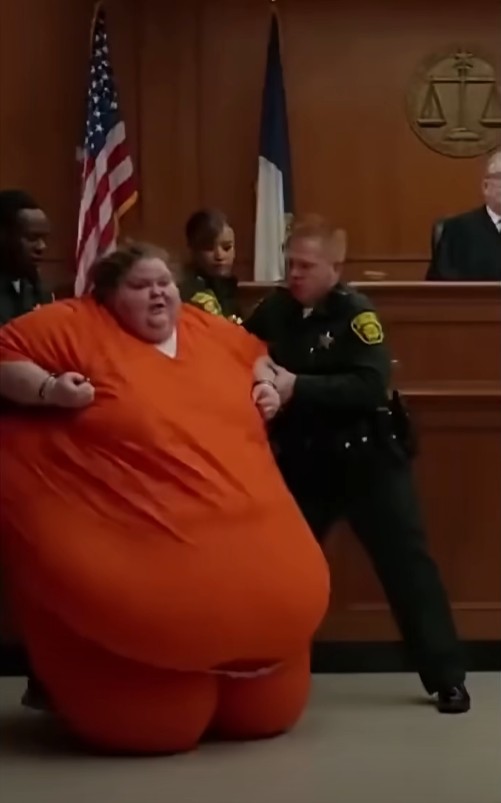
Woman Tells Court She Was ‘Only Discussing an Idea’ — But the Judge’s Response Reveals a Serious Legal Misunderstanding
In a Fictional Courtroom Case, a Confident Defendant Learns Why an Unlawful Agreement Can Carry Legal Consequences Even When the Planned Crime Is Never Completed
The courtroom fell quiet as Marla Dune stood before the magistrate, convinced that one simple explanation would settle the case against her. She had not personally carried out the act at the center of the allegations. As far as she was concerned, that should have been enough to end the matter.
Marla believed there was an obvious difference between talking about doing something and actually doing it. She had discussed a plan, she insisted, but she had never completed the proposed act. What she struggled to understand was why the authorities were treating those conversations as potentially criminal.
But the legal issue before the fictional Stonebridge Magistrates was more complicated than Marla expected. The court was not necessarily concerned only with whether the planned offense had been completed. It also had to consider whether the alleged agreement itself could satisfy the elements of a criminal conspiracy offense.
That distinction forms the heart of this fictional courtroom story, which illustrates a misunderstanding that can arise when people confuse discussing an idea with entering into an unlawful agreement.
The important lesson is not that ordinary conversations are crimes. Rather, certain agreements to pursue unlawful conduct may carry criminal consequences when prosecutors can prove the necessary legal elements.
She Walked Into Court Believing the Case Was a Mistake
Marla Dune was portrayed as outspoken, confident, and accustomed to defending her decisions with forceful explanations. When she appeared before the fictional court, she believed the allegations against her rested on an unreasonable interpretation of her words.
Her argument was straightforward: she had discussed an idea, but she had not personally put it into action. In her view, a conversation could not become a crime simply because the subject was controversial or unlawful.
At first glance, that reasoning contains an important truth. People are generally not criminally responsible merely for imagining wrongdoing, discussing hypothetical situations, or expressing unpopular opinions.
However, the distinction between an abstract discussion and a genuine agreement to commit a crime can become legally significant.
In the fictional scenario, Marla’s confidence began to weaken when she realized that the court was examining the alleged agreement rather than focusing exclusively on whether the planned act had occurred.
Her personal description of the conversation was relevant, but it could not automatically determine the legal outcome.
The Legal Question Was Not as Simple as She Thought
Criminal conspiracy is a legal concept that generally concerns an agreement between two or more people to pursue an unlawful objective.
The exact definition varies depending on the jurisdiction and the particular offense. Prosecutors may need to establish that the accused knowingly entered into an agreement and possessed the intention required by the applicable law.
Some conspiracy statutes also require proof of an overt act, meaning an action taken by at least one participant to advance the alleged agreement. Other statutes do not require that additional element.
These differences are important because there is no single legal rule that applies identically to every conspiracy case.
For Marla, the central misunderstanding was her assumption that the absence of a completed underlying crime necessarily prevented any criminal liability.
Under certain conspiracy laws, the prosecution may not need to prove that the planned offense was successfully carried out. Instead, the focus may be on whether the unlawful agreement and any other required elements can be established.
When Does a Conversation Become a Criminal Conspiracy?
Imagine two people discussing a fictional crime while watching a television drama. They speculate about how the characters might behave, criticize their decisions, or debate what could happen next.
Such a conversation does not, by itself, establish a criminal conspiracy.
Now consider a different situation in which individuals allegedly reach a genuine agreement to commit an unlawful act and begin coordinating their intended conduct.
Depending on the relevant law and the available evidence, that situation may raise questions about criminal conspiracy.
The critical distinction is not simply whether someone mentioned a crime. It is whether the required agreement, intent, and any additional statutory elements existed.
Courts must consider the context of statements and conduct rather than treating isolated words as conclusive evidence.
A hypothetical discussion, a joke, an expression of anger, or a fictional scenario should not automatically be interpreted as an agreement to commit wrongdoing.
Likewise, describing a genuine plan as merely an idea does not necessarily resolve the legal question.
Why Saying ‘I Didn’t Do It’ May Not End the Case
Marla’s fictional defense centered on the fact that she had not personally completed the proposed act.
For many criminal offenses, evidence of the accused person’s actions is central to determining liability. But conspiracy laws can address a different form of alleged wrongdoing.
Where the law recognizes an unlawful agreement as a criminal offense, the prosecution may focus on the participants’ agreement and intentions rather than the eventual success of their plan.
That does not mean every person who hears about a proposed crime becomes part of a conspiracy.
Merely knowing about an unlawful plan, being present during a conversation, or associating with someone accused of wrongdoing does not automatically establish participation.
The prosecution must prove the required elements concerning the particular defendant.
In a criminal trial, those elements generally must be established beyond a reasonable doubt, subject to the applicable legal system.
The distinction protects individuals from being convicted solely because they were connected to an unpleasant conversation or happened to know someone suspected of criminal activity.
The Evidence Matters More Than a Dramatic Explanation
In the fictional Stonebridge case, Marla expected her explanation to persuade the court immediately. But legal proceedings require more than a defendant’s confidence or a prosecutor’s accusations.
Courts must examine evidence relevant to the alleged offense.
Depending on the circumstances, that evidence may include communications between individuals, witness testimony, documented conduct, or other material that helps establish what the participants intended.
However, no single message, statement, or action automatically proves a conspiracy in every case.
Words can have different meanings depending on the context in which they were spoken. A statement that sounds threatening when quoted alone may have been part of a fictional discussion, while an apparently ordinary message could take on a different meaning when considered alongside other reliable evidence.
That is why investigators and courts must evaluate the complete circumstances rather than relying on assumptions.
The accused must also have an opportunity to challenge the prosecution’s evidence and present a defense through the procedures available under the applicable law.
Why Intent Can Be Difficult to Establish
One of the challenges in conspiracy cases is determining whether an accused person genuinely intended to participate in an unlawful agreement.
Intent is not something a court can directly observe. Instead, it may be inferred from admissible evidence, including statements and conduct, while applying the required legal standards.
This creates an important distinction between speculation and proof.
Someone may discuss an unlawful possibility without intending to pursue it. Another person may express agreement sarcastically, without genuinely committing to any action.
Conversely, an agreement may be communicated through conduct or indirect language rather than an explicit written statement.
Because circumstances differ, courts cannot determine criminal intent through a simplistic rule that treats every discussion alike.
In Marla’s fictional situation, the court would need to consider whether the alleged communications demonstrated an actual agreement and the necessary criminal intent.
Without that proof, confidence in the accusation would not be enough to justify a conviction.
Not Every Conspiracy Law Requires the Same Evidence
Another important issue is that conspiracy laws differ across legal systems.
Some jurisdictions require proof that at least one participant performed an overt act to advance the agreement. That act may be different from the underlying crime itself.
Other conspiracy offenses can be established without proving a separate overt act, provided all the legally required elements are satisfied.
The rules may also differ depending on the type of unlawful objective involved.
These variations mean that a general description of conspiracy cannot determine the outcome of an individual case.
Before reaching a conclusion, it is necessary to identify the applicable statute, the relevant jurisdiction, and the evidence presented.
The fictional story of Marla Dune does not specify a real jurisdiction or criminal statute, so it cannot support a definitive conclusion about her guilt.
Instead, it illustrates why the legal distinction between discussion and agreement matters.
Marla’s Confidence Began to Fade in the Fictional Courtroom
As the proceedings continued, Marla began to understand that her original explanation did not answer every question raised by the allegations.
She had focused on what she claimed not to have done. The court, however, was concerned with whether the prosecution could establish the elements of the alleged offense.
Her surprise reflected a common misunderstanding about criminal responsibility.
People sometimes assume that legal consequences can arise only after the final act in a proposed plan has been completed. But certain offenses concern conduct that occurs before the intended result.
At the same time, the existence of conspiracy laws does not eliminate the requirement for proof or allow courts to punish people simply for having troubling thoughts.
Marla’s fictional realization was therefore not proof of guilt. It was an acknowledgment that the legal issue was more complex than she had initially believed.
Any actual verdict would depend on the evidence, the applicable law, and the court’s findings.
Why Real Criminal Cases Require Responsible Reporting
Courtroom stories can attract attention because they often involve dramatic confrontations, unexpected explanations, and moments when a defendant’s expectations are challenged.
However, there is a significant difference between a fictional legal scenario and a documented criminal proceeding.
The character Marla Dune and the name Stonebridge Magistrates are fictional elements in this account. No verified criminal case involving those names has been established by the supplied material.
Presenting such a story as a genuine conviction would risk misleading readers.
In real cases, responsible reporting should distinguish between allegations, evidence presented in court, judicial findings, and final outcomes.
A person accused of conspiracy should not be described as guilty merely because charges have been filed or a dramatic allegation has attracted public attention.
That distinction is essential to fair reporting and to protecting the reputations of people who may be accused of crimes they did not commit.
The Important Difference Between Thoughts, Words and Agreements
Perhaps the most valuable lesson from the fictional case is that thoughts, conversations, and criminal agreements are not legally interchangeable.
Thinking about an unlawful act does not automatically constitute a crime. Discussing a hypothetical scenario does not necessarily create criminal liability, and hearing someone describe a plan does not automatically make a listener a participant.
But an actual agreement to pursue an unlawful objective may be treated differently when the necessary legal elements are present.
Understanding that distinction requires attention to the circumstances and the law, not simply the language used by the people involved.
For example, calling something a joke does not automatically establish that it was harmless, just as using serious language does not automatically establish criminal intent.
The surrounding evidence remains essential.
Criminal courts must assess that evidence carefully because the consequences of an incorrect conclusion can be severe.
What the Fictional Case Teaches About Criminal Responsibility
Marla Dune entered the fictional courtroom believing that the absence of a completed act would settle the matter in her favor.
Her argument reflected an understandable but incomplete view of how criminal conspiracy laws may operate.
The legal system distinguishes between merely discussing wrongdoing and entering into an unlawful agreement that satisfies the elements of a specific offense.
Where those elements are established, the failure to complete the planned crime may not necessarily prevent a conspiracy conviction.
But the opposite principle is equally important: a person cannot properly be convicted merely because their words sound suspicious or because someone interprets a conversation negatively.
Evidence, intent, statutory requirements, and the burden of proof all remain central to a fair outcome.
Those safeguards help ensure that criminal law addresses legally established wrongdoing rather than speculation or unpopular opinions.
The Lesson Behind the Courtroom Drama
In the end, the fictional story of Marla Dune is less about an unexpected courtroom confrontation and more about the importance of understanding what the law actually requires.
Her belief that an uncompleted plan could never carry criminal consequences was too broad. Yet it would be equally misleading to suggest that simply discussing an unlawful idea automatically makes someone a criminal.
The distinction lies in whether the prosecution can prove the particular elements of an offense under the applicable law.
That requires careful attention to evidence, context, intention, and the rights of the accused.
For readers, the story offers a reminder that legal questions rarely have answers as simple as a dramatic headline might suggest.
Words can matter, agreements can carry consequences, and the absence of a completed crime does not always end the legal inquiry. But accusations must still be proved through a fair legal process.
Editor’s note: This article is an educational fictional scenario. Marla Dune and Stonebridge Magistrates are fictional, and the courtroom events described are not a verified criminal proceeding. The discussion of conspiracy law is general information, not legal advice. Specific requirements vary by jurisdiction and offense.