
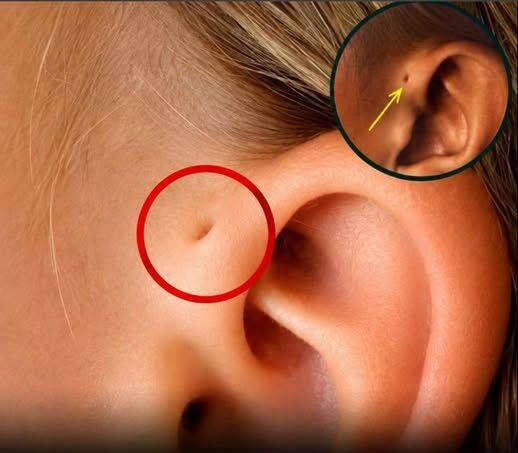
Have a Tiny Hole Near Your Ear? Here’s What It Really Means and When You Should Worry
That Small Opening in Front of Your Ear Has a Medical Name, and Most People Who Have One Never Experience Any Problems
Have you ever noticed a tiny hole in the skin just in front of someone’s ear? At first glance, it might look like an old piercing, a small scar, or an unusually deep pore.
But for some people, that little opening has been there since birth. It is called a preauricular pit, and it is a congenital feature that develops before a baby is born.
Although its appearance can be surprising, a preauricular pit is usually harmless. Many people have one throughout their lives without ever needing treatment or experiencing any symptoms.
However, there are a few important things worth knowing about this unusual anatomical feature, including why it forms, whether it can be inherited, and the warning signs that suggest medical attention may be necessary.
What Exactly Is a Preauricular Pit?
A preauricular pit is a small opening in the skin near the front of the external ear, often located where the upper part of the ear meets the face.
It may appear as a tiny round hole or indentation that resembles a piercing. In some people, the opening is barely noticeable, while in others, it is more visible.
Beneath the skin, the opening may connect to a narrow tract known as a preauricular sinus. The length and shape of this tract can vary from person to person.
Some people have a pit beside only one ear, while others have one on both sides.
Unlike an ordinary skin pore, a preauricular pit is present from birth. It is not caused by poor hygiene, wearing earrings, or an injury later in life.
Why Do Some People Have a Tiny Hole Near Their Ear?
The explanation begins during the earliest stages of fetal development, when the structures that form the external ears are taking shape.
The outer ear develops from several small tissue elevations that gradually grow and join together. A preauricular pit is thought to result from an irregularity in this developmental process.
When the tissues do not join in the usual way, a small opening or channel may remain beneath the skin.
This process takes place before birth, which explains why the feature can be seen in newborn babies.
It is not something that develops because of a person’s lifestyle or behavior, and having one does not mean the ear failed to develop normally in every other respect.
In most cases, the rest of the ear develops and functions as expected.
Can Preauricular Pits Run in Families?
Yes. Preauricular pits can sometimes be inherited, meaning several members of the same family may have them.
In certain families, the trait follows an autosomal dominant inheritance pattern. This means a parent with the feature may pass it to a child, although not everyone who inherits the relevant genetic tendency will necessarily have the same appearance.
However, a preauricular pit can also occur without any known family history.
Someone may be the only person in their immediate family with one, while another person may notice that a parent, sibling, or grandparent has a similar opening.
Having a preauricular pit does not automatically mean a person has an inherited medical disorder.
For most individuals, it is simply an isolated anatomical variation.
Are These Tiny Ear Holes Dangerous?
Most preauricular pits do not cause health problems.
People with uncomplicated pits generally have normal hearing, normal ear function, and no discomfort associated with the opening.
Many individuals discover the feature by chance while looking in a mirror or having someone point it out.
Others have known about it since childhood but never considered it medically important.
When a preauricular pit causes no symptoms, treatment is usually unnecessary.
Doctors generally recommend leaving the area alone rather than attempting to close or remove it for medical reasons.
The main concern is that the narrow tract beneath the skin can occasionally become infected.
What Happens if a Preauricular Pit Becomes Infected?
Although most preauricular pits remain harmless, bacteria can sometimes enter the opening or become trapped within the tract beneath the skin.
When an infection develops, the surrounding tissue may become inflamed.
One of the first signs can be redness or tenderness near the opening. The area may also become swollen, warm, or painful to touch.
Some people notice fluid draining from the pit, which may be cloudy or contain pus.
If the infection progresses, a painful lump or abscess may form beneath the skin.
In more significant infections, fever or spreading redness can occur.
These symptoms should not be ignored, particularly if swelling increases quickly or the person feels generally unwell.
How Doctors Treat an Infected Preauricular Pit
Treatment depends on the severity of the infection and whether an abscess has developed.
For a bacterial infection, a healthcare professional may prescribe antibiotics based on the clinical findings.
If pus has collected beneath the skin, antibiotics alone may not be sufficient. An abscess sometimes requires drainage by a medical professional.
It is important not to attempt to drain an infected pit at home, as squeezing or puncturing the area can worsen inflammation or introduce additional bacteria.
Some people experience only one infection and never have another problem.
Others develop repeated episodes because the underlying tract remains present.
When infections recur, an ear, nose, and throat specialist may recommend surgery to remove the sinus tract after the active infection has been appropriately treated.
Removing the tract can reduce the likelihood of future infections, although recurrence is still possible.
Should You Ever Squeeze or Clean Inside the Hole?
If you have a preauricular pit, it may be tempting to squeeze it or insert something into the opening to see how deep it goes.
However, this is not recommended.
The tract beneath the skin can be narrow and irregular, making it difficult to clean internally without causing irritation or injury.
Attempting to probe the opening with cotton swabs, needles, or other objects may introduce bacteria or damage surrounding tissue.
For an uncomplicated preauricular pit, ordinary washing of the surrounding skin is generally sufficient.
There is usually no need for special cleaning solutions, deep cleansing, or routine application of medication.
If the opening begins to drain fluid repeatedly or develops an unpleasant odor, a healthcare professional should examine it rather than relying on home treatments.
Can a Preauricular Pit Affect Your Hearing?
In most cases, a preauricular pit does not affect hearing.
The opening is located in the skin near the external ear and generally has no connection to the structures responsible for transmitting sound.
People with isolated preauricular pits typically have normal ear function.
However, doctors pay closer attention when the feature appears alongside other congenital differences, hearing concerns, or unusual physical findings.
In those circumstances, additional evaluation may be recommended to rule out an associated condition.
For example, certain rare genetic syndromes can involve preauricular pits together with hearing abnormalities or differences affecting other organs.
That does not mean everyone with a tiny ear opening needs extensive medical testing.
For an otherwise healthy person with an isolated pit, the finding is usually reassuring.
When Should You See a Doctor About a Tiny Ear Hole?
Although most preauricular pits do not require treatment, changes in the surrounding skin deserve attention.
Contact a healthcare professional if the area becomes painful, swollen, unusually red, or tender.
Persistent drainage, repeated infections, or the development of a lump near the opening are also reasons to arrange an examination.
Prompt assessment is especially important if redness spreads, swelling increases rapidly, or fever develops.
For infants and young children, parents should mention any unusual ear findings during routine medical appointments so a clinician can determine whether further evaluation is necessary.
If a preauricular pit is accompanied by hearing difficulties or other congenital abnormalities, the doctor may recommend a more detailed assessment.
Otherwise, the opening can often be left alone without affecting everyday life.
That Tiny Hole Is Usually Nothing to Worry About
A preauricular pit may look mysterious, especially to someone seeing one for the first time, but its explanation is surprisingly straightforward.
It is a small congenital opening that forms during the development of the external ear before birth.
Some people inherit the feature from a parent, while others have no known family history.
Most individuals with preauricular pits never experience symptoms, and the openings generally do not interfere with hearing or other normal ear functions.
The main complication to watch for is infection, which can cause redness, swelling, pain, or drainage.
When those symptoms appear, medical evaluation can help prevent further complications and determine whether treatment is needed.
For everyone else, there is usually nothing special to do beyond keeping the surrounding skin clean and avoiding unnecessary manipulation.
So if you’ve noticed a tiny hole just in front of your ear, you may simply have a preauricular pit — a small feature you’ve carried since before you were born.
Have you ever noticed one of these tiny openings on your own ear or someone else’s? Many people are surprised to learn what they actually are.