
My Stepsister Tore My Late Mother’s Cardigan. Then My Choir Teacher Read the Name Inside.
Brooke Tried to Take My Solo, but Mrs. Goodwin Knew Exactly How I’d Earned It
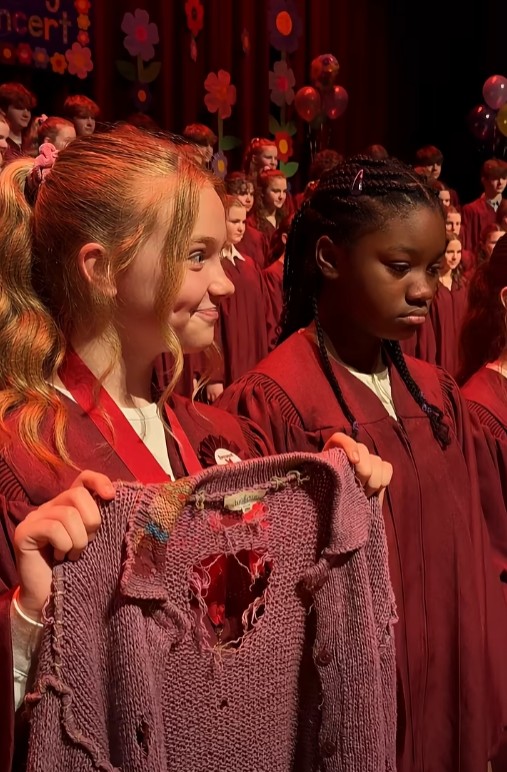
My knees still hurt from falling off the choir risers when my father asked me to come down from the stage. He wanted to settle things at home. Behind me, my stepsister Brooke was adjusting the microphone for the solo I’d spent nearly a month rehearsing. At the edge of the stage, Mrs. Goodwin held the gray cardigan Brooke had just torn apart.
My mother had knitted it for me. She’d been dead for three years, and the little blue letters inside the collar still spelled out her name. JUDITH STAFFORD. Until that night, I thought the name meant something only to me and my father.
Brooke Told the Audience I’d Given Up My Solo
Mrs. Goodwin had stopped the concert and told my father there was something he needed to hear. My stepmother, Wanda, smiled as she suggested that the school auditorium was a poor place to discuss family matters. When Mrs. Goodwin pointed out that Brooke had pushed me off the risers and torn my cardigan, Wanda called it a disagreement between children.
Then she turned to the audience and said I sometimes used my mother’s death to get attention. She’d said versions of that to me at home and in the car, usually when Dad wasn’t around. Hearing her say it in front of three hundred people made me look down at my shoes.
Brooke took the microphone before Mrs. Goodwin could stop her. She told the audience I’d won the solo by crying during practice and telling stories about Mom. I remembered the audition clearly. Brooke and I had sung the same passage, one after the other. I hadn’t said a word about my mother.
Brooke announced that I was too upset to perform and had decided to give up the solo. “I’ll sing it instead.” Wanda started clapping, softly enough that anyone joining in could pretend the decision had already been made.
Dad asked me again to come down. I told him Brooke was lying. He said we could talk at home, then asked me to apologize for my part in what had happened.
“Then why can’t you just be the bigger person?” he asked when I told him I’d done nothing wrong.
I Remembered the Promise I’d Made to My Mother
I’d heard that question when Wanda packed away Mom’s photographs and when Brooke took Mom’s old scarf and refused to give it back. I was thirteen. I’d spent months trying to work out how to be the bigger person when everyone seemed to want me to take up less space.
A piece of the cardigan had fallen near my shoe. I bent down to pick it up and remembered sitting beside Mom on the couch, holding the ball of wool while she knitted. Sometimes she’d pull out an entire row because one stitch was wrong. I’d asked her once why she couldn’t just leave it.
“Because, sweetheart, something being difficult to fix doesn’t mean it’s not worth fixing.”
Then I remembered the last thing she’d asked me before she died. She’d been tired that day, but she reached for my hand. “Promise me you’ll never be afraid to use your voice, Maya.”
I straightened and told Dad I wasn’t going to apologize. Then I looked at Brooke. “I earned that song.” My voice was quiet, but she heard me. I told her I’d practiced for weeks, sung the audition, and been chosen by Mrs. Goodwin. I was keeping my solo.
Mrs. Goodwin Had the Notes and Recordings From Both Auditions
Mrs. Goodwin stepped between my father and the microphone. She asked Brooke to explain exactly when I’d talked to her about my mother. Brooke said I’d told people how much the song meant to me. When Mrs. Goodwin asked who she meant, Brooke looked toward Wanda. Her mother gave her a small nod, and Brooke repeated the accusation into the microphone.
Mrs. Goodwin explained how she’d made her decision. Both of us had been asked to sing a difficult passage near the end of the piece. She remembered my pitch, the way I’d managed my breathing, and how I’d carried the melody to the last note. She remembered where Brooke had struggled, too. She had notes from both auditions and recordings made with our permission.
“Your accusation is false.”
Brooke went quiet. I looked for Dad, hoping he’d finally say something. Before he did, Mrs. Goodwin picked up the cardigan from the piano bench. She turned the collar outward and ran her thumb across the blue stitching.
“Judith Stafford.”
She asked whether that was my mother’s full name and whether Mom had made the cardigan. I said yes. Then Mrs. Goodwin closed her eyes, and a tear ran down her cheek.
My Mother Had Given My Teacher Piano Lessons Years Before I Was Born
Andrea Goodwin had spent part of her childhood in foster care. She moved between homes and loved playing piano, but she had nowhere to practice and couldn’t afford lessons. After a community music program one day, a woman noticed her sitting alone and asked whether she wanted to learn properly.
That woman was my mother. She offered to teach Andrea for free and let her practice on the piano at home. Sometimes she sat nearby while Andrea played. Sometimes she made hot chocolate and encouraged her to keep trying when a piece became difficult. Years later, Andrea applied for music scholarships and eventually became a teacher.
“Your mother gave me a future, Maya. And I am so sorry that tonight, the people who should have protected you treated her gift as though it were worthless.”
I’d never heard this story. Andrea had written to Mom years later and never found out whether her letter arrived. What she remembered immediately was the stitching. Mom used to put her name inside the things she made so the people she gave them to would know she’d made something especially for them.
Wanda seized on the connection and asked how anyone could believe the audition had been fair. Andrea said she’d chosen me before she knew Judith Stafford was my mother. She offered the notes and recordings again. Brooke looked from Andrea to Wanda, then blurted out something none of us expected.
“You told me nobody would find out!”
Brooke Told My Father What Wanda Had Promised Her
Wanda told Brooke to be quiet, but Dad had heard her. He asked what Wanda had known. When she tried to brush it off, he asked again. This time, Brooke answered.
She said her mother had told her to make me give up the solo if I got it. Wanda had assured her that Dad would take her side, that he’d make me apologize, and that Brooke would get to sing. She’d even told Brooke that if I embarrassed the family enough, Dad might send me away.
Dad took a step back. He’d seen me fall. He’d watched Brooke tear the cardigan and heard Wanda laugh. Now he was hearing what Brooke had expected him to do afterward, and he’d nearly done it.
Andrea announced that I was still the soloist. Brooke would be removed from the concert, and what had happened would be reported to the school administration. Wanda protested, but Andrea finished the announcement. Then Dad walked up to the stage and looked at my knees.
“Are you hurt?”
I said they hurt a little. He swallowed and told me he was sorry. When Wanda suggested they go home and settle everything privately, he told her he was leaving with me. He said he wouldn’t stay in a marriage where his daughter was treated like an unwanted guest.
Dad Asked Me to Stay and Sing
Before we left the stage, Andrea brought the cardigan back. The left sleeve was hanging by a few strands, and the wool had separated near the shoulder. I asked whether it was ruined. She said she knew someone who repaired knitted clothes and could help save the original wool.
“I can’t promise it will look exactly as it did before. But I promise we won’t erase your mother’s stitches.”
Then she offered to teach me piano after school, free of charge. She’d wanted to thank my mother for years. Teaching me was something she could do with what Mom had given her.
Backstage, Dad told me he’d noticed I was getting quieter at home. I’d stopped singing around the house and rarely spoke about Mom. He’d accepted Wanda’s explanation because it was easier than asking me what had changed. He held me while I cried, and I told him I’d been afraid of making him unhappy. He said I should always have been able to tell him when someone hurt me.
Nearly an hour had passed. Some families had gone home, but others were still waiting. Andrea asked if I wanted to sing. I looked at Dad, who was ready to stay and listen, and told her I did.
My first notes shook. Andrea kept playing, and I found enough breath to get through the difficult passage I’d practiced every evening. By the last verse, I could hear my own voice clearly. When I finished, Dad was the first person to stand and applaud.
Andrea Kept the Blue Embroidery Right Where It Belonged
A week later, Andrea took me to a woman who repaired hand-knit clothes. She rejoined the original pieces where she could and reinforced the places that needed it. The left sleeve felt different afterward, but the collar held, and Mom’s name was still stitched in blue inside it.
At my first piano lesson, Andrea put an old photograph on the piano. She was standing beside my mother, and they were both smiling. I’d seen plenty of pictures of Mom. This was the first one that showed me something she’d done that I’d never known about.
By then, Wanda and Brooke were no longer living with us. Dad had put Mom’s photographs back on the shelves and taken her piano books out of the cupboard. One evening, I wore my repaired cardigan to the piano and opened one of those books. Dad came in and sat beside me.
I started to play. For months, I’d been afraid that talking about Mom would make him pull away. That evening, with her name inside my collar and her music open in front of us, he stayed beside me and listened.
This is a fictional story.