
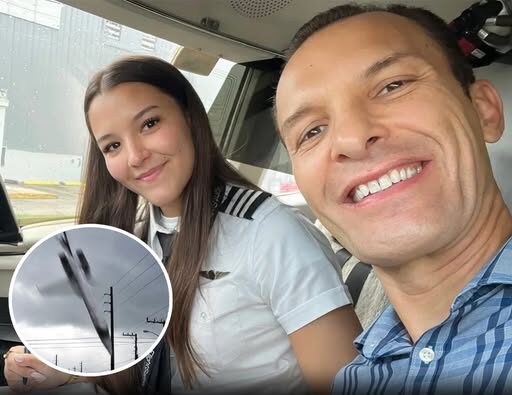
Pilot Who Lost His 20-Year-Old Daughter in Florida Learjet Crash Asks Why Crew Stayed on Course
Allan Filgueiras Is Searching for Answers After the November 1 Crash Killed All Nine People Aboard
Allan Filgueiras has listened repeatedly to the radio calls his daughter made in the final moments of a Learjet flight that crashed near Greenacres, Florida. Nathalia Filgueiras, 20, was the co-pilot and was handling communications with air traffic control when the aircraft began descending rapidly. She and the eight other people aboard were killed.
The Learjet 60 was flying from Austin, Texas, to the Bahamas on November 1. In his first public remarks about the loss, Allan, an experienced pilot who began teaching Nathalia to fly when she was 12, asked why the crew continued along its route as weather conditions worsened. He also spoke about the pride he felt hearing how his daughter responded once the emergency began.
A Father Questions the Route Through Worsening Weather
Speaking to Good Morning America reporter Rhiannon Ally, Allan focused on what options might have been available before the aircraft went into its rapid descent. A different route, he believes, might have taken another 20 or 30 minutes. He wants to understand why the crew stayed on the course it had chosen.
”Why did they go where they went,” he asked. He returned to the question as he considered whether the pilots could have taken a longer route. ”So why they didn’t go around?” he said. ”What made them go through the routes that they went?”
Allan described Nathalia as a cautious and responsible pilot who would avoid unnecessary risks. His account of her judgment came from years of knowing her as both a daughter and a pilot. The investigation still has to establish what the crew faced in the air and what led to the loss of control.
The Crew Reported Ice and Turbulence at About 35,000 Feet
The National Transportation Safety Board’s account places the Learjet at approximately 35,000 feet when the crew reported ice accumulating on the aircraft and moderate turbulence. Nathalia also told air traffic control that the jet’s altitude was fluctuating by about 700 feet. She was relaying those conditions from a cockpit she shared with Captain Jeff Gregory, 55.
After encountering precipitation, the crew asked for permission to climb to 37,000 feet. Air traffic control approved the request. Less than 30 seconds later, the pilots reported that the aircraft was descending rapidly.
Those transmissions establish the order in which the crew reported the weather, requested a climb, and alerted controllers to the descent. The speed of the change put the aircraft in an emergency within moments of the clearance. Investigators are working to determine what happened in that interval.
Nathalia Issued a Mayday as the Descent Accelerated
Nathalia called for help as she and Gregory struggled to regain control. ”Mayday, mayday. We’re descending 10,000 feet per minute,” she was heard saying. She then reported that the aircraft was moving too fast and descending at twice the rate she had just given.
“We are in an overspeed condition descending 20,000 feet per minute.” The two calls documented a rapidly worsening situation. As the Learjet continued to lose altitude, Nathalia’s next words conveyed how little time the crew had left.
”We’re going to crash into the ground!” she reportedly shouted. Her final words included: “Look outside! Holy f\*\*k. We’re out of time.”
The Learjet struck a roadway near Greenacres, igniting a large fire and leaving a crater at the crash site. Debris was reported across an area extending several miles from the point of impact. All nine people aboard died.
Her Father Says Her Experience Earned Her a Place in the Cockpit
Much of the attention surrounding Nathalia has centered on her age. Allan pointed to the training and experience she had accumulated by the time she became the flight’s co-pilot. She had logged 1,300 hours of flight experience and completed the training required to operate the Learjet.
Her father had been part of that education from its earliest stages. He began teaching her to fly when she was 12 and watched her put in the work that eventually took her into the cockpit of the Learjet 60. When he spoke about her after the crash, he emphasized the preparation behind that role.
Listening to Nathalia’s final transmissions has been painful for Allan. He has returned to them repeatedly and said he remains proud of the way she responded. As the emergency worsened, she continued giving controllers specific information about the descent and the condition of the aircraft.
The Aircraft and Its Maintenance History Are Among the Questions Still Open
Allan has brought in attorneys Andrew Yaffa and Stuart Grossman to help examine the circumstances of the crash. Their work includes looking at the aircraft and its maintenance history. His questions about the route are part of that broader effort to understand what happened before and during the loss of control.
Bombardier, the aircraft’s manufacturer, has said it will cooperate with investigators. The company has declined to comment on a possible cause while the investigation is ongoing. The conditions the crew described over the radio remain part of the timeline investigators are examining.
Allan’s question about a possible detour concerns an earlier stage of the flight, when the crew was still proceeding toward the Bahamas. The climb clearance and emergency calls concern the final stage, when events were changing in seconds. Establishing what happened across both parts of the flight is central to understanding how a crew reporting ice and turbulence came to issue a Mayday shortly afterward.
The Radio Calls Tell One Part of Nathalia’s Story
For investigators, Nathalia’s transmissions provide a record of what the pilots were experiencing and when they alerted air traffic control. For Allan, they also preserve the voice of the daughter he taught to fly. He hears her reporting the altitude changes, describing the increasing descent rate, and calling for help as the crew tried to recover.
He wants to know why the Learjet reached that point and whether another route was available. In speaking publicly, he also wanted people to understand the pilot behind those calls. She was 20, had accumulated 1,300 hours of flight experience, and kept communicating as the aircraft descended. Those are the actions her father has said he is proud to remember as he waits for answers.