
Can You Spot the Fifth Goose? This Countryside Puzzle Rewards a Second Look
Four Birds Are Easy to See, but the Final Goose Is Concealed
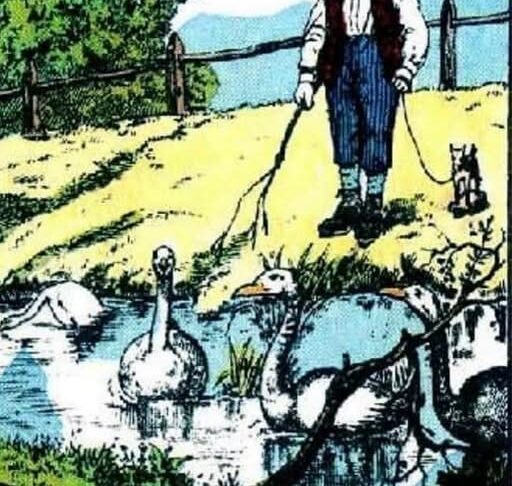
A countryside pond illustration presents viewers with a deceptively simple challenge: find five geese. Four birds are readily visible on the water, while the fifth is hidden within the larger scene.
The difficulty comes from looking beyond the objects that first attract attention. Once viewers recognize the pond and its four obvious birds, they may continue searching for another goose that looks exactly like those already found.
This puzzle calls for a different approach. The concealed bird is easier to investigate by examining outlines, surrounding foliage, and the empty spaces between recognizable features.
The farmer’s outline is a useful area to inspect. Rather than treating the figure and the nearby landscape as separate objects, viewers need to consider how their shapes work together.
The challenge is therefore less about counting the birds already in plain sight and more about recognizing an unexpected shape within the composition.
Why the First Four Geese Can Distract You
The visible birds establish an immediate pattern. They tell viewers what a goose looks like in this illustration and suggest where another one might reasonably appear.
That expectation can make the pond the main focus of the search. Someone may repeatedly inspect the water, looking for a smaller bird, a partially concealed body, or another familiar silhouette.
However, continuing to search in the same way can leave the hidden shape unnoticed. The illustration’s trick depends on directing attention toward features that do not initially appear to belong to a bird.
Recognizing that possibility changes the task. The countryside scene becomes a collection of lines and spaces that can be examined independently of their apparent subjects.
A shape understood as part of a person or a patch of foliage may contribute to another outline. The viewer’s task is to notice that second reading without assuming every feature has only one purpose.
Negative Space Provides an Important Clue
Negative space refers to the areas around and between the objects in an image. In a hidden-object puzzle, those spaces can be as useful as the figures that occupy the foreground.
Instead of searching only for a fully drawn goose, viewers can examine gaps and boundaries. An opening between two features may suggest part of a bird even when neither feature looks unusual on its own.
This requires temporarily setting aside the scene’s obvious meaning. The farmer remains a farmer, and the foliage remains foliage, but their edges may also help define something else.
The distinction is subtle. Looking at an object means recognizing what it represents; looking at its boundary means following the line without deciding too quickly what that line must belong to.
For this puzzle, that change in attention is central. The fifth goose is concealed through the composition rather than presented as another immediately recognizable bird floating beside the others.
Inspect the Farmer’s Outline and Nearby Foliage
The strongest clues direct attention toward the farmer and the surrounding vegetation. These areas deserve a slower examination than they might receive during an initial glance at the pond.
Following the farmer’s outline can help separate its individual curves and angles from the figure as a whole. The same approach applies to the edges of the foliage nearby.
Viewers can then consider whether adjacent lines or empty areas combine into a recognizable bird shape. The aim is to examine relationships between features, rather than searching each object in isolation.
It is important not to invent details that the illustration does not support. Without the picture itself, the exact placement of the hidden goose’s head, neck, or body cannot be identified reliably.
The available guidance narrows the search to an approach and an area. It does not provide a precise visual solution that can be checked against the drawing.
Shift Your Attention Without Losing the Whole Scene
A close inspection is useful, but the larger composition also matters. A concealed outline may become easier to recognize when several nearby details are viewed together.
Moving attention between the overall scene and individual boundaries offers two ways to examine the same artwork. One reveals how the features connect, while the other makes small changes in shape easier to notice.
The key is to avoid returning automatically to the four obvious birds whenever the search becomes difficult. Their locations are already known, so they provide little new information about the missing goose.
Instead, the unresolved part of the challenge lies in the countryside details that first seemed unrelated to the count. The farmer and foliage become more useful once they are viewed as possible components of a second image.
That does not require imagining a bird where none exists. It means remaining open to an outline that the first reading of the scene may have concealed.
The Puzzle Turns on Recognition Rather Than Speed
A hidden-object illustration can be satisfying precisely because the answer does not appear immediately. Time spent reconsidering a shape is part of the activity, rather than evidence that the viewer has failed.
In this case, the first four geese establish an easy beginning. The fifth introduces a different kind of observation, asking viewers to question the categories they assigned during their first glance.
The search becomes more productive when the question changes from where another pond bird might be to whether an existing boundary forms a bird in disguise.
That shift connects all the clues: negative space, the farmer’s outline, nearby foliage, and a willingness to reconsider the scene. Each encourages attention to the construction of the illustration rather than its obvious subject matter.
The appeal of the puzzle lies in that moment of recognition. A scene that seemed to contain only four geese can take on a second meaning when its less obvious shapes begin to fit together.