
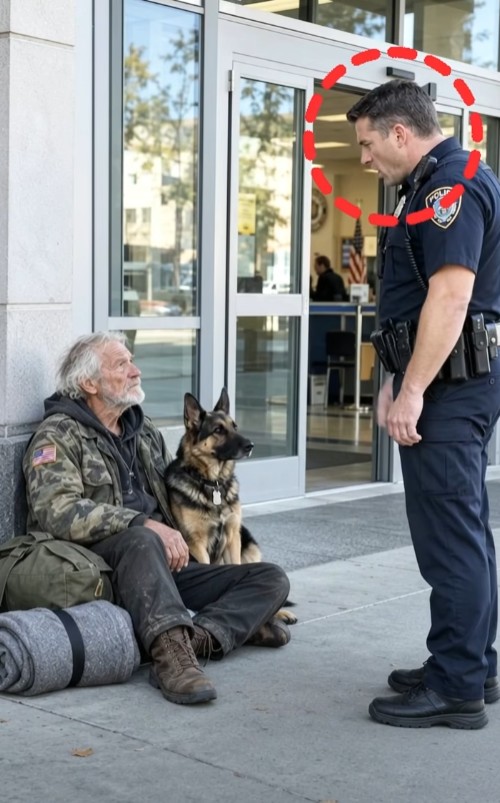
An Officer Stopped to Check on an Elderly Man and His Dog—Then Learned Why He Was Afraid to Go Home
Fiction: A Quiet Wait Outside a Community Office
Thomas Bennett had been sitting on the wooden bench for nearly half an hour when Officer Daniel Harris noticed him. Beside the seventy-eight-year-old man, a German Shepherd lay quietly with his leash resting in Thomas’s hand.
A small shopping bag sat near his walking cane. Thomas appeared tired, but nothing about the scene immediately suggested an emergency.
Daniel slowed as he approached the building. He knew residents often visited the community services office for assistance, and he wondered whether the man was waiting for someone or needed help.
The dog lifted his head as Daniel came closer, then remained beside his owner’s feet. Thomas greeted the officer politely and explained that he had stopped to rest.
At first, the conversation seemed likely to end there. But when Daniel asked a few more questions, Thomas admitted that returning home had become difficult.
He knew where he lived and how to get there. What worried him was reaching his third-floor apartment once he arrived.
The elevator had been unreliable for several days, and the stairs were becoming harder for him to manage. Sitting outside the office, Thomas was trying to gather enough energy for a journey he no longer felt confident about completing.
A Familiar Routine Becomes More Demanding
Thomas had lived in the neighborhood for more than forty years. Its streets, shops, and nearby park were familiar parts of his daily life.
For nearly eight years, Rex had accompanied him on those outings. The German Shepherd was calm, well-trained, and accustomed to walking at Thomas’s pace.
Their mornings usually followed a comfortable pattern. They took a short walk through the park, stopped at a bakery, and returned to the apartment for breakfast.
That morning had been different. Thomas had visited the community services office because he wanted information about the elevator problem in his building.
He had already reported the repeated interruptions, but he still had no definite date for repairs. Meanwhile, getting upstairs was taking more effort.
After the appointment, he stepped outside with Rex and realized that the walk had tired him more than expected. The bench offered somewhere to pause before heading back.
He intended to rest briefly. As the minutes passed, however, his concern about the stairs remained.
Daniel listened while Thomas described the situation. Rather than assuming the older man needed a particular kind of help, he first asked whether Thomas felt unwell or required medical attention.
Thomas explained that he was not experiencing an emergency. His difficulty was practical, but it was affecting his ability to return safely to the place where he lived.
A Second Officer Helps Consider the Options
Officer Michael Turner emerged from the building after an unrelated community appointment. Recognizing Daniel, he approached to see whether assistance was needed.
Daniel introduced him to Thomas and explained the problem. Michael greeted Thomas before acknowledging Rex from a respectful distance.
He asked permission before giving the dog a gentle pat. Thomas smiled, explaining that Rex enjoyed meeting friendly people.
The conversation then returned to the elevator. Thomas described the service interruptions and admitted that climbing three flights of stairs worried him.
Daniel asked whether he had a telephone number for the building manager. Thomas produced a folded notice containing the management company’s contact information.
Michael suggested calling to find out whether a repair schedule was available. Daniel agreed, while also pointing out that Thomas needed a safe plan for that afternoon.
A repair update alone would not resolve the immediate difficulty if the elevator remained out of service. The officers needed to understand what help Thomas would accept and whether someone could meet him.
Thomas mentioned his daughter, who worked elsewhere in the city and visited when she could. He had been reluctant to contact her because he did not want to interrupt her working day.
The officers did not promise an immediate repair or assume they could remove every obstacle. They focused on the next steps: contacting management, speaking with family, and finding somewhere comfortable for Thomas to wait.
The Elevator Has No Definite Repair Date
Daniel called the management office using the number on Thomas’s notice. A representative confirmed that the elevator was awaiting a replacement component.
A technician was expected to return, but the company could not provide a definite repair time. That uncertainty meant Thomas could not rely on finding the elevator working when he reached the building.
Daniel explained that a resident was having difficulty accessing his apartment. The representative agreed to alert the property manager and discuss temporary assistance.
While Daniel handled that call, Michael spoke with Thomas about contacting his daughter. Thomas hesitated again, uncomfortable with the thought of drawing her away from work.
Michael gently explained that family members often wanted to know when someone needed help. Telling Catherine would allow her to understand the situation rather than leaving Thomas to manage it alone.
After considering that, Thomas agreed to call her. He explained where he was and why he had stopped.
Catherine was concerned to learn that her father had been using the stairs despite his increasing difficulty. She offered to leave work and meet him.
Knowing she was coming gave the afternoon a clearer direction. Thomas no longer needed to decide, from the bench, whether to attempt the journey by himself.
A Comfortable Place to Wait With Rex
Daniel suggested that Thomas wait somewhere more comfortable until Catherine arrived. Michael contacted the community services office inside the building to ask whether a suitable space was available.
A staff member offered a quiet waiting area where Rex could stay beside his owner. The officers helped Thomas collect his shopping bag and cane before accompanying him indoors.
Once seated in a comfortable chair, Thomas could rest without preparing himself for another immediate walk. A staff member brought him water, and Rex settled at his feet.
Michael also contacted a local senior assistance program to learn what support might be available. The coordinator explained that the program could help arrange transportation and referrals for appropriate temporary accommodation.
Any arrangement would require Thomas’s agreement and consideration of his needs. The officers explained the possibilities without pressuring him to accept a particular option.
Thomas wanted to remain close to his familiar neighborhood. He was also clear that Rex needed to stay with him.
The dog was his daily companion, and separating them would have added another concern to an already unsettling situation. Daniel and Michael acknowledged that Rex’s needs should be included in any plan.
By the time Catherine arrived, the conversation had moved beyond the question of whether Thomas could struggle upstairs that afternoon. There were alternatives to discuss, and he had support in deciding which one suited him.
Catherine Offers a Temporary Solution
Catherine thanked the officers for taking the time to speak with her father. Then she sat with Thomas and discussed what would make the next few days manageable.
Her home was on the ground floor, and she offered him a temporary place there until the elevator was repaired. Rex was welcome too.
The arrangement addressed Thomas’s most immediate concerns. He would not have to climb several flights of stairs, and his dog could remain beside him.
Thomas agreed that staying with Catherine was sensible. It did not mean giving up his apartment or abandoning the routines he valued; it gave him somewhere accessible while the building problem was resolved.
The officers helped coordinate their departure and confirmed that management had been informed. Later that afternoon, Catherine drove her father and Rex to her home.
She prepared a comfortable room and placed Rex’s bed nearby. For Thomas, the reassurance came from knowing that getting to his room would not require the effort he had been dreading on the bench.
Over the following days, Catherine stayed in contact with the management company. She requested updates while Thomas waited for confirmation that the elevator was ready to use.
Returning Home After the Repairs
The property manager eventually confirmed that the replacement component had arrived. A technician completed the work, and the elevator underwent operational checks.
Once management confirmed that service had resumed, Thomas arranged to return to his apartment. Catherine accompanied him and helped carry his belongings using the repaired elevator.
Rex explored the familiar rooms before settling beside his favorite window. Thomas was back in the home and neighborhood he knew, with the immediate access problem resolved.
Several days later, he encountered Daniel during another walk. This time, Thomas was able to thank him without the uncertainty that had shaped their first conversation.
Daniel asked whether the elevator was working properly. Thomas smiled and confirmed that it was.
The officers had not repaired the machinery themselves or offered a solution they could not deliver. They had listened, made calls, and helped Thomas consider support he had hesitated to request.
That assistance had changed his afternoon. Instead of attempting the stairs alone, he had waited comfortably, spoken with his daughter, and chosen a temporary arrangement that kept him and Rex together.
As Thomas continued home with the dog beside him, the encounter remained a reassuring memory. Someone had noticed that his quiet rest on a bench concealed a difficulty—and had stayed long enough to help him find a way through it.