
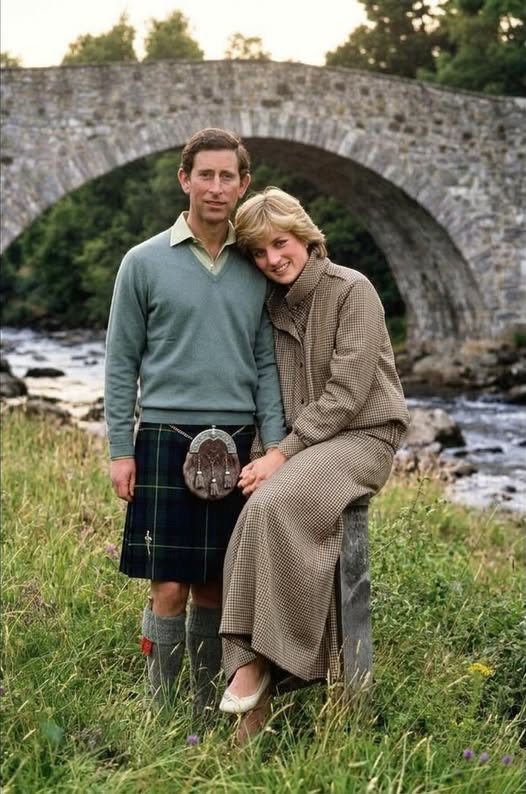
The Bench Hidden From View in Diana and Charles’s Famous Balmoral Portrait
A Royal Photograph Creates a Misleading Height Difference
A photograph taken at Balmoral in 1981 has attracted attention for a detail that seems difficult to explain at first glance. Princess Diana, wearing a tan jacket, appears beside Charles, dressed in a green sweater, with a noticeable difference in their apparent heights.
Charles looks considerably taller. Yet the pair were described as standing approximately the same height, around five feet ten inches.
That contrast encouraged questions about how the portrait had been arranged. Some observers interpreted it as an example of royal photography presenting the male partner as taller, regardless of the couple’s actual measurements.
Other photographs from the same session provide a more immediate explanation. Diana was seated on a wooden bench while Charles stood beside her, and the tighter portrait excluded the seat from view.
Once that positioning is understood, the apparent discrepancy becomes much less mysterious. The image was not showing two people standing together on equal footing, even though its composition could encourage that assumption.
The photograph offers a useful distinction between what an image shows and what a viewer supplies. Diana and Charles were both visible, but the missing bench concealed information essential to understanding their positions.
The Detail Outside the Frame
The wooden bench changes how the Balmoral portrait is read. Without it, viewers may assume Diana’s shoulders and head indicate where she would stand beside Charles.
That assumption creates the impression that he is substantially taller. In reality, their different positions account for the visible difference without requiring either person’s height to be misrepresented through a change in scale.
The wider photographs matter because they restore the surrounding scene. They allow the seated and standing positions to be understood together rather than leaving the viewer to infer what lies below the crop.
Nothing about the visible faces or clothing needs to change for the interpretation to shift. The additional information is simply the support beneath Diana and the fuller view of how the pair were arranged.
This is why tightly framed photographs can be persuasive even when they leave an important question unresolved. A close portrait may feel complete because it clearly shows the subjects, while still excluding details that explain their relationship to the space around them.
In the Balmoral image, the missing information is ordinary. A garden bench, rather than an unusual camera technique, provides the central explanation.
The resulting illusion depends on a familiar expectation: when two people appear side by side in a portrait, viewers often imagine them standing unless the photograph gives them a reason to think otherwise.
Why Viewers Suspected Deliberate Staging
The discussion did not develop solely from one image. Observers had also noticed other royal portraits and appearances in which Charles seemed taller than Diana despite their reportedly similar heights.
That broader impression made the Balmoral photograph appear to fit an existing pattern. Instead of examining its particular arrangement, some viewers treated it as another example of the same visual choice.
Critics suggested that such images reflected traditional expectations about couples, especially the familiar convention of presenting a man as taller than his female partner. Within formal royal imagery, they believed that difference could communicate a conventional relationship between husband and wife.
Sociologist Lisa Wade previously examined royal portraits from that period in connection with social expectations favoring taller male partners. That perspective concerns the meanings audiences attach to height and the way those meanings can influence the interpretation of photographs.
However, a general observation about cultural expectations does not establish why a particular portrait was composed in a particular way. The Balmoral image must also be considered alongside the photographs that reveal its actual arrangement.
Those wider views explain the visible difference through Diana’s seated position. They do not require speculation about whether Charles needed to appear taller for reasons of status or presentation.
The explanation is specific to this session. It should not automatically be extended to every other photograph of the couple, each of which may involve different poses, footwear, or camera positions.
What a Photograph Can Explain—and What It Cannot
Recognizing the bench resolves the basic question of why Charles appears taller in this portrait. It does not reveal every decision made during the session or establish what the photographer intended viewers to think.
A seated pose and a standing pose are observable arrangements. A claim about protecting royal tradition is an interpretation of motive, and those are different kinds of conclusions.
The distinction is important because an accurate explanation should not replace one unsupported assumption with another. The available context shows how the effect occurred, without necessarily explaining why that particular crop was selected.
Likewise, describing the photograph as an illusion does not mean the image itself was altered. An ordinary scene can produce a misleading impression when relevant surroundings fall outside the frame.
The people in the portrait remain where they were photographed. What changes is the viewer’s understanding of their positions once the rest of the scene becomes visible.
That makes the wider session more informative than a debate based entirely on the close crop. Comparing related photographs supplies evidence that the isolated portrait cannot provide by itself.
The Balmoral example therefore supports a limited but clear conclusion: the apparent height difference is explained by Diana sitting while Charles stands. Claims about the purpose behind that arrangement go beyond what the positioning alone establishes.
Posture and Footwear Also Shape Royal Comparisons
Height discussions continue with other members of the royal family. Comparisons involving Prince William and Catherine illustrate how viewers assess differences through photographs rather than measurements alone.
William is described as six feet three inches tall, while Catherine is described as five feet nine inches. Even where a genuine height difference exists, footwear and posture can influence how pronounced it appears in a particular image.
A photograph records the way people are positioned at one moment. It does not necessarily provide a reliable comparison of their standing heights, especially when the ground, shoes, or lower bodies are outside the frame.
The same caution applies when looking back at Diana and Charles. Their reported measurements may prompt a question, but the answer requires attention to the circumstances of the photograph rather than the measurements alone.
In the Balmoral session, the decisive circumstance is not a subtle difference in posture. It is the much more substantial difference between sitting and standing.
Once that information is restored, the portrait becomes easier to understand. The viewer no longer needs to imagine a dramatic physical difference between two people described as being approximately the same height.
The enduring interest in the image comes from how convincingly its framing supports an initial assumption. A closer look at the full session reveals that the missing detail was not hidden within an expression or a gesture, but beneath the edge of the photograph: the wooden bench on which Diana sat.