
What Your Finger Length Might Say About You: Exploring Science, Beliefs, and Personal Reflection
A Small Detail That Sparks Big Curiosity
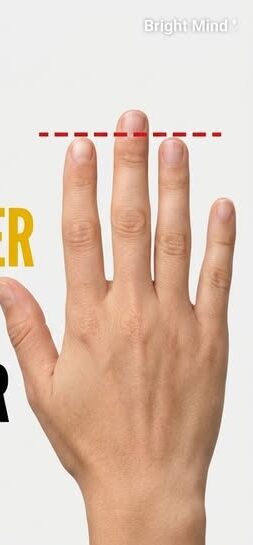
Take a moment to look at your hand.
Compare your index finger with your ring finger and notice which one appears longer.
For many people, the ring finger slightly exceeds the index finger in length, while for others, the opposite may be true.
This subtle difference has attracted attention for years, leading to questions about what it might reveal about a person.
The Longstanding Fascination with Hands
Throughout history, hands have been viewed as more than simple tools for daily tasks.
They have often been seen as reflections of deeper traits, including personality, emotional strength, and life experiences.
Different cultures developed interpretations that connected hand features to identity and purpose.
Some traditions suggested that even small physical characteristics could hold symbolic meaning.
In these interpretations, finger length was sometimes believed to reflect qualities such as balance, strength, or emotional depth.
While these ideas varied widely, they shared a common belief that the body could offer insight into a person’s inner world.
A Modern Scientific Perspective
Today, the comparison between the index finger and ring finger is known as the 2D:4D ratio.
This ratio has been studied in scientific settings to understand how physical development before birth may influence certain traits.
Researchers have suggested that the relative length of these fingers may be connected to hormone exposure during early development.
In particular, the balance of hormones such as testosterone before birth is believed to play a role in shaping this ratio.
A longer ring finger, in relation to the index finger, is often associated with higher levels of prenatal testosterone.
This does not determine a person’s identity, but it may reflect aspects of early biological development.
What Studies Suggest About Behavior
Some research has explored potential connections between finger length ratios and behavioral tendencies.
These studies do not provide fixed conclusions but instead highlight patterns observed across groups.
Individuals with a longer ring finger have sometimes been linked to traits such as competitiveness and confidence.
Other observations include a tendency toward risk-taking or strong focus when pursuing goals.
In certain cases, this ratio has also been discussed in relation to decision-making styles or performance in competitive environments.
However, these associations remain general and do not apply to every individual.
Understanding the Limits of Scientific Findings
It is important to recognize that such findings describe tendencies, not rules.
Human behavior is complex and influenced by many factors beyond physical characteristics.
Environment, upbringing, experiences, and personal choices all play a major role in shaping personality.
The 2D:4D ratio offers insight into one small aspect of development, but it does not define who a person is.
Scientific observations should be understood as part of a broader picture rather than a final explanation.
The Symbolic and Personal Interpretation
Beyond scientific discussion, many people continue to interpret finger length in a more personal or symbolic way.
For some, a longer ring finger represents inner strength or resilience.
Others see it as a sign of emotional depth or the ability to navigate challenges.
These interpretations are not based on measurable evidence but on how individuals relate to their own experiences.
In this sense, physical traits become a way to reflect on personal qualities rather than predict them.
Why Meaning Often Goes Beyond Measurement
People naturally seek meaning in small details.
Observing something as simple as finger length can lead to deeper questions about identity and behavior.
This curiosity is not about finding absolute answers but about exploring possibilities.
When individuals assign meaning to physical traits, they are often engaging in self-reflection.
They consider their strengths, their habits, and how they respond to different situations.
In this way, the focus shifts from the trait itself to the person interpreting it.
A Balanced View of Science and Belief
The discussion around finger length sits at the intersection of science and personal interpretation.
On one side, there are measurable factors related to biology and development.
On the other, there are symbolic meanings shaped by culture and individual perspective.
Both viewpoints offer something valuable.
Science provides structure and understanding, while personal interpretation adds depth and meaning.
Together, they create a more complete picture of how people understand themselves.
A Reminder About Individual Identity
No single physical trait can fully describe a person.
Finger length does not determine personality, behavior, or future outcomes.
It is only one small detail within a much larger and more complex identity.
Each person is shaped by a combination of biological factors and life experiences.
Choices, values, and personal growth play a far greater role than any physical measurement.
This perspective helps maintain a healthy balance between curiosity and realism.
Using Curiosity as a Tool for Reflection
Instead of viewing finger length as a fixed label, it can be approached as a starting point for reflection.
It offers an opportunity to think about personal qualities and how they develop over time.
Questions such as personal strengths and responses to challenges become more meaningful.
This approach encourages self-awareness rather than limitation.
It allows individuals to explore who they are without being defined by a single characteristic.
In this way, curiosity becomes a positive and constructive tool.
Common Questions About Finger Length
Many people wonder what it means if their ring finger is longer than their index finger.
From a scientific perspective, it may reflect aspects of prenatal development.
From a symbolic perspective, it is often associated with confidence or resilience.
Another common question is whether this ratio determines personality.
The answer is no, as it only shows general patterns rather than fixed outcomes.
Personality is influenced by a wide range of factors that extend far beyond physical traits.
Some also ask whether this feature is unusual.
In reality, it is quite common, and many people share similar finger length patterns.
This makes it a normal variation rather than something exceptional.
A Simple but Meaningful Perspective
The smallest details can often lead to the biggest reflections.
Looking at your hand may seem insignificant at first, but it can inspire thoughtful consideration.
It reminds people to pay attention to themselves in a deeper way.
Your hands do not define your path or determine your future.
They simply exist as part of who you are.
What truly matters is how you understand and shape your own experiences.
Final Reflection
Take another look at your hands.
Not to analyze them too closely, but to notice them with a sense of curiosity.
They are a part of your story, but not the whole story.
Sometimes, the value of small observations lies in the thoughts they inspire.
They invite you to reflect, to question, and to better understand yourself.
And in that process, the meaning becomes far more important than the detail itself.