
A Dog’s Instinct Prevents a Dangerous Encounter at Home
An Ordinary Evening Takes an Unexpected Turn
The evening began like any other. A routine walk had just ended, and the quiet surroundings offered no indication that anything was wrong. The air was calm, the yard was still, and the familiar path home felt safe and uneventful.
Walking side by side, the dog showed no signs of distress or agitation. His behavior was steady, relaxed, and typical after a long outing. There were no sudden distractions, no unusual movements, and no hint that anything was about to change.
As they approached the apartment door, the sense of normalcy remained intact. It was simply the end of another day, with nothing to suggest that the next few moments would unfold into something far more serious.
A Sudden Shift in Behavior
Standing at the door, the owner reached into a bag to retrieve the keys. It was a simple, habitual action, one performed countless times before without a second thought.
But in that instant, the dog’s demeanor changed completely. His body stiffened, and his attention locked onto the door. His ears rose sharply, his posture tightened, and a low, unfamiliar growl began to emerge.
The transformation was immediate and striking. Only seconds earlier, he had been calm and composed. Now, he seemed intensely focused, as though reacting to something beyond human perception.
At first, the behavior appeared puzzling rather than alarming. It seemed possible that he had heard a sound from the hallway or sensed movement nearby. Attempts were made to reassure him, to calm him down and restore the sense of normalcy.
However, the dog did not respond. His attention remained fixed, unwavering and urgent.
Attempts to Intervene
As the key was brought closer to the lock, the dog’s reaction intensified. He began to push against his owner, physically interfering with the action. His movements were no longer subtle or hesitant—they were deliberate and insistent.
He stepped directly in front of the door, blocking access with his body. His whining grew louder, filled with urgency and distress. It was clear that this was not playful behavior or simple restlessness.
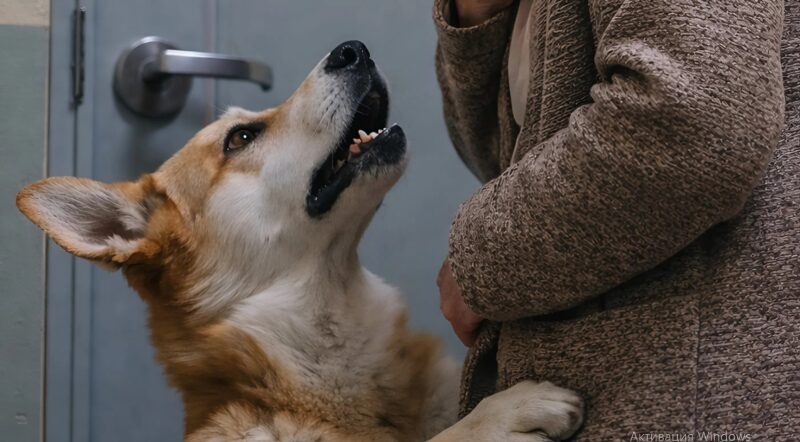
He pressed his paws against his owner’s legs, attempting to prevent any movement toward the lock. His eyes conveyed tension and alertness, a look that had never been seen before.
Despite the unusual behavior, frustration began to set in. The situation felt confusing and inconvenient after a long walk. It seemed as though the dog was acting without reason.
In an effort to proceed, he was gently pushed aside. The key was inserted into the lock, despite the continued resistance.
A Warning Ignored
The moment the door began to open, the dog’s reaction escalated further. His bark changed into something sharper, louder, and more intense. It carried a sense of alarm that was impossible to ignore, even if its meaning was not yet understood.
Still, the door opened, and the step inside was taken.
At first, the apartment appeared unchanged. It was dark and quiet, with nothing immediately out of place. Yet within seconds, a subtle but unmistakable feeling emerged.
Something was wrong.
A foreign scent lingered in the air, unfamiliar and unsettling. It was not part of the usual environment, and it immediately raised concern.
Signs of Intrusion
As the eyes adjusted to the dim light, small details began to stand out. A drawer in the hallway was slightly open, even though it had been carefully closed earlier in the day.
This small inconsistency quickly grew into a larger realization. A faint rustling sound could be heard deeper inside the apartment, subtle but undeniable.
Every instinct signaled danger. The silence was no longer calm—it was heavy and uncertain.
Looking ahead, the door to another room appeared slightly ajar. It seemed as though something—or someone—was moving behind it.
In that moment, the situation became clear.
A Rapid Response
Before any further action could be taken, the dog broke free. His leash slipped away as he rushed forward with force and determination.
His barking filled the space, loud and commanding. Within seconds, the sound of movement echoed from inside the apartment. A heavy thud followed, along with hurried footsteps and a voice raised in alarm.
The presence of an intruder was confirmed.
The reaction was immediate and overwhelming. Fear took hold, and the only instinct was to retreat. Backing out of the apartment, the door was pulled shut as quickly as possible, even as hands trembled with urgency.
Outside, the heart raced, and the reality of the situation began to settle in.
The Dog’s Protective Instinct
Inside the apartment, the dog stood between the intruder and the exit. His behavior, once misunderstood, now revealed its purpose with complete clarity.
He had sensed the danger long before the door was opened. His actions had not been random or excessive—they had been deliberate attempts to prevent entry into a dangerous situation.
The intruder, clearly unprepared for the presence of a protective dog, struggled to react. Items were dropped, movements became frantic, and attempts to escape were met with resistance.
The dog’s persistence created a barrier, buying crucial time. His presence alone disrupted whatever plan had been in place.
Those few moments made all the difference.
Help Arrives
Outside on the landing, calls were made for assistance. Neighbors began to open their doors, drawn by the noise and urgency. Some stepped out to help, while others contacted authorities.
The atmosphere shifted quickly from isolation to shared concern. The seriousness of the situation was clear to everyone present.
Authorities arrived shortly after. The intruder was apprehended inside the apartment, unable to carry out his intentions or leave unnoticed.
It became evident that the break-in had occurred earlier, during the time the apartment was empty. The plan had likely been to enter quietly, collect valuables, and leave without detection.
That plan was interrupted entirely.
Understanding What Happened
In the aftermath, the sequence of events took on new meaning. The dog’s behavior at the door was no longer confusing or frustrating—it was protective and purposeful.
He had detected signs that were beyond human awareness. Whether it was a scent, a sound, or a subtle shift in the environment, he recognized the presence of danger.
His attempts to block the door, to push his owner away, and to create distance were all efforts to prevent exposure to that danger.
Even when misunderstood, he did not stop. His actions grew more urgent, more insistent, as he tried to communicate what could not be easily explained.
In the end, his instincts proved accurate.
A Lasting Realization
The experience left a lasting impression. What had initially seemed like irrational behavior was revealed as a critical warning.
It served as a powerful reminder of the unique awareness animals can possess. Their senses often detect what humans cannot, and their reactions, though sometimes puzzling, can carry important meaning.
In this case, that awareness prevented a potentially dangerous encounter. It provided time to react, to escape, and to call for help.
The bond between owner and dog took on a deeper significance. Trust, once taken for granted, was now reinforced by a clear understanding of loyalty and protection.
What began as an ordinary evening ended as a moment of profound realization—one that would not be forgotten.
A Quiet Hero at Home
Looking back, the events highlight the importance of paying attention to unusual behavior, especially from animals who are deeply attuned to their surroundings.
The dog’s actions were not driven by confusion or fear alone. They were driven by instinct, awareness, and a desire to protect.
In a situation where seconds mattered, those instincts created an opportunity to avoid harm.
The outcome could have been very different. Instead, it became a story of awareness, quick action, and the quiet heroism of a companion who refused to ignore danger.
Sometimes, the most important warnings come without words—and recognizing them can make all the difference.