
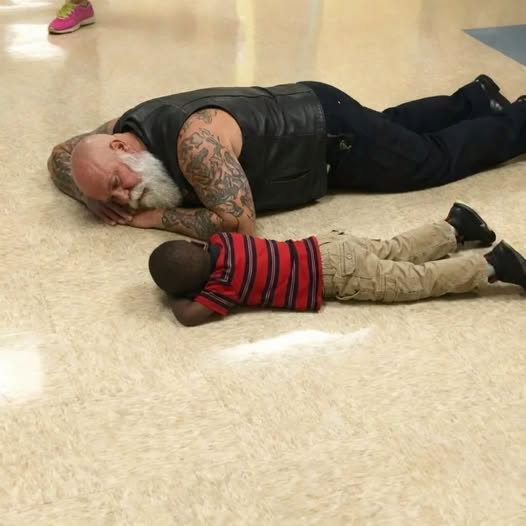
My Son Was Overwhelmed in a Waiting Room—Then a Stranger Quietly Lay Down Nearby
Fiction: A Pediatric Nurse Found Herself Facing a Crisis as a Mother
The noise seemed to fill the waiting room, reaching every corner at once. Marcus dropped to the floor, his body drawing inward as distress overwhelmed him.
I recognized that he was struggling. This was not a child refusing an instruction or trying to attract attention.
But recognizing what was happening did not mean I could immediately help him through it. My son was on the floor, and the approaches I usually relied upon were not reaching him.
I reached for his headphones and tried the familiar supports available to us. I softened my voice, hoping something recognizable would give him a little room to recover.
Marcus remained deeply distressed. Each moment felt longer because I could see how much he was struggling and could not make it stop.
My work in pediatrics had brought me alongside many families during difficult moments. Being there with my own child exposed a vulnerability that professional experience had never removed.
The Room Felt Smaller Under Other People’s Eyes
I had helped parents remain steady while their children were overwhelmed. I understood how difficult those situations could look from the outside and how little appearances could explain.
Now I was the parent feeling everyone’s attention. Some faces showed concern, others discomfort, and I was conscious of reactions I could not interpret with certainty.
That awareness added to my own distress. I wanted to protect Marcus from the noise, from scrutiny, and from the expectation that he should recover quickly.
I also wanted to be useful. The gap between knowing something about care and finding what helped my son felt painfully wide.
Marcus did not need me to perform competence for the room. He needed support suited to that particular moment, even if I had not yet found it.
Then a man I did not recognize came toward us. His approach was unhurried, and he stopped short of crowding my son.
The Stranger Offered No Instructions
The man looked at the situation, lowered himself to the floor, and lay on his back a short distance from Marcus. He did not tell him to be quiet or ask him to explain himself.
For several moments, Marcus showed no visible response. The man stayed where he was without moving closer.
I watched, unsure what he intended. His posture was unexpected, but it did not introduce another demand for Marcus to answer.
He was simply nearby. He did not require my son to look at him, speak, or demonstrate that anything was improving.
In my own exhausted state, I noticed that absence of pressure. There was another adult present, but he was not adding instructions to a moment already crowded with difficulty.
I stayed attentive to Marcus. I did not know whether the stranger’s presence would help, and I could not assume that one person’s response would suit every child.
What happened next unfolded slowly enough that no single movement explained it.
Marcus Began to Notice Him
Marcus’s breathing changed a little. His cries continued, but there were pauses between them that had not been there before.
Then he turned his head toward the man on the floor. The stranger remained still.
After a while, Marcus moved nearer and lay down too. No one had asked him to copy the position.
I resisted the urge to fill the silence with encouragement. He was making a choice, and I wanted to allow him time to make it without turning it into another task.
The man began humming softly. The sound was low and steady, without sudden changes.
Marcus did not become calm immediately. His body remained tense, and the distress eased unevenly rather than disappearing.
Still, as the minutes passed, he seemed less tightly braced. Eventually, he was able to sit upright.
I could not identify one action that had caused the change. I only knew that he had begun recovering while someone stayed nearby without rushing him.
Bear Explained Why He Had Stayed
Only then did the man introduce himself. His name was Bear.
He told me about his grandson, Tyler, who was autistic. His experience with Tyler had taught him that moments of overwhelm could become more difficult when adults responded with urgency or repeated demands.
He was describing what he had learned within his own family. He did not present himself as a clinician or suggest that he had discovered a solution for everyone.
That modesty mattered. He had offered companionship in a difficult moment, not a judgment about my parenting or a claim that he understood everything Marcus needed.
As I listened, I felt some of my own tension ease. I no longer felt like the only person in the room trying to understand rather than correct what was happening.
Bear did not linger over his explanation. His attention remained on Marcus, who was gradually becoming more aware of the surroundings again.
There was no expectation that he should immediately talk, smile, or thank anyone.
Curiosity Returned Before Conversation
When Marcus seemed ready for something different, Bear showed him photographs of his motorcycle and places he had visited. They were ordinary pieces of his life, offered without turning the exchange into a lesson.
Then he played a recording of the engine. I tensed, remembering how the earlier noise had affected Marcus.
But my son responded differently to this sound. He leaned toward it with cautious interest.
That reaction did not mean the earlier distress had been inexplicable. Different sounds and circumstances could be experienced differently, and Marcus was responding to what was in front of him now.
Bear allowed him to remain curious at his own pace. He did not insist on a response or push the interaction forward.
Eventually, he offered us the option of stepping outside to see the motorcycle. There was no demand to accept.
We went out when Marcus was ready.
A Small Gesture Beside the Motorcycle
Outside, there was more space around us. The motorcycle stood parked nearby, and Marcus approached it cautiously.
His hand hovered before he touched the surface. Then his fingers moved over it with close attention.
Bear waited. He did not hurry Marcus toward a photograph or ask him to react in a particular way.
After a while, my son reached for his hand.
It was a small movement, but I noticed it immediately. Earlier, he had been overwhelmed; now he was choosing a connection.
I did not need to turn that gesture into proof of anything larger. It was meaningful because it belonged to Marcus and happened on his terms.
Before leaving, Bear wrote down his number. He explained that someone had once offered similar support to his family, and he wanted to extend that kindness when he could.
He left without drawing attention to himself. I remained beside my son, grateful for the time he had given us.
Our Families Continued Getting to Know Each Other
Over the following weeks and months, the encounter became a continuing friendship. Bear visited occasionally with Tyler, and the boys began sharing time together.
Their connection did not always look like the play adults might expect. Often, they were comfortable occupying the same space without speaking or taking part in a joint activity.
There could be silence, repeated movements, or an interest followed separately but nearby. I learned to appreciate those moments without requiring them to become something more recognizable to me.
What mattered was whether the boys seemed comfortable. Their relationship did not need constant conversation to deserve attention and respect.
Bear’s presence also gave me someone with whom I could share parts of our experience. We did not need identical circumstances to understand the value of patience.
The friendship grew quietly. It did not depend on recreating the waiting-room encounter or expecting the same response every time someone struggled.
Marcus Offered Tyler His Own Version of Support
One day, when Tyler became distressed, I saw Marcus lower himself nearby. He became quieter and stayed close without trying to force an interaction.
I recognized something of what Bear had done. Marcus was not repeating a formal set of instructions; he was offering a familiar kind of company.
It did not happen perfectly, and it was not a response he used in every situation. I did not expect it to be.
But watching him, I understood that the kindness he had received had become something he could offer in his own way.
That moment stayed with me because it concerned more than calming down. It showed two children making room for each other without requiring an immediate explanation.
I had spent years thinking carefully about what to say and what support to offer. Marcus reminded me that the manner of being present could matter too.
The Encounter Changed How I Understood Help
Bear did not resolve every difficulty our family faced. He did not replace the knowledge, preparation, or individualized support Marcus might need at other times.
What he offered was narrower and still valuable: patience during a moment when both my son and I were struggling.
I could remember that without turning his actions into a universal method. A quiet hum, a nearby position, or an unfamiliar person’s approach would not necessarily feel comfortable to someone else.
The lasting lesson was to pay attention to the individual and avoid letting my own urgency become another demand. Sometimes the next helpful step was smaller than the one I initially wanted to take.
In that waiting room, Bear had given Marcus time and given me company. The friendship that followed allowed those acts to become part of our family’s life.
I still valued my professional experience. I simply understood more clearly that care also involved knowing when to pause, observe, and let another person find their own pace.