
A Cemetery Encounter Leads a Grieving Mother Toward the Truth
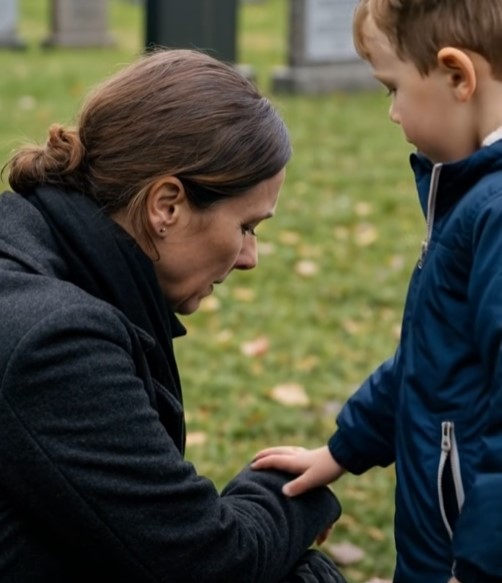
Two years after losing her daughters, Taylor had developed a routine for managing difficult days. On the morning of her latest visit to the cemetery, she focused on counting her steps and steadying her breathing as she approached the gravestone.
In her hands, she carried white lilies for Ava and pink flowers for Mia. The visit was meant to be quiet and private, like many moments of grief that had come to define her life since the loss.
Before she reached the grave, however, a child’s voice interrupted the silence.
A small boy nearby pointed toward the gravestone and said that the girls in the photo were in his class. The remark stopped Taylor in place and shifted the course of the entire day.
A life divided into before and after
Taylor’s daughters, Ava and Mia, were five years old when they died. In the final ordinary moments before everything changed, the house had been full of movement, laughter, and the familiar sounds of family life.
The girls had been playing on the couch cushions, competing to see who could balance better. Taylor watched from the doorway, reminding them to be careful while still enjoying the scene in front of her.
It was the kind of everyday moment that rarely seems important while it is happening. Later, it became one of the memories she returned to most often.
After that day, her recollections became fragmented. She remembered a phone ringing, the sound of emergency response vehicles, the hospital corridors, and her husband Stuart repeating her name while the family was guided through a crisis that would permanently alter their lives.
The funeral passed in a haze. Many details blurred together, but one moment remained sharp in her mind: the first night back home, when Stuart quietly left their bedroom and closed the door behind him.
From then on, grief settled into their house in ways neither of them seemed able to explain. Time moved forward, but Taylor’s understanding of what had happened never felt complete.
An unexpected comment at the grave
At the cemetery, Taylor knelt beside the gravestone and placed the flowers on the grass. She spoke softly to her daughters, apologizing for not coming as often as she wished and telling them she was trying to do better.
Then the boy spoke again, repeating that the girls were in his class. His mother immediately corrected him for pointing, and he apologized, but by then Taylor’s attention was fixed on what he had said.
She asked what he meant, and the woman gently encouraged her son to explain. The child said that a classmate named Demi had brought the girls’ picture to school and told classmates they were her siblings who now lived in the clouds.
The name struck Taylor immediately. Demi was the daughter of Macy, the babysitter who had been connected to the final day of Ava and Mia’s lives.
The boy’s mother added that the children had recently completed a school project about people who live on in their hearts. Demi had shared a picture of her siblings, and the activity had clearly affected her.
That short explanation was enough to leave Taylor shaken. She thanked them and asked which school the children attended.
When they left, she remained at the grave, standing between memory and a new set of questions she had not expected to face.
A familiar name brings back old doubts
Back at home, Taylor could not let the moment go. She paced the kitchen, replaying the child’s words and thinking about the photograph described in the classroom.
The issue was not only that the image existed. It was that Macy still had it, had kept it for all this time, and had apparently shared it with her own daughter.
That raised questions Taylor had not asked in years, or perhaps had not known how to ask. Why did Macy have that particular photograph? Why had it remained in her possession? And why was it being presented as part of Demi’s family story?
Taylor eventually called the school. She explained that she believed a photograph of her daughters might be displayed in a classroom and said she wanted to understand how it got there.
After a brief pause, the receptionist offered to connect her with Ms. Edwards, the teacher.
A classroom display reveals more than expected
When Taylor visited Lincoln Elementary, Ms. Edwards welcomed her kindly. The classroom was filled with children’s artwork and the usual signs of a busy school day, but Taylor’s focus moved immediately to the photo on the wall.
There it was: Ava and Mia in pajamas, their faces marked by melted ice cream, with Demi standing between them. It was not a formal portrait or a distant school image. It was a relaxed family-style moment, taken during a shared outing.
Taylor asked where the photograph had come from.
Ms. Edwards explained that Demi had introduced the girls as her siblings and that Demi’s mother had provided the image. The teacher also said the picture had been described as the last time they all went out for ice cream together.
The answer confirmed that Macy had not only kept the photo but had remembered the details around when it was taken. For Taylor, that realization deepened the significance of what she was seeing.
Even so, she did not ask for the picture to be removed. Instead, she said it could stay, describing it as part of the girls’ memory.
That choice reflected the conflict she was living with in the moment. The photo was painful, but it also preserved a real image of her daughters being happy.
A conversation that changes everything
Later that evening, Taylor went to see Macy directly. What followed was a conversation that began with tension and quickly moved into long-hidden truth.
Taylor confronted her about the photograph, saying she recognized the girls’ pajamas and understood that the image had been taken on the day everything happened.
Macy admitted that this was true.
She said that she had picked up Ava and Mia first and had then been supposed to collect Demi. Instead, when the girls asked for ice cream, she agreed to stop before completing the rest of the plan.
Macy said she had treated the detour as a brief decision that would take only a few minutes. But in the aftermath, she had not told the full truth.
She acknowledged that she had previously described the situation differently to police. In doing so, she had concealed the fact that she had made an unscheduled stop with the children before events turned tragic.
For Taylor, the admission was devastating not only because of what Macy revealed, but because of what had been withheld for two years.
The most painful part came next. When Taylor asked whether Stuart had known, Macy said he did.
According to Macy, she had told him after the funeral. He had urged her not to tell Taylor, saying that sharing the truth would only cause more pain and would not change what had happened.
That explanation did not lessen the harm. Instead, it left Taylor facing the possibility that while she had carried guilt and uncertainty, others had been living with information she never received.
The weight of hidden truth
What made the revelation especially difficult was the emotional burden Taylor had been carrying. For two years, she had lived without a full understanding of the events surrounding her daughters’ final day.
In that gap, guilt had taken root. The absence of clarity had allowed her to blame herself in ways that were never openly corrected.
Now, she was learning that key details had been intentionally withheld. Macy had not been fully honest, and Stuart had chosen silence after learning the truth.
That silence changed the meaning of the last two years. It meant that Taylor’s suffering had unfolded alongside a secret maintained by people she trusted.
After hearing Macy’s account, Taylor did not remain to continue the argument. She left.
The decision to walk away reflected the emotional shock of the moment. There was nothing to sort through immediately. There was only the reality that everything she believed about those years had shifted.
A public confrontation brings long-buried facts into the open
The following day, Taylor contacted Stuart and told him they needed to meet. The meeting took place in a ballroom filled with other people, turning what might have been a private exchange into a public reckoning.
When Stuart urged her not to address the issue there, Taylor refused. After two years of silence, she was no longer willing to let the truth remain hidden for the sake of comfort or appearance.
She said plainly that he had allowed others to blame her and had let her carry that burden without correcting the record. As people around them began to pay attention, the atmosphere changed.
Stuart reportedly responded by calling it an accident. But the statement did little to answer the larger issue: he had known important information and had chosen not to share it with his grieving wife.
His mother, hearing what was being said, reacted with shock. Others nearby also turned their attention toward him.
For Taylor, the significance of the moment was not that public attention had shifted. It was that the narrative surrounding her grief had finally begun to change.
Until then, sympathy had existed alongside blame, uncertainty, and quiet judgment. Now the people around Stuart were seeing the cost of his silence.
Returning to the grave with a different understanding
One week later, Taylor returned to the cemetery. The setting had not changed, but she had.
Standing again before the gravestone, she spoke to Ava and Mia and told them that she was still there. She said she had loved them, that she had trusted the wrong people, and that the shame she had carried no longer belonged to her.
It was not a declaration that grief had ended. The loss of her daughters remained, and no revelation could undo that. But something important had shifted in the way she understood her place within the story.
The difference was the removal of false responsibility. What she had carried as private guilt was now separated from the facts that had been hidden from her.
That distinction gave her something she had not had in the two years since the tragedy: room to breathe without the same weight pressing on every memory.
As the wind moved across the cemetery, Taylor told her daughters she was leaving the guilt behind. The words marked a quiet turning point, not away from love or remembrance, but away from misplaced blame.
How a chance moment changed the course of grief
The entire sequence began with a simple comment from a child who did not understand the impact of what he was saying. His observation connected a classroom memory project to a graveyard visit and, in doing so, opened a path toward truth.
Without that moment, the photograph might have remained on the classroom wall without drawing Taylor’s attention. Macy’s role might have stayed unspoken. Stuart’s silence might never have been challenged.
Instead, an ordinary exchange in an extraordinary place created an opening that years of grief had not provided.
The story is not one of easy closure. The loss at its center remains permanent, and the people involved must continue living with the consequences of their choices. But it is also a story about what happens when hidden facts finally surface.
For Taylor, that truth did not erase sorrow. It did, however, separate sorrow from self-blame.
That distinction matters. Grief is already heavy enough without the added burden of responsibility built on incomplete information.
By the time Taylor left the cemetery after her second visit, she was not leaving her daughters behind. She was leaving behind the belief that their loss was hers alone to carry as guilt.
After two years of pain, confusion, and silence, that realization gave her something she had not felt in a very long time: freedom to remember them without the same shadow over every thought.