
The Boston Champion Pencil Sharpener: A Durable Classic of Everyday Workspaces
An Enduring Tool from a Practical Era
The Boston Champion pencil sharpener stands as a recognizable example of early twentieth-century office and classroom equipment. Built from solid metal and operated by a hand crank, it reflects a time when everyday tools were engineered for long-term reliability rather than disposability.
Designed for frequent daily use, this desk-style sharpener became a dependable fixture in schools, offices, and home study areas. Its sturdy construction and straightforward mechanical function made it a practical solution wherever pencils were used in large numbers.
Even decades later, surviving models continue to capture attention for both their durability and their nostalgic presence.
Recognizable Features and Design Details
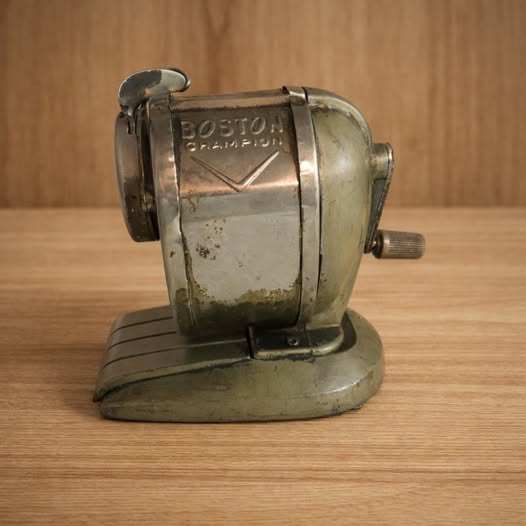
The most distinctive visual element of the Boston Champion is the embossed branding stamped directly into its metal housing. The words “BOSTON CHAMPION” are pressed into the body, giving the tool a sense of permanence and industrial authenticity.
On one side sits a hand crank fitted with a knurled metal grip. This textured handle was designed to provide firm control while turning, ensuring smooth and consistent sharpening with each rotation.
At the front of the unit is the pencil opening, where a standard wooden pencil is inserted before sharpening begins. The opening guides the pencil into the internal cutting mechanism, aligning it for an even point.
The sharpener rests on a weighted base intended to sit securely on a desk or table. Many models were also designed to be fastened to a surface for added stability, particularly in busy classrooms or shared workspaces.
When It Became Common
While pencil sharpening devices existed before the twentieth century, hand-crank, desk-mounted sharpeners became especially widespread during the early to mid-1900s. This period emphasized mechanical efficiency and long-lasting construction in everyday office tools.
Most Boston Champion sharpeners still found today date back to the early 1900s through the middle of the century. During this era, heavy metal construction and replaceable parts were standard expectations rather than premium features.
These sharpeners were built to serve institutions that required dependable performance day after day, year after year.
Manufacturing Background
The “Boston” brand name is historically linked to American pencil sharpener manufacturing. It has commonly been associated with the Hunt Manufacturing Company and related product lines that carried the Boston name.
The Boston Champion was not the invention of a single individual. Instead, it represents a manufactured product line shaped by practical engineering and mass production techniques.
Its development reflected the needs of educational institutions, clerical offices, and drafting environments that demanded consistent results from simple mechanical systems.
Purpose and Everyday Use
The primary function of the Boston Champion was straightforward: sharpening standard wooden pencils quickly and efficiently. In environments where pencils were constantly in use, a reliable sharpener was essential.
Classrooms relied on them to keep students supplied with ready-to-use pencils throughout the day. Clerical offices used them to maintain writing tools for bookkeeping, correspondence, and recordkeeping.
Drafting desks and home study areas also benefited from their consistent performance. In each setting, the ability to produce a clean, uniform point helped maintain accuracy and efficiency.
How the Mechanism Operates
Using the Boston Champion is simple and methodical. The user begins by inserting a pencil into the front opening of the device.
Once the pencil is in place, the side crank is turned smoothly. The motion of the crank activates internal cutters that shave away the wood casing and graphite core.
As the crank rotates, the pencil is shaped into a pointed tip. The user can typically feel a slight change in resistance when sharpening is complete.
At that point, the crank is stopped and the pencil is removed. Shavings collect inside the unit or in an internal compartment, depending on the specific model.
This straightforward mechanical process allowed for repeated use without reliance on electricity or disposable blades.
Why the Design Was Preferred
One of the main advantages of the Boston Champion was speed combined with control. The hand-powered crank gave users the ability to sharpen quickly while maintaining steady motion.
Consistency was another important factor. Compared to many small handheld sharpeners, the desk-mounted design produced a more uniform and predictable point.
Durability played a major role in its widespread adoption. The heavy metal construction was intended to withstand years of repeated use without structural failure.
The weighted base minimized slipping during operation, making it especially suitable for shared environments where stability was essential.
Built for Longevity
Unlike many modern plastic sharpeners, the Boston Champion was created during a period often described as the “built-to-repair” era. Components were engineered to be maintained rather than discarded.
With basic cleaning and occasional maintenance, many of these sharpeners remain fully functional decades after their manufacture. This durability contributes significantly to their continued presence in homes and collections.
The solid metal housing also protects the internal mechanism from external damage, further extending the tool’s lifespan.
Collectible Appeal in the Present Day
Today, the Boston Champion holds strong appeal among collectors and enthusiasts of vintage office equipment. Its industrial aesthetic, marked by aged metal and natural patina, reflects craftsmanship from another time.
The embossed branding adds character, serving as both identification and decorative detail. For many, the stamped lettering represents authenticity and mechanical heritage.
The smooth action of the crank and the precision of the cutting system provide a satisfying tactile experience that modern alternatives often lack.
Beyond its physical qualities, the sharpener carries strong associations with traditional schoolrooms and mid-century offices. It evokes memories of chalkboards, wooden desks, and handwritten notes.
Mechanical Satisfaction
Part of the Boston Champion’s continued charm lies in the physical interaction it requires. Turning the crank engages the user directly in the sharpening process.
The steady rhythm of rotation and the gradual formation of a sharp point create a sense of control and accomplishment. This mechanical feedback is often described as deeply satisfying.
Unlike electric sharpeners, which operate quickly and sometimes abruptly, the hand-crank design allows for deliberate and measured use.
Maintenance and Care
Proper care helps preserve both function and appearance. If the crank becomes difficult to turn, it is important not to force it.
Removing the pencil and checking for broken graphite or lodged shavings can prevent internal damage. Regular cleaning of collected shavings keeps the mechanism clear and efficient.
For exterior preservation, gentle cleaning methods are recommended. Harsh chemicals can damage the original finish or remove desirable patina.
When used as a display piece, keeping the sharpener dry and dust-free helps reduce the risk of corrosion over time.
A Symbol of Practical Engineering
The Boston Champion represents a broader philosophy of design rooted in practicality. Every feature, from the weighted base to the knurled crank grip, serves a clear purpose.
Its construction reflects an era when tools were expected to endure heavy daily use without frequent replacement. The focus was on function first, supported by sturdy materials.
This approach to manufacturing contributed to the sharpener’s reputation for reliability and consistency.
From Workhorse to Heirloom
Many Boston Champion sharpeners that remain in circulation today have outlived the desks they once sat upon. Some have passed through generations within families or institutions.
What began as a practical office necessity has evolved into a piece of functional history. It bridges the gap between everyday utility and collectible artifact.
Whether still in active use or displayed as a decorative item, the sharpener maintains a presence that speaks to durability and thoughtful design.
Conclusion
The Boston Champion pencil sharpener is more than a simple writing accessory. It is a durable mechanical device shaped by the needs of classrooms, offices, and homes throughout the early to mid-twentieth century.
Its embossed metal body, steady hand crank, and weighted base define a design focused on reliability and consistency. Built during an era that valued repairable tools, it continues to function long after its original production period.
Today, the Boston Champion stands as a reminder of practical engineering and everyday craftsmanship. Whether valued for its performance or admired for its nostalgic appeal, it remains an enduring symbol of a time when even the simplest tools were made to last.